

On this page
A bag of urea and a heap of cow-dung manure both feed a crop nitrogen, phosphorus and potassium. They differ in how fast those nutrients reach the roots, and in what each does to the soil over decades. Field trials running for generations in England and India show what happens.
What is the difference between organic and chemical fertiliser?
A chemical (synthetic) fertiliser is a manufactured compound whose nutrients are already in a form that dissolves in soil water. Urea, NH2-CO-NH2, is highly water soluble and contains 46% nitrogen, according to the Government of India's Vikaspedia page on neem-coated urea.
An organic fertiliser, such as farmyard manure (FYM) or compost, holds its nutrients inside dead plant and animal matter. Plants cannot take up that organic nitrogen directly. Soil microbes break it down first (mineralisation), releasing ammonium, which other bacteria turn into nitrate. That second step is explained in our step-by-step guide to nitrification and denitrification. For the Class 8 version, see manure vs fertiliser for Class 8, with real numbers.
How fast does each one release nutrients?
Synthetic fertiliser starts working soon after it dissolves, so a farmer can apply it when the crop needs it. Manure releases nutrients on the microbes' timetable, which follows warmth and moisture, not the crop.
That timing has a measurable cost. Rothamsted's Broadbalk wheat field in England has had drains under its plots since 1849, first sampled in the 1870s. The Broadbalk handout from Rothamsted Research reports that nitrate losses are greatest when more than 200 kg of fertiliser nitrogen per hectare is applied, or when FYM is used every year. There, manure goes on in autumn and releases nitrogen through the winter, when the crop cannot use it, and decades of manure have raised the soil's mineralisation rate. Organic does not mean pollution-free.
What do long-term field trials show about yield?
Broadbalk was first sown to wheat in autumn 1843 and compares 35 tonnes of FYM per hectare per year with fertilisers supplying N, P, K, Na and Mg, according to Rothamsted's Broadbalk handout. Best early grain yields were about 3 tonnes per hectare; the largest now exceed 13 t/ha, with fertiliser alone or FYM plus extra spring nitrogen. Rothamsted concludes that on this soil, with good management, yields can be kept up or raised with manure, fertiliser or both.
India's version began in September 1970, when ICAR launched the All India Coordinated Research Project on Long-Term Fertilizer Experiments, according to a 2022 Indian Farming review by ICAR-Indian Institute of Soil Science scientists. At Palampur, on acid soil, the review's table gives 0 kg/ha of wheat with nitrogen alone, below the 400 kg/ha from the plot that got nothing. The same site gave 1,904 kg/ha with full NPK and 2,879 kg/ha with NPK plus FYM.
Organic farming as a whole, not just its manure, usually yields less. A 2012 meta-analysis in Nature found organic yields ranged from 5% lower (rain-fed legumes and perennials on weak-acidic to weak-alkaline soils) to 34% lower when the two systems were most comparable. A larger 2015 analysis of 115 studies in Proceedings of the Royal Society B put the gap at 19.2%, falling to about 8% when only the organic farms used crop rotations. Rotations with legumes also add nitrogen, as our post on why crop rotation with legumes keeps soil fertile explains.
Does manure build soil carbon better than chemical fertiliser?
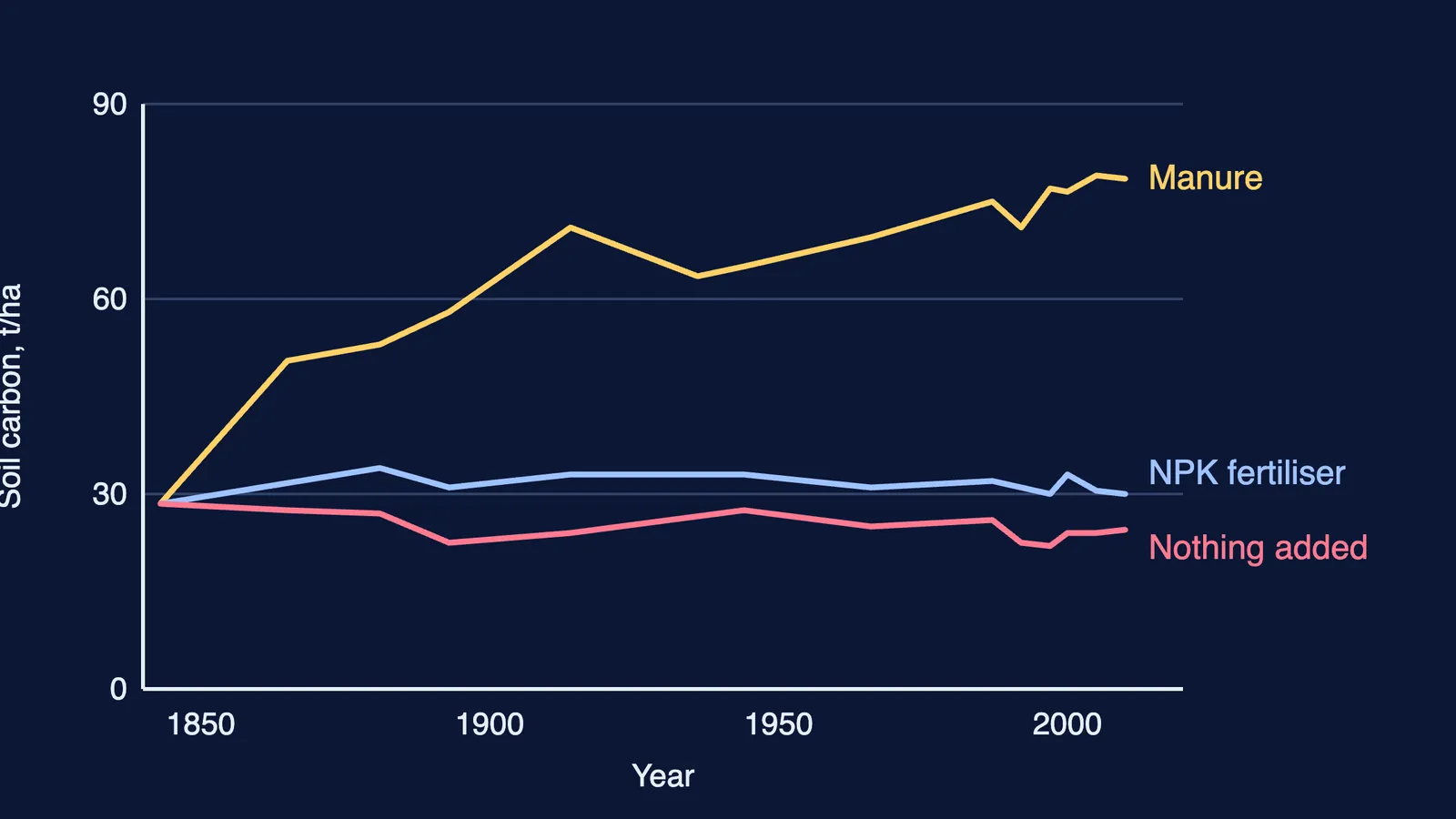
Yes, though not without limit. At Broadbalk, 35 t/ha of FYM a year has more than doubled the organic matter in the top 23 cm of soil, with most of the rise in the early decades, according to Rothamsted. More recently, much of the carbon added in manure has been lost again as the soil nears a new equilibrium. Mineral nitrogen raised soil organic matter only a little, probably because bigger crops return more roots and residues.
The Indian trials found that balanced NPK and NPK plus FYM both improved soil organic carbon compared with unbalanced fertiliser. The ICAR authors say this rules out the idea that chemical fertiliser itself destroys soil carbon (Indian Farming, 2022).
How do you compare them in an exam answer or project?
Answer four questions:
Nutrient content: how much urea supplies 100 kg of nitrogen? At 46% nitrogen (Vikaspedia), 100 / 0.46 = about 217 kg.
Release speed: does it dissolve now, or wait for microbes to mineralise it over months?
Soil carbon: does it add organic matter? At Broadbalk, manure more than doubled it (Rothamsted).
Balance and yield: is any nutrient missing? At Palampur (ICAR data), NPK plus FYM gave 2,879 / 1,904 = 1.51, about 51% more wheat than NPK alone, while nitrogen alone gave nothing.
If the percentage step trips you up, the Fermi Problem Library has worked problems with a step-by-step solver that explains the reasoning rather than printing an answer. If mineralisation and nitrification blur together, the Fermi Concept Library gives every concept in chemistry and biology its own lesson.
Next time someone says organic is always better, or that chemicals ruin soil, ask which trial and which treatment.


