

On this page
Manure and fertiliser both feed crops, but they do different jobs. Here is what each does, with real numbers and an answer plan.
What is the difference between manure and fertiliser?
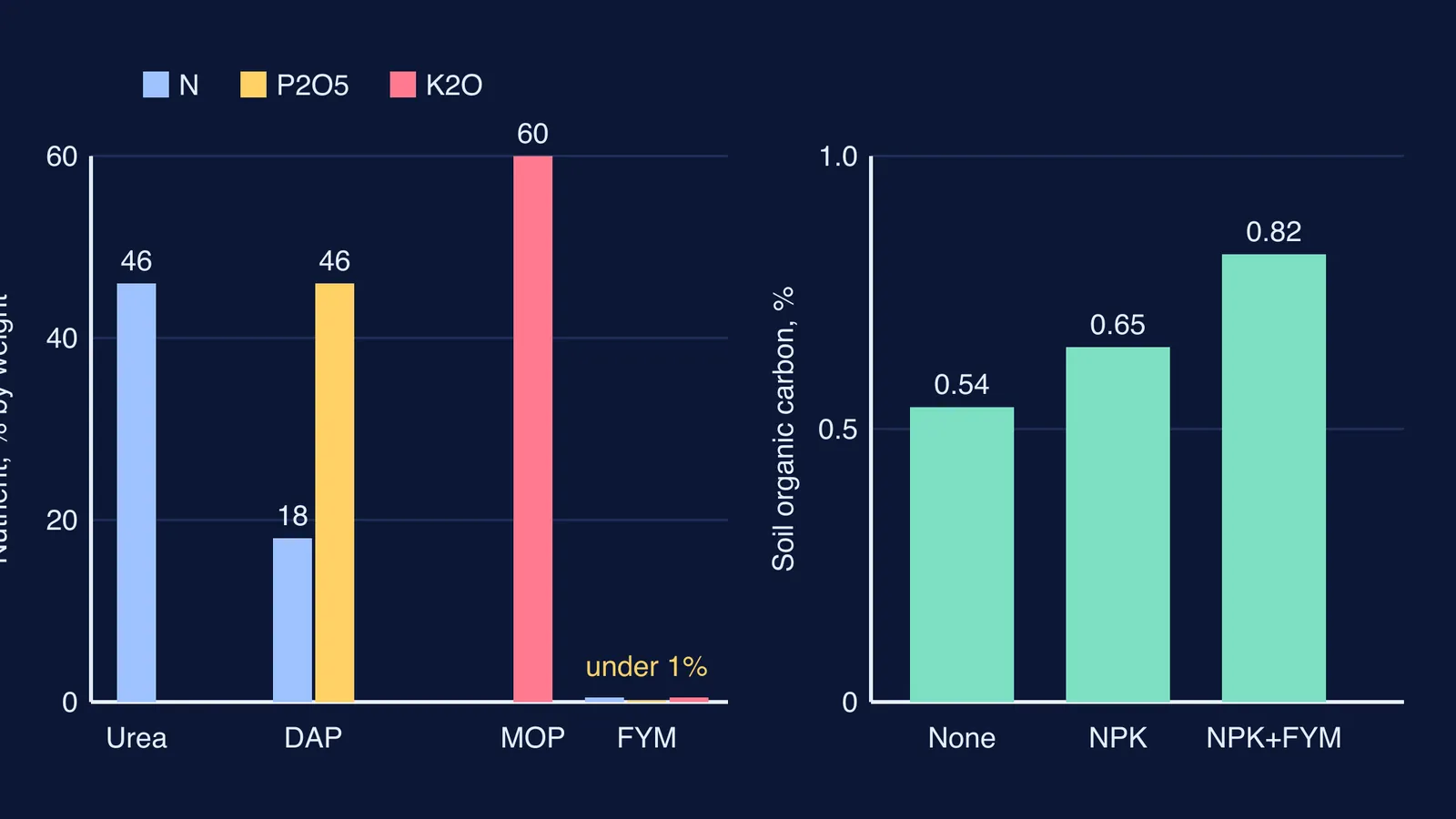
Manures are plant and animal wastes used as sources of plant nutrients, according to the Tamil Nadu Agricultural University (TNAU) Agritech Portal. The same TNAU page says well-decomposed farmyard manure contains on average 0.5% nitrogen, 0.2% phosphorus (as P2O5) and 0.5% potassium (as K2O).
A fertiliser is a chemical product rich in specific plant nutrients, and most are made in factories. Under the FAO fertilizer specifications, urea must contain at least 46% nitrogen, diammonium phosphate (DAP) at least 18% nitrogen and 46% P2O5, and muriate of potash at least 60% K2O.
Point by point, from these sources:
Source: manure comes from rotted dung, urine, crop waste and other plant and animal matter; most fertilisers are made in factories.
Nutrients: manure has small amounts of many nutrients, including micronutrients; fertiliser is rich in one to three specific ones (N, P, K).
Humus: manure adds organic matter that becomes humus; fertiliser adds none.
Soil structure and water: manure improves soil structure and water holding capacity; fertiliser adds no organic matter to do this.
Release: manure releases nutrients slowly as it decomposes; fertiliser nutrients are mostly water-soluble and act faster.
Amount used: TNAU says farmers usually spread 10 to 20 tonnes of farmyard manure per hectare; fertiliser is measured in kilograms.
Why does manure add humus but fertiliser does not?
Humus forms through the successive decomposition of dead material and modified organic matter, according to FAO Soils Bulletin 80. FAO explains that organic matter, especially the more stable humus, increases the soil's capacity to store water. As it slowly decomposes, it darkens the soil, binds particles into stable crumbs, helps the soil hold on to nutrients and contributes nitrogen, phosphorus and other nutrients.
Fertiliser adds no dead plant or animal tissue, so decomposers have nothing to build humus from. For the creatures that break manure down, see why earthworms are called the farmer's friend.
How much manure equals one sack of urea?
The FAO specification says urea is packed in 50 kg bags. Take one 50 kg sack and compare it with farmyard manure, using the TNAU figures:
Check the 46%. The molar mass of urea, CO(NH2)2, is 12 + 16 + 2 x (14 + 2) = 60 g/mol, and its two nitrogen atoms weigh 28 g. 28 / 60 = 46.7%, which is why the specification can promise at least 46%.
Nitrogen in the sack: 50 kg x 0.46 = 23 kg.
Manure with the same nitrogen at 0.5%: 23 / 0.005 = 4,600 kg, about 4.6 tonnes.
TNAU says only about 30% of the nitrogen in farmyard manure is available to the first crop, so those 4.6 tonnes give about 23 x 0.30 = 6.9 kg in the first season.
The same manure also brings about 9.2 kg of P2O5 and 23 kg of K2O, plus organic matter that builds humus.
Fertiliser wins on nutrients per kilogram; manure wins on soil.
If percentage-by-mass steps like step 1 trip you up, the Fermi Problem Library has worked problems with a step-by-step solver that explains the reasoning rather than printing an answer.
Is it better to use manure, fertiliser or both?
A 2011 study in Field Crops Research by H. Pathak and colleagues analysed 26 long-term field experiments across India (abstract on the ICRISAT repository). Average soil organic carbon was 0.54% in plots given no fertiliser, 0.65% with recommended NPK fertiliser and 0.82% with NPK plus farmyard manure. In most of the experiments, yields were also higher with NPK plus manure than with NPK alone.
In 17 of the 26 experiments, NPK plus manure gave both more soil carbon and a higher net return than NPK alone; in the other 9, the extra soil carbon came with a lower net return. The paper also discusses manure availability. So the usual answer is "both, in balance". Growing legumes is another way to put nitrogen back; see why crop rotation with legumes keeps soil fertile.
How do you write the difference in an exam?
Use this plan for a three- or five-mark answer:
Define each in one line, as in the summary above.
Give four differences in matched pairs: source, nutrients, humus, soil structure and water.
Name examples: farmyard manure or compost; urea, DAP or an NPK mix.
End with one line on why farmers combine them: fertiliser for quick nutrients, manure for long-term soil health.
To link humus and plant nutrition to the rest of your syllabus, the Fermi Concept Library covers every concept in physics, chemistry, biology, mathematics and computing, each with its own lesson and its place in the map.


