On this page
Turn over moist garden soil and you will usually find earthworms doing three jobs a farmer would otherwise pay for: digging, enriching and mixing. Here is what each job does, with numbers from real studies, a calculation you can check and a model exam answer.
Why is the earthworm called the farmer's friend?
Because it improves the soil's structure, chemistry and living community at once. A review in the European Journal of Soil Science notes that earthworms make up the largest part of the animal biomass in soil and are commonly termed "ecosystem engineers" (Blouin et al., 2013).
The clearest farm number comes from a meta-analysis that pooled published experiments. On average, earthworm presence in agroecosystems led to a 25% increase in crop yield and a 23% increase in aboveground biomass (van Groenigen et al., Scientific Reports, 2014). The benefit grew when more crop residue was returned to the soil and disappeared when soil nitrogen availability was high. The authors concluded that earthworms seem to help plants mainly by releasing nitrogen locked away in residue and soil organic matter.
How do earthworm burrows aerate the soil?
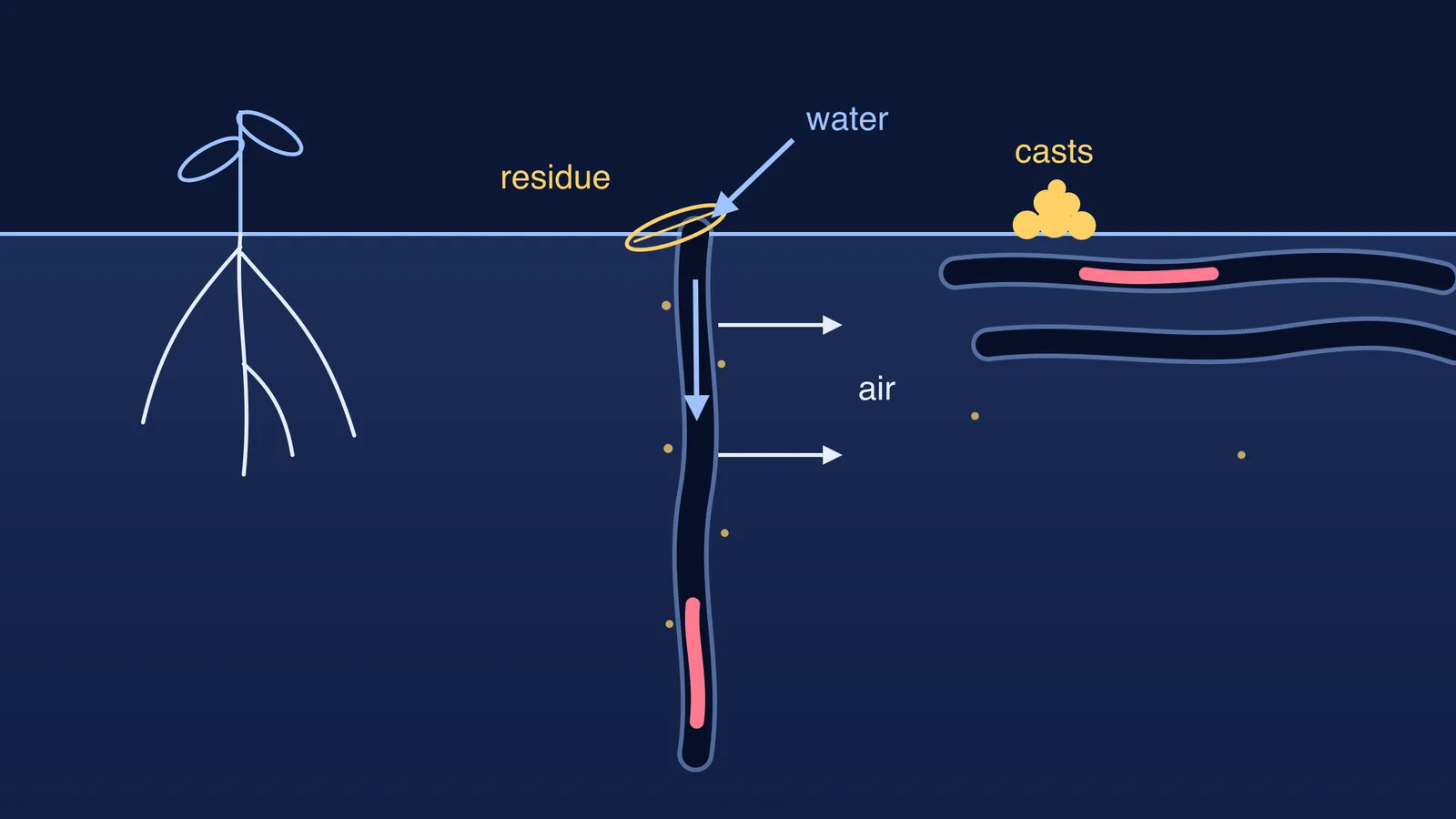
Each tunnel is a channel for air and water. Penn State Extension's soil scientists describe subsoil-dwelling earthworms, of which the nightcrawler is the best-known, living in permanent vertical burrows that can be 5 or 6 feet deep (Penn State Extension). They call these vertical burrows "very important points of entry for quick water infiltration into the soil".
Air matters as much as water. Roots need oxygen to grow, and the carbon dioxide they release has to leave the soil, so air-filled pores help roots thrive (same source). Worms add a second effect: mixing soil and organic matter in their guts improves aggregation, binding soil into stable crumbs, or aggregates.
What do earthworm castings add to the soil?
Castings, or casts, are the soil and digested plant matter a worm excretes. Earthworm casts have more available nitrogen, phosphorus, potassium and calcium than the surrounding soil, and a higher cation-exchange capacity (Penn State Extension).
A year-long study in a subtropical plantation in China found nutrient concentrations 1.6 to 4.3 times higher, and microbial biomass 7 to 8 times higher, in casts than in the bulk soil (Forests, 2021). An older study from the Philippines found organic matter, available phosphorus and exchangeable magnesium 1.6 to 1.9 times higher in casts than in topsoil (Domingo, 1984, via FAO AGRIS).
How do earthworms mix organic matter into the ground?
Nightcrawlers need surface crop residue to live, and they pull it to the entrances of their burrows (Penn State Extension). The same page says typical earthworm populations can easily consume 2 tons of dry matter per acre per year, and in one pasture study earthworms consumed 20 to 40 tons of soil per acre per year. Surface leaves end up as organic matter lower down, where decomposers in the ecosystem finish breaking them down. Charles Darwin studied this churning closely: see how Darwin weighed the earthworm's work.
Farming choices decide how many worms stay. Long-term no-till fields typically hold at least twice the earthworms of clean-tilled fields, and the insecticides carbaryl and carbofuran are extremely toxic to them (same source). In India, vermicomposting puts worms to work on farm waste: an ICAR-NAARM training in Mangaluru in February 2024 gave farmers portable vermicompost units and earthworms (ICAR).
Worked example: how much cast lands on one square metre?
The subtropical study measured 8.3 tonnes of surface casts per hectare in one year (Forests, 2021). Convert it:
1 hectare = 10,000 square metres.
8.3 tonnes = 8,300 kg.
8,300 kg divided by 10,000 square metres = 0.83 kg per square metre per year.
Spread evenly, that is about 69 g per square metre each month.
The real pattern was uneven: more than 80 g per square metre per month from April to November and less than 30 g from December to March. To see for yourself how earthworms respond to moisture, try an earthworm choice-chamber experiment.
How should you write this answer in an exam?
For a 3-mark question, give one point per job and name the effect on the crop:
Burrowing makes soil porous, so air reaches roots and rainwater soaks in.
Castings are rich in nitrogen, phosphorus and potassium, which raises soil fertility.
Earthworms pull dead leaves into the soil and mix them in, adding organic matter; farmers also use them to make vermicompost.
Model answer: "Earthworms are called farmers' friends because their burrows aerate the soil and let water in, their castings add nutrients such as nitrogen, phosphorus and potassium, and they mix dead organic matter into the soil, making it fertile."
If soil terms keep blurring together, the Fermi Concept Library gives every concept in biology and chemistry its own lesson and its place in the map, so you can see how soil, decomposers and nutrients connect.