

On this page
In 1881, just six months before his death, Charles Darwin published his final book: *The Formation of Vegetable Mould through the Action of Worms, with Observations on Their Habits*. While he was already world-famous for his theory of evolution, this quiet study of the garden became an immediate bestseller. Long before scientists like Vladimir Vernadsky mapped the biosphere to show how life shapes the Earth's crust, Darwin proved that the fertile topsoil we rely on is not a static layer of dirt, but the continuous creation of millions of earthworms.
How much soil do earthworms move?
Darwin was fascinated by "vegetable mould"—the dark, rich layer of topsoil that supports plant life. He discovered that worms create this layer by swallowing earth and organic matter, digesting the nutrients, and ejecting the remains on the surface as castings.
To understand the scale of this unseen workforce, Darwin calculated the weight of dried castings across different fields and environments. He collected castings near Nice, on Leith Hill Common, and in various pastures. He found that earthworms bring between 10.51 and 18.12 tons of soil to the surface of a single acre every year.
The sheer numbers of these creatures make this possible. Citing the estimates of the German physiologist Victor Hensen, Darwin noted that an average acre of garden ground contains over 53,000 worms, all working tirelessly to churn the earth. Hensen had calculated that there must exist 133,000 living worms in a single hectare of land, and believed they were even more numerous in gardens than in corn-fields.
Why do stones sink into the ground?
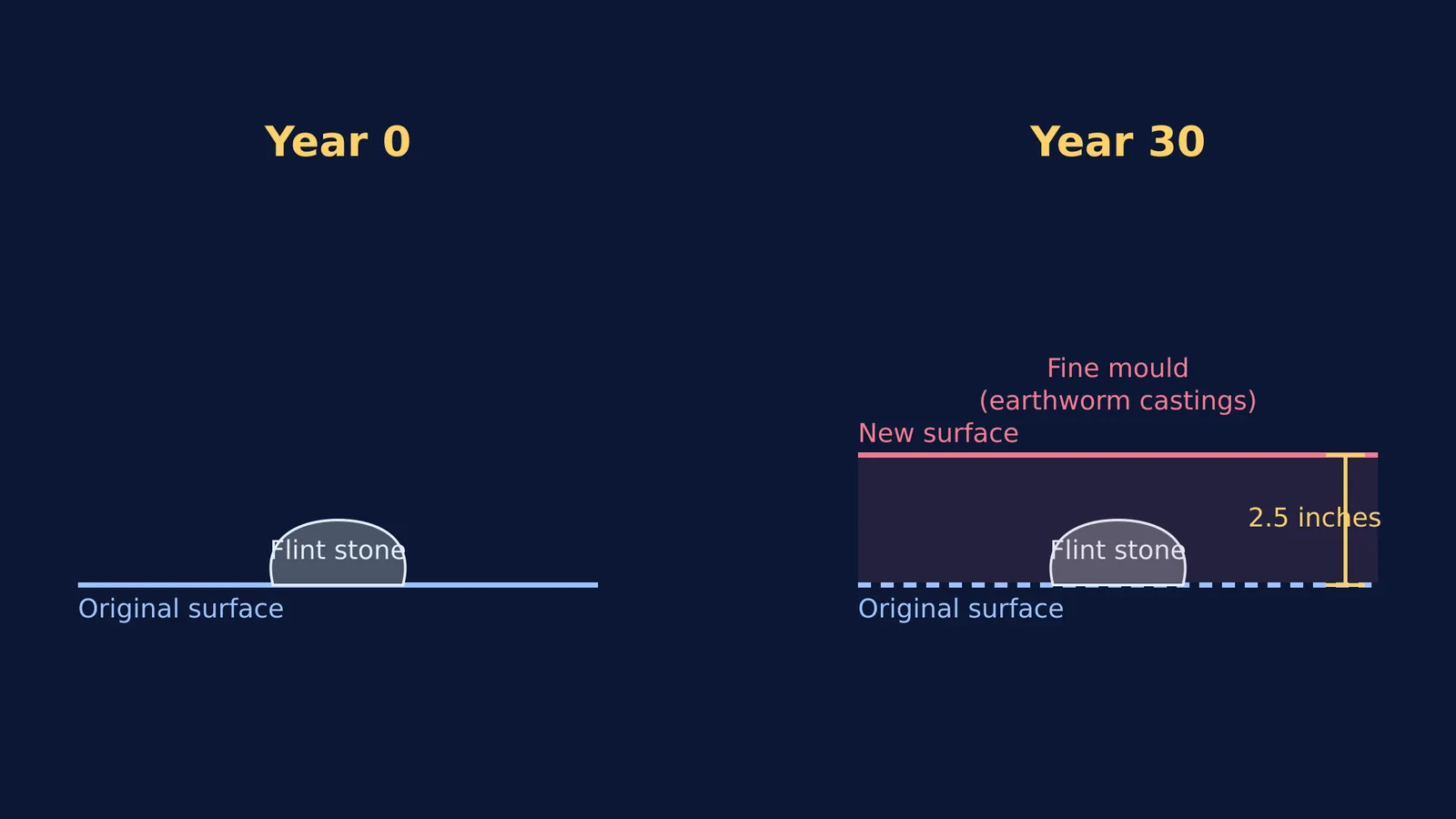
One of Darwin's most famous observations began with a simple mystery: why do large stones and ancient ruins slowly disappear into the ground? He proved that the objects were not sinking due to their weight. Instead, the ground was rising around them.
As worms continually deposit fine soil on the surface, any object left on the grass is eventually buried. The earthworms undermine the objects, and their accumulated castings slowly raise the surface level. In one study of a "stony field" near his home, Darwin measured that a layer of mould 2.5 inches thick had accumulated over 30 years, burying the flints at a rate of 0.083 inches per year.
In another experiment at Down House, a field covered with broken chalk nodules was buried under 7 inches of soil in 29 years. Darwin calculated that in many parts of England, worms bring up enough earth to form a layer approximately 0.2 inches thick every year. This slow, relentless burial is the reason so many Roman villas, like those at Silchester and Wroxeter, and ancient artifacts in England have been preserved underground for over 1,400 years.
Can an earthworm hear?
Darwin treated his garden as a laboratory. To understand how earthworms interact with their environment, he tested their senses with household items. He placed pots containing worms on a table near a piano and found them completely deaf to the sound waves in the air, even when played as loudly as possible. They also ignored notes from a bassoon.
However, when he placed the pots directly on the piano, the worms instantly darted into their burrows when he struck a note to create a vibration. This demonstrated that while they cannot hear atmospheric sound, they are extremely sensitive to vibrations in solid objects. He carefully recorded how they dragged leaves into their burrows to plug the entrances, laying the groundwork for later scientists like Niko Tinbergen to study animal behaviour.
Understanding biology requires the same focus on underlying mechanisms. If you want to explore how these systems connect, the Fermi Concept Library holds every concept in physics, chemistry, biology, mathematics and computing, each with its own lesson and its place in the map.
Did earthworms invent the plough?
The book forever changed how the public viewed the earthworm, transforming it from a garden pest into an essential ecosystem engineer. Darwin's careful measurements proved that the humble worm is responsible for creating the foundation of human agriculture.
Darwin closed his final scientific work with a tribute to their planetary impact: "The plough is one of the most ancient and most valuable of man's inventions; but long before he existed the land was in fact regularly ploughed, and still continues to be thus ploughed by earth-worms."


