

On this page
An earthworm choice chamber experiment is a classic biology practical that tests how organisms respond to environmental stimuli. By dividing a tray into different controlled zones, you can clearly observe whether earthworms prefer dark or light sides, and damp or dry sides.
This simple yet effective experiment demonstrates two key biological behaviours: hydrotaxis (a directed movement in response to moisture) and phototaxis (a directed movement in response to light). It is an excellent, hands-on way to study animal behaviour, sensory responses, and evolutionary adaptation, making it a standard part of the biology curriculum for school students and a useful conceptual foundation for competitive exams.
How to set up an earthworm choice chamber experiment?
The goal is to test one environmental variable at a time, or a combination of both variables, within a controlled tray to see which conditions the earthworms prefer.
Materials needed:
A wide, shallow plastic tray or a large Petri dish to act as the choice chamber.
Paper towels to create the moist and dry substrates.
Black construction paper or cardboard to block out light and create a dark zone.
A desk lamp or bright room light to provide a directional light stimulus.
A few live earthworms (such as *Pheretima posthuma*, the common Indian earthworm) collected safely from compost or moist soil.
A spray bottle with water to moisten the towels evenly without soaking them.
Testing moisture (Hydrotaxis):
Line one half of the tray with completely dry paper towels.
Line the other half with paper towels sprayed with water until they are damp but not flooded. Leave a very small gap between the two sides.
Place the earthworms exactly on the centre line between the dry and damp zones.
Wait for a few minutes to give the earthworms time to react.
Count the number of earthworms on the damp side versus the dry side.
Testing light (Phototaxis):
Cover one half of the tray with black cardboard to create a shaded, dark zone.
Leave the other half exposed to the desk lamp or room light.
Place the earthworms in the centre of the tray.
Wait for a short time and then count the number of worms in each zone.
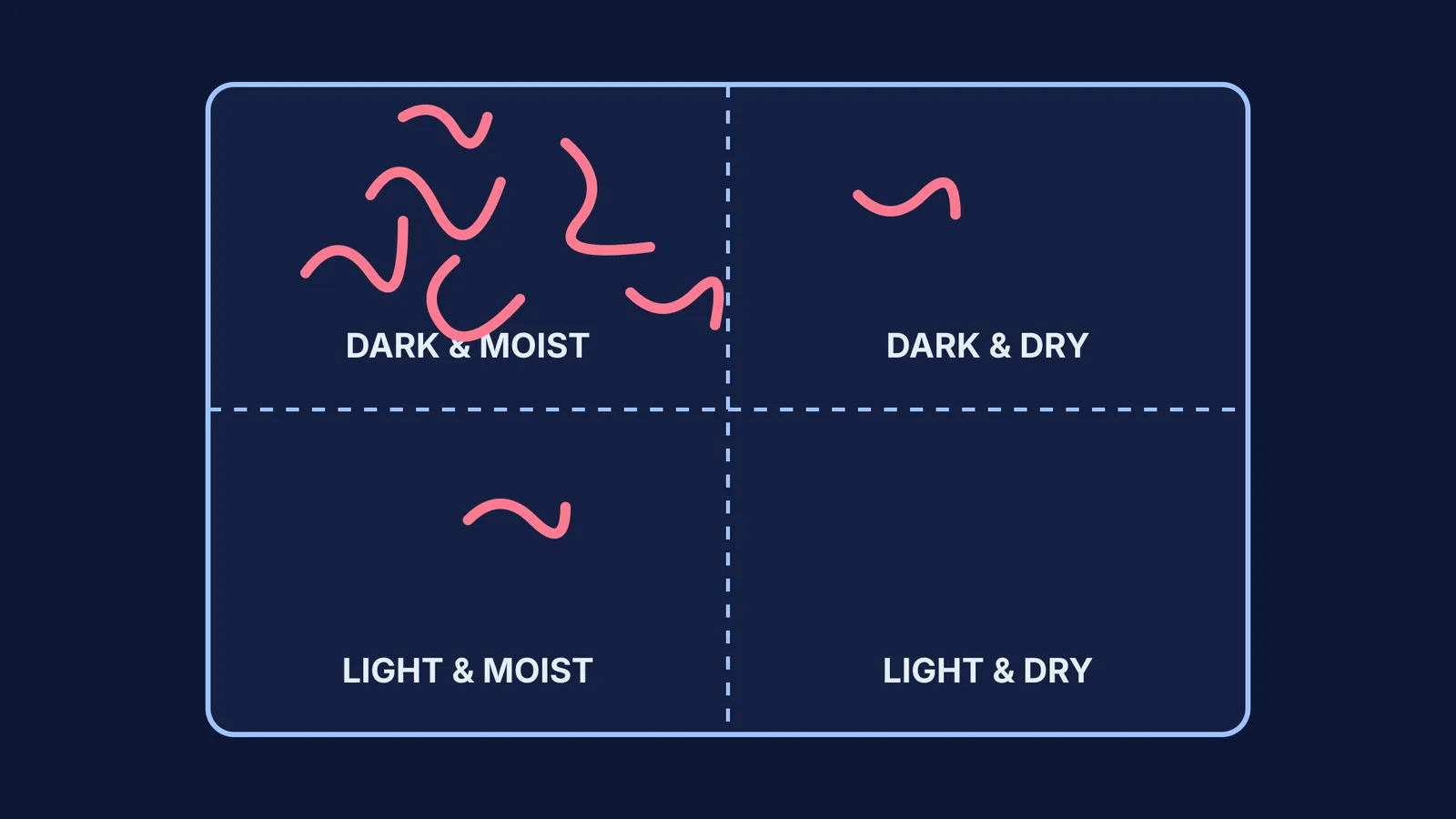
For a combined test, you can set up the tray to create four distinct quadrants: Dark/Moist, Dark/Dry, Light/Moist, and Light/Dry.
What are the expected results and why?
In a typical experiment, the vast majority of earthworms will move toward the moist paper towel and into the dark zone, demonstrating their natural survival instincts.
Positive hydrotaxis: Earthworms have no special respiratory organs like lungs or gills. Instead, they breathe through their skin in a process called cutaneous respiration, according to Earthworm - Wikipedia. Oxygen diffuses through the skin into capillaries and is picked up by hemoglobin dissolved in the blood plasma, while carbon dioxide is released. For this gas exchange to work, their outer surface must be kept constantly moist. If their skin dries out, the diffusion stops and they suffocate. This is why earthworms secrete mucus to keep themselves moist and deliberately move toward moisture to survive.
Negative phototaxis: Earthworms generally exhibit negative phototaxis, meaning they reflexively move away from light. While they do not have true eyes, they possess specialized photoreceptors known as the light cells of Hess. These light-sensing cells are distributed in their epidermis but are highly concentrated at their anterior (front) end, specifically on the prostomium, which is the fleshy lobe over their mouth. Light usually signals that they have surfaced above ground, where they are exposed to the sun's drying heat and are visible to predators like birds. Seeking darkness drives them safely back underground.
When learning these biological concepts for NEET or board exams, visualising the anatomy and behaviour makes it easier to remember. The Fermi Concept Library contains detailed, mapped lessons on animal tissues and anatomy, helping you connect an organism's structure directly to its survival behaviours.
How to treat earthworms humanely in school experiments?
Even though earthworms are invertebrates, they are living animals and are subject to ethical guidelines in a laboratory setting. A choice chamber is strongly preferred over invasive biology tests because it relies entirely on natural observation without harming the organism.
To ensure humane treatment during the experiment, follow the 3Rs of animal ethics (Replacement, Reduction, Refinement) and these specific care rules:
Handle with damp hands: Always wet your hands or wear damp gloves before touching a worm. Dry hands will pull moisture directly from their sensitive skin.
Limit exposure time: Keep the time the worms spend out of their natural soil habitat to an absolute minimum.
Keep temperatures low: Keep the experimental tray away from direct heat sources, including hot lamps. High temperatures can be rapidly fatal to them.
Provide a recovery period: If you are running multiple trials, let the worms rest in a dark, soil-filled container between tests so they can recover.
Safe return: Once the experiment is completely over, return the earthworms to a shaded garden or a compost bin. Never throw live worms in the trash or leave them in a dry container.
Understanding how to run a choice chamber ethically ensures that the biological data collected is accurate—stressed animals do not behave naturally—and teaches the fundamental scientific principle of animal welfare.


