

On this page
In a classic biology experiment, a respirometer measures how quickly living things consume oxygen. When you compare germinating seeds with boiled seeds, the difference in the dye drop's movement provides a clear, visual proof of active cellular respiration.
How does a dye drop respirometer work?
A simple respirometer consists of an airtight boiling tube connected to a thin, horizontal capillary tube. Inside the main tube, you place the seeds on top of a layer of cotton wool. Beneath the cotton sits a chemical carbon dioxide absorber.
This setup requires a strong potassium hydroxide (KOH) solution to absorb the carbon dioxide released by the seeds.
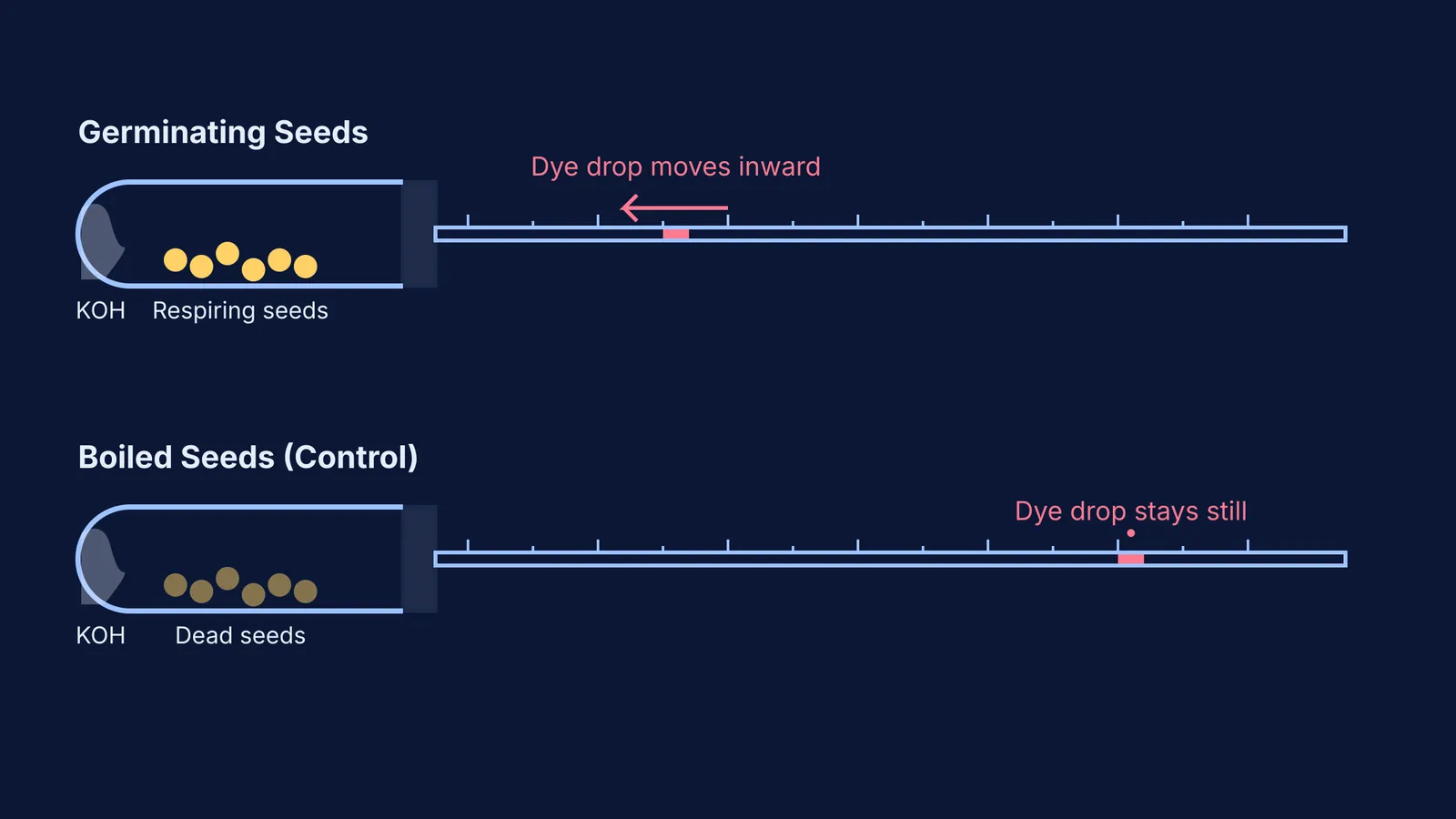
A small drop of coloured liquid (the dye drop) is introduced at the open end of the capillary tube. Because the tube is completely sealed off from the atmosphere, any change in the volume of gas inside the main chamber will push or pull this dye drop along the scale.
Why does the dye drop move with germinating seeds?
Germinating seeds have broken dormancy and are growing rapidly. To fuel this rapid growth, they carry out aerobic respiration, a fundamental metabolic process that consumes oxygen (O₂) and releases carbon dioxide (CO₂) as a waste product.
Because the respiratory quotient for carbohydrates is 1.0, seeds that are metabolising their stored carbohydrate reserves will release exactly 1 molecule of carbon dioxide for every 1 molecule of oxygen they consume. If the seeds simply swapped these gases without any chemical interference, the total gas pressure and volume inside the sealed tube would remain exactly the same, and the dye drop would not move. This is where the potassium hydroxide comes in. It chemically reacts with the released CO₂ to form solid potassium carbonate and water.
Because the carbon dioxide is removed from the air as fast as it is produced, the total volume of gas inside the respirometer decreases as the seeds use up the available oxygen. This continuous removal creates a partial vacuum, which pulls the dye drop inward along the capillary tube. The distance the drop moves directly indicates the volume of oxygen consumed by the germinating seeds over a specific period.
What happens to boiled seeds in a respirometer?
Boiling the seeds kills the developing embryos and denatures the crucial enzymes responsible for respiration. When you place boiled seeds in a respirometer, they act as the negative control group for the experiment.
Because the boiled seeds are dead, they do not respire and therefore do not consume any oxygen from the air. With no oxygen being removed and no carbon dioxide being produced, the gas volume inside the sealed tube remains entirely constant. As a result, the dye drop stays completely still.
Comparing both tubes confirms that the pressure change is caused by a biological process (living seeds actively respiring) rather than a physical or chemical reaction of the seed material itself. It is standard practice to sterilise boiled seeds with a mild antiseptic to ensure that respiring bacteria or fungi on the seed surface do not skew the results by consuming oxygen.
Why must temperature remain constant during the experiment?
Because the respirometer relies on measuring very small changes in gas volume, it is highly sensitive to fluctuations in environmental temperature. According to the ideal gas law, the volume of a fixed mass of gas expands when it is heated and contracts when it is cooled. If the laboratory room warms up even slightly during the experiment, the gas inside the sealed boiling tube will naturally expand. This physical expansion could push the dye drop outward, effectively masking the inward movement caused by the germinating seeds consuming oxygen.
To prevent this thermal expansion from skewing the results, the respirometer tubes are usually submerged in a constant-temperature water bath. In a rigorous setup, scientists also use a thermobarometer—an additional respirometer containing glass beads equal in volume to the seeds, with a drop of dye in its capillary tube. Because the glass beads do not respire, any movement of the dye drop in the thermobarometer is caused entirely by changes in atmospheric pressure or room temperature. By measuring the movement in this control tube, researchers can mathematically correct the readings for the germinating seeds and calculate the true volume of oxygen consumed.
Connecting the experiment to learning
Visualising invisible gases and pressure changes can be difficult when reading a static textbook. Before handling the physical glassware and caustic chemicals, students can explore these relationships using the Fermi Simulation Lab, which features interactive simulations for the ideas that are easier to see than to read.
Understanding cellular respiration goes beyond measuring oxygen uptake. To see how different nutrients are broken down for energy, you can review how respiration acts as an amphibolic pathway. For a fascinating look into the history of respiratory science, read about J. S. Haldane's work on respiration and his early discoveries concerning gas exchange.


