

On this page
Bacteria are the sole members of Kingdom Monera and the most abundant microorganisms on Earth. While they can survive in extreme environments ranging from hot springs and deserts to deep oceans, one of the first ways we categorise them is by their physical morphology.
According to NCERT Class 11 Biology, this remarkably simple physical structure contrasts with their highly complex behaviour and extensive metabolic diversity. Knowing these shapes is a foundational step for board exams and NEET.
What are the four shapes of bacteria?
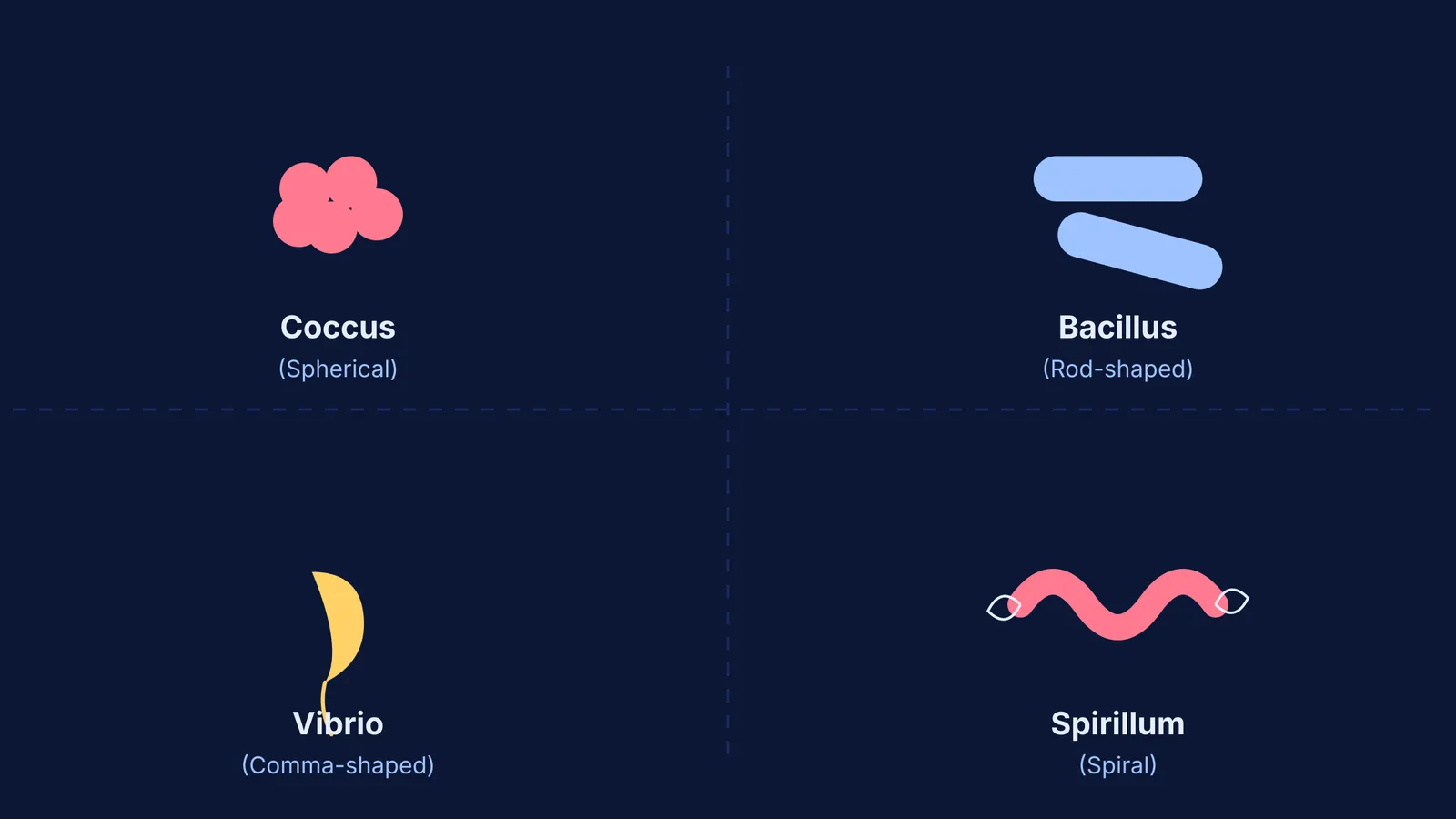
The NCERT textbook groups bacteria into four basic morphological categories:
Coccus (plural: cocci): These bacteria are spherical or round in shape.
Bacillus (plural: bacilli): These are cylindrical or rod-shaped bacteria.
Vibrio (plural: vibrio): These bacteria are comma-shaped, often featuring a slight curve.
Spirillum (plural: spirilla): These bacteria have a rigid, spiral or corkscrew shape.
To see these shapes clearly under a light microscope, biologists rely on chemical staining. You can read the story of Hans Christian Gram and the stain that sorts bacteria to see how these microscopic structures were first made visible in the laboratory.
What are examples of coccus, bacillus, vibrio and spirillum?
Associating a shape with a real-world disease or everyday process makes the concepts easier to retain for your exams.
Coccus examples: Because spherical bacteria often remain attached after dividing, they form specific arrangements. *Streptococcus* species, like the one responsible for strep throat, form long chains. Another common sphere is *Staphylococcus*, which forms grape-like clusters and is frequently responsible for skin infections.
Bacillus examples: Rod-shaped bacteria are everywhere in everyday life. *Lactobacillus* is the harmless, helpful bacterium that turns milk into curd. On the dangerous side, *Bacillus anthracis* is the spore-forming bacterium responsible for anthrax. The World Health Organization notes that anthrax primarily affects herbivores but can cause severe, sometimes fatal, illness in humans.
Vibrio examples: The most infamous comma-shaped bacterium is *Vibrio cholerae*. The WHO reports that the ingestion of food or water contaminated with *V. cholerae* causes cholera, an acute diarrhoeal infection responsible for 1.3 to 4.0 million cases globally each year.
Spirillum examples: Spiral bacteria typically move using tufts of flagella located at one or both ends. An example is *Spirillum volutans*, which is a large spiral bacterium commonly found in stagnant freshwater.
Why does the shape of a bacterium matter?
The shape of a bacterium is not just a visual feature; it dictates how the single-celled organism survives, absorbs nutrients, and interacts with its environment.
For example, a spherical coccus has a lower surface-area-to-volume ratio than a rod-shaped bacillus. This compact shape helps the coccus resist drying out in harsh, arid conditions. On the other hand, the elongated rod shape of a bacillus provides a greater surface area, which makes it more efficient at absorbing nutrients from its surroundings.
The spiral shape of spirillum bacteria, combined with their flagella, allows them to move efficiently. This corkscrew motion is highly effective for swimming through thick, viscous fluids. Understanding these functional advantages makes it easier to see why evolutionary forces have preserved these four specific morphologies.
How can you remember bacteria shapes for exams?
When preparing for biology exams, it is easy to mix up the examples and terminology. If you are struggling to keep your concepts straight, the Fermi Concept Library maps out every concept in physics, chemistry, biology, mathematics and computing, each with its own lesson and its place in the map. When you run into a block, Fermi's AI tutor can walk you through the differences between a coccus cluster and a bacillus chain, checking understanding as it goes.
Here is a practical checklist for answering morphology questions:
Identify the root word in the name: If a bacterium's scientific name contains its shape (like *Lactobacillus* or *Streptococcus*), you already have the answer.
Look for arrangement prefixes: Remember that "staphylo-" means clusters and "strepto-" means chains.
Contrast with other organisms: Remember that while viruses and viroids share a microscopic scale with bacteria, they do not have these cellular shapes at all. For more on the exceptions, see our guide on viruses, viroids and lichens.
As you study, keep returning to the basic definitions. While bacteria show extensive diversity—ranging from photosynthetic autotrophs to vast populations of heterotrophs—their physical structure remains remarkably simple. Knowing these four basic shapes is your first step in unlocking the rest of their biology.


