On this page
Many answers on the nitrogen cycle jump straight to *Nitrosomonas*. That skips a question worth asking: where did the ammonium come from in the first place? Answer that, and nitrification and denitrification fall into place.
About 78% of Earth's atmosphere is nitrogen gas, according to the LibreTexts microbiology text on the nitrogen cycle/16%3A_Microbial_Ecology/16.04%3A_Nutrient_Cycles/16.4E%3A_The_Nitrogen_Cycle). Yet most organisms rely on more usable forms such as ammonium and nitrate, as a 2018 review in Nature Reviews Microbiology by Kuypers, Marchant and Kartal puts it. Networks of microbes carry out most of the reactions that make and unmake those forms.
What are the steps of the nitrogen cycle, in order?
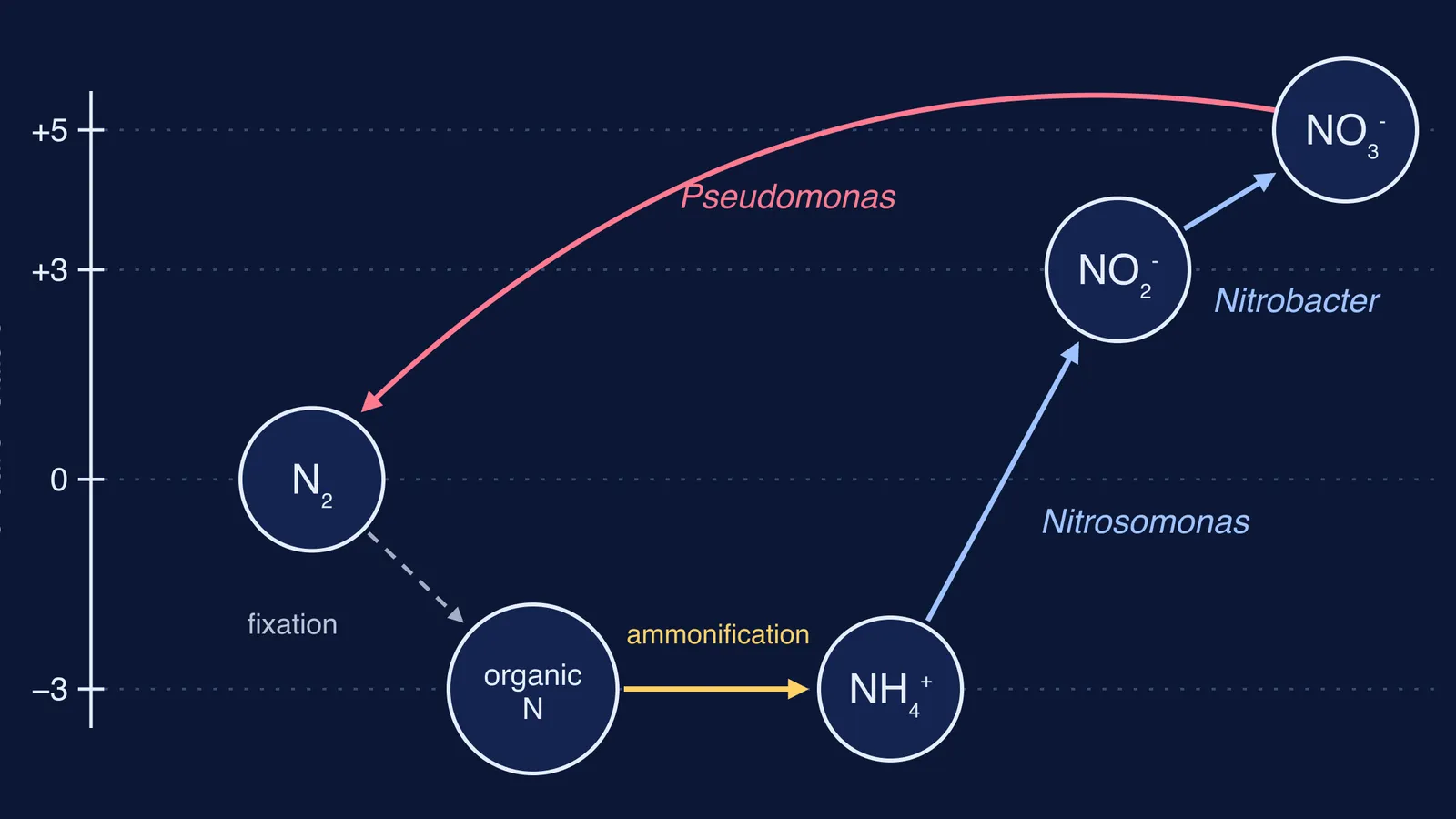
Nitrogen fixation: N₂ becomes ammonia, for example in the heterocysts of cyanobacteria (see how Nostoc and Anabaena fix nitrogen).
Ammonification: nitrogen in dead organisms and wastes becomes ammonium (NH₄⁺).
Nitrification, step one: ammonium becomes nitrite (NO₂⁻), by *Nitrosomonas*.
Nitrification, step two: nitrite becomes nitrate (NO₃⁻), by *Nitrobacter*.
Denitrification: nitrate goes back to nitrogen gas, by bacteria such as *Pseudomonas*.
Plants take up nitrate and ammonium in between and build them into proteins, which brings you back to step 2 when they die.
What is ammonification, and why do students forget it?
In ammonification, bacteria or fungi convert the organic nitrogen from dead organisms back into ammonium (NH₄⁺), as the LibreTexts microbiology chapter/16%3A_Microbial_Ecology/16.04%3A_Nutrient_Cycles/16.4E%3A_The_Nitrogen_Cycle) states. It is decomposition seen from nitrogen's point of view: proteins in a fallen leaf or in animal waste are broken down, and the nitrogen comes out as ammonium.
It is easy to drop because it has no famous genus to memorise. It is done by many ordinary decomposers, the same ones described in our post on humus, soil fertility and decomposers. But without it, *Nitrosomonas* would have nothing to work on.
How does nitrification work, and which bacteria do it?
Nitrification is the conversion of ammonium into nitrite and then nitrate by nitrifying microbes, with *Nitrosomonas* and *Nitrobacter* as the textbook examples, as the Gettysburg College ecology text on LibreTexts describes. The order matters: *Nitrosomonas* turns ammonium into nitrite; *Nitrobacter* turns nitrite into nitrate. A memory hook: the longer name makes the longer jump (see the worked example below).
Both steps are oxidations, and the classic nitrifiers use oxygen for them. The real picture has more players. In 2005, Könneke and colleagues isolated a marine archaeon that oxidises ammonia to nitrite aerobically, the first observation of nitrification in the Archaea. In 2015, Daims and colleagues reported a *Nitrospira* bacterium that carries out both steps. Until then no known nitrifier did both, a split that, in their words, "has puzzled microbiologists for a century." For a school or entrance exam, write the two-step version with the two genera; the extra organisms are useful if a question asks why the picture is changing.
What is denitrification, and why does it need low oxygen?
Denitrification is the conversion of nitrate back into nitrogen gas by bacterial species such as *Pseudomonas* and *Clostridium*, usually in anaerobic conditions, according to the LibreTexts microbiology chapter/16%3A_Microbial_Ecology/16.04%3A_Nutrient_Cycles/16.4E%3A_The_Nitrogen_Cycle). These bacteria use nitrate in place of oxygen during respiration, so they do this when oxygen is scarce. Along the way they can release nitric oxide (NO) and nitrous oxide (N₂O), as the Gettysburg College text notes.
So think of waterlogged soil, where air cannot get in. The same low-oxygen conditions drive other microbial processes too, as in why rice paddy fields release methane.
A worked example: follow one nitrogen atom
Take one nitrogen atom in a protein in a pea leaf. Check each step with the oxidation state of nitrogen, which you can work out yourself (hydrogen is +1, oxygen is −2):
Leaf protein (amino group, N at −3) falls and rots. Decomposers release NH₄⁺ (N still −3). Ammonification, no change in oxidation state.
In airy soil, *Nitrosomonas* oxidises NH₄⁺ to NO₂⁻ (N goes from −3 to +3). Nitrification, step one.
*Nitrobacter* oxidises NO₂⁻ to NO₃⁻ (+3 to +5). Nitrification, step two.
Heavy rain waterlogs the field. *Pseudomonas* reduces NO₃⁻ to N₂ (+5 to 0). Denitrification, and the atom returns to the air.
The numbers give you a self-check: nitrification only ever goes up, so it is oxidation, and the nitrifiers here use oxygen to do it; denitrification goes down, so it is reduction, with nitrate standing in for oxygen where oxygen is short.
If one step keeps slipping, the Fermi Concept Library gives every concept in biology its own lesson and its place in the map, so you can revisit the ideas the nitrogen cycle builds on. To practise, the Fermi Problem Library has worked problems with a step-by-step solver that explains the reasoning rather than printing an answer.
Before your next test, write the chain from the worked example from memory with the organism and oxidation state for each step, then check it against the list above.