

On this page
When leaves fall to the forest floor or a crop is harvested, the dead plant matter does not stay there forever. It slowly breaks down, disappearing into the earth. The end product of this decay is humus, the dark, stable organic material that gives topsoil its rich texture and life.
Understanding how humus forms and why it matters is a key part of environmental biology and agriculture. It is the reason healthy soil can withstand a drought and keep plants fed without constant chemical fertilisers.
What is humus and how it forms in soil?
Humus is the stable form of soil organic matter that remains after plant and animal substances have decomposed. It is not the same as the fresh litter on the ground or the actively rotting material, which scientists call detritus.
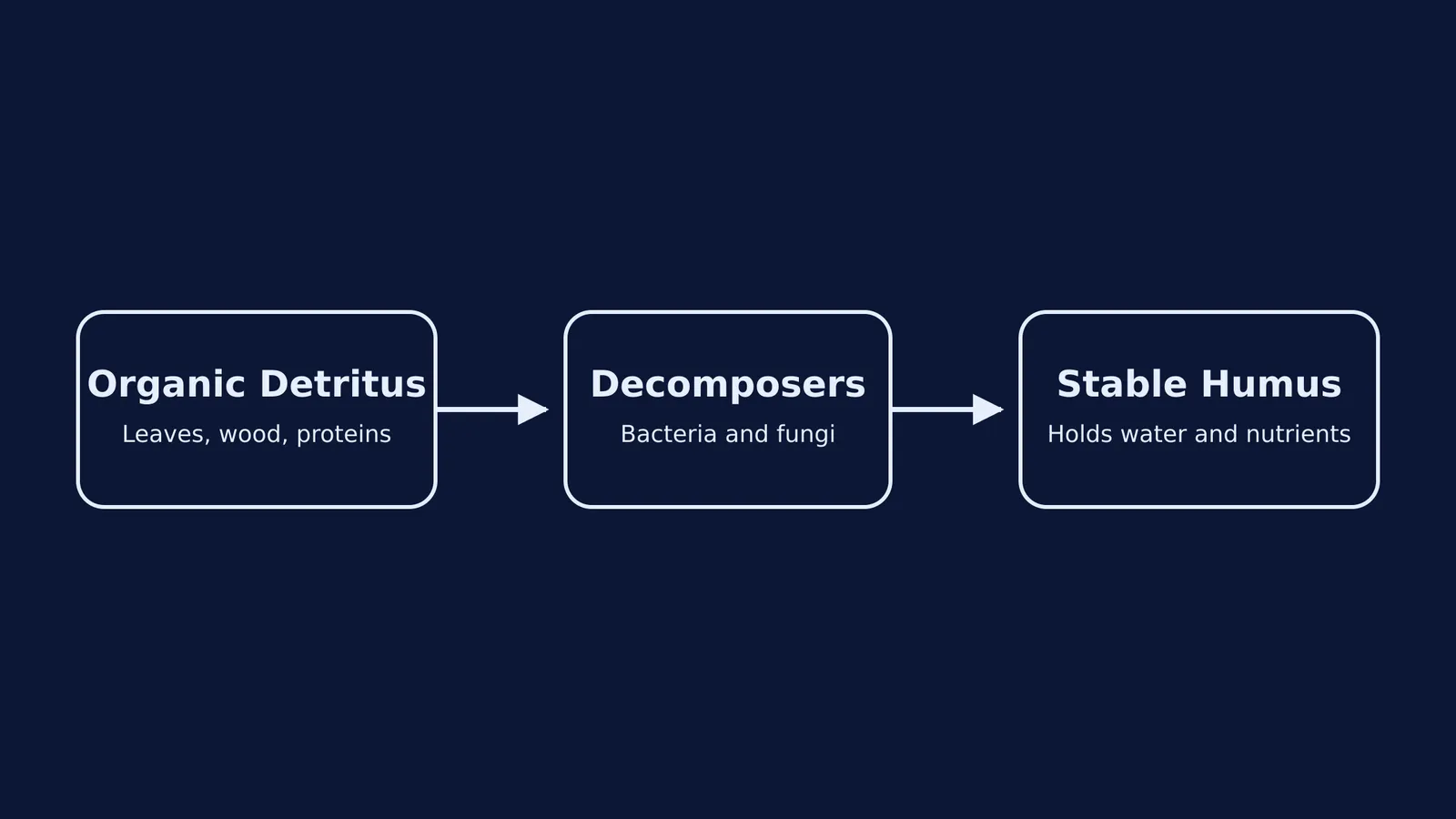
The transformation from dead organic matter to stable humus is called humification. When a leaf falls, soil decomposers such as earthworms, fungi and bacteria move in. They quickly break down the simple sugars and starches. Tougher materials like cellulose and lignin take longer, slowly transformed by fungi and microbial by-products into complex, large molecules.
During this process, microbes secrete sticky, gum-like substances that bind soil particles together into crumbs. This improves the soil structure, allowing roots to breathe and water to drain. If you want to understand more about the bacteria and fungi involved in these cycles, our guide on microbes in human welfare maps out their roles.
Once formed, humus is remarkably resilient. Much of the humus in most soils has persisted for more than 100 years, rather than having been decomposed into carbon dioxide.
Why is humus dark in colour?
Humus ranges in colour from dark brown to jet black. This comes from its high carbon content—the organic backbone of the original plant matter.
This dark colour is not just a visual marker of fertile soil; it serves a physical purpose. Dark surfaces absorb more solar energy than light ones. The dark colour of humus helps to warm cold soils in spring, giving seeds and young roots a much-needed temperature boost when the growing season begins.
How does humus hold water and nutrients?
Humus acts like a chemical and physical sponge in the soil. Physically, humus can hold the equivalent of 80 to 90% of its weight in moisture, which dramatically increases the soil's capacity to withstand drought.
Chemically, humus molecules are large, complex and carry a negative charge. This negative charge gives humus a high cation-exchange capacity. It acts like a magnet for positively charged nutrient ions (cations) such as calcium, magnesium and potassium. Instead of letting rain wash these nutrients away, humus holds them in the topsoil until plant roots need them.
Humus also contains a steady supply of nitrogen and phosphorus. The ratio of carbon to nitrogen in humus commonly ranges between 8:1 and 15:1, with the median being about 12:1. If you are exploring how essential elements move through ecosystems, you can find a lesson for every concept in the Fermi Concept Library. Fermi's AI tutor can work out what you already know and build a plan for the session, so you sit down to a clear next step.
For more on the basics of what makes up the earth under our feet, see our look at nature's treasures in Class 6.
A framework for healthy soil
If you are studying agriculture or gardening at home, you cannot add pure humus directly to the ground. Instead, you build it over time by feeding the humification process:
Add organic matter: Mix in compost, fallen leaves and crop residues.
Protect the decomposers: Minimise the use of harsh chemicals that kill earthworms and beneficial fungi (you can read more about safe alternatives in biocontrol agents and biofertilisers).
Reduce digging: Excessive tilling exposes stable humus to too much oxygen, causing microbes to burn it off as carbon dioxide. Leave the soil layers intact where possible.


