On this page
On a clear day, look straight up and then let your eyes drop slowly to the horizon. The deep blue overhead fades to a pale, almost white band just above the ground. The usual explanation blames dust and haze, and haze does make it worse. But the pale band is still there in very clean air. In his chapter on atmospheric optics, Craig Bohren points out that the same fading can be seen from an aircraft flying at 10 km, above most particles, so the sky must be uneven in colour on its own (Bohren, Atmospheric Optics).
This post shows, with numbers, how air molecules alone whiten the horizon. Why scattered light is blue at all, and Rayleigh's 1/λ⁴ law, are covered in why the sky is blue: Rayleigh's 1/λ⁴ law explained. How dust and droplets turn distant hills grey is in why far-away hills look blue. Here the particles are left out entirely.
Why do you look through more air near the horizon?
Looking straight up, your line of sight crosses the atmosphere by the shortest route. Looking low, it runs a long way through the dense air near the ground. The air mass m measures this: the amount of air along the path, compared with the amount straight up. Overhead, m = 1.
For a flat atmosphere, m = 1/sin(elevation). That works well down to about 10°, but at the horizon it gives infinity, which is wrong because the Earth is round. Kasten and Young fitted a formula that stays finite, giving m ≈ 38 at the horizon (Kasten and Young, Applied Optics, 1989). Bohren's chapter makes the same estimate from the 8 km scale height of the air: the horizon path is roughly 35 to 39 times thicker than the vertical one. Air mass also explains why solar panels collect less in the morning, as worked out in why solar trackers collect 57% more sunlight, then only 38%.
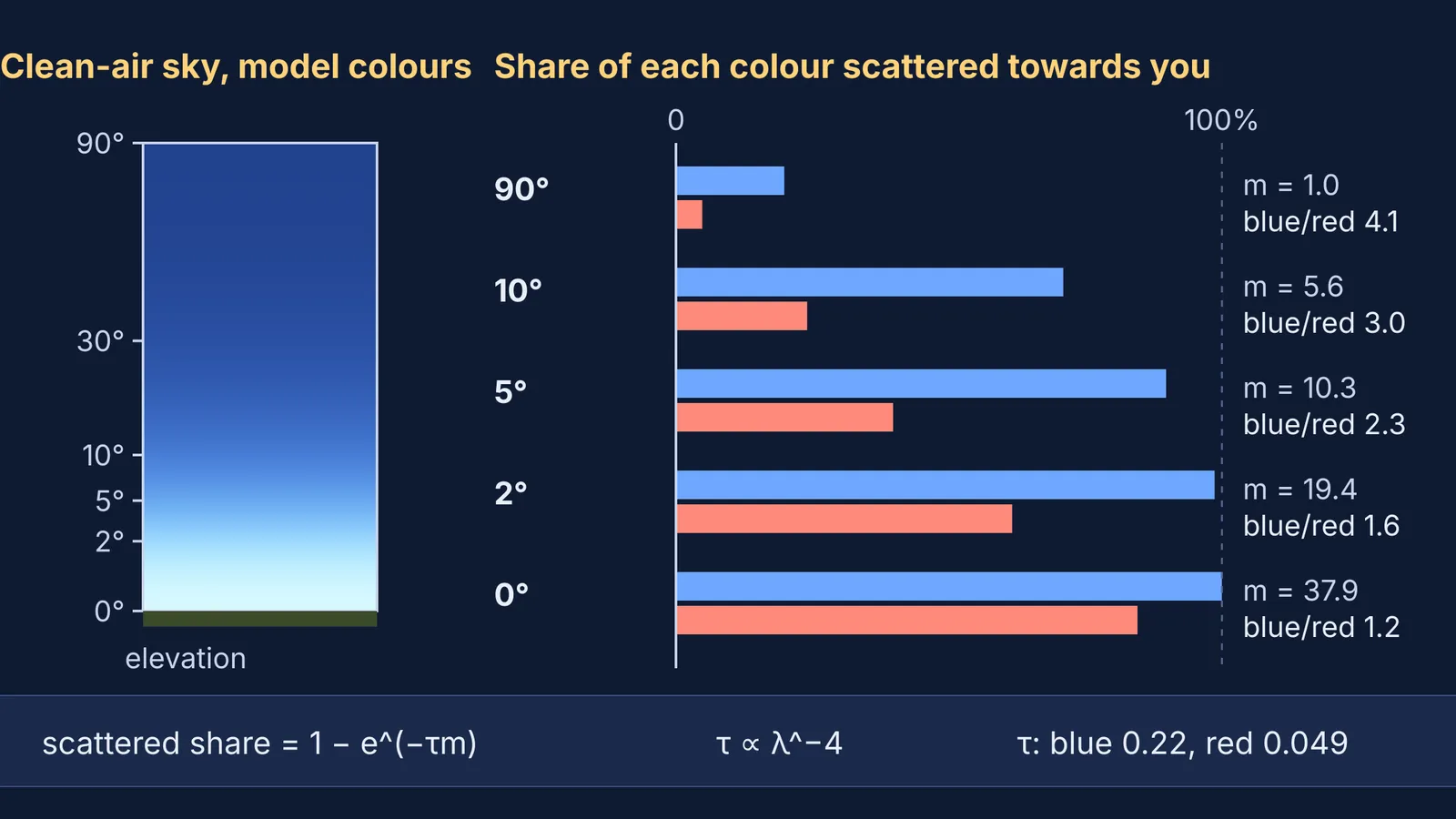
Values from the Kasten–Young formula:
90° (overhead): m = 1.0
10°: m = 5.6
5°: m = 10.3
2°: m = 19.4
0° (horizon): m = 37.9
How much does clean air scatter each colour?
The strength of scattering along a path is its optical depth τ. Light crossing optical depth τ keeps a fraction e^(−τ) and loses the rest to scattering. For the whole vertical atmosphere at sea level, the Rayleigh optical depth is about 0.221 at 450 nm (blue) and 0.0492 at 650 nm (red), from the formula of Bodhaine and colleagues (Journal of Atmospheric and Oceanic Technology, 1999)016%3C1854:ORODC%3E2.0.CO;2). Their ratio, 4.5, is a little more than (650/450)⁴ = 4.35, because the refractive index of air also changes slightly with colour.
Both numbers are small, so overhead the air is optically thin: only about 20% of blue and 5% of red is scattered along a vertical path. Near the horizon, multiply by m. At 2°, the blue optical depth is 0.221 × 19.4 = 4.3. That path is optically thick for blue.
How can more scattering make the sky less blue?
Imagine following your line of sight outwards from your eye. Every stretch of air along it scatters some sunlight towards you. Blue is scattered about four times as strongly as red, so each stretch sends you mostly blue. But light from far stretches must also come back through the air in between, and on the way blue is knocked out of your line of sight four times as fast as red.
Add up the whole path (with equal blue and red sunlight falling on it), and the light reaching you is proportional to:
1 − e^(−τm)
For small τm this is about τm, so blue wins by the full factor of about 4. For large τm it approaches 1 and stops growing: blue saturates. Red, with its smaller τ, keeps growing. Bohren describes exactly this balance: more short-wave light is scattered towards you, but long-wave light is more likely to get through, and over a long path the two cancel, so the horizon light takes on the colour of sunlight itself.
Worked example: how blue is the sky 2° above the horizon?
Take the blue and red optical depths above and the Kasten–Young air mass.
Air mass. At 2° elevation, m = 19.4.
Path optical depths. Blue: 0.221 × 19.4 = 4.30. Red: 0.0492 × 19.4 = 0.96.
Blue share. 1 − e^(−4.30) = 1 − 0.014 = 0.986. Blue is 98.6% saturated.
Red share. 1 − e^(−0.96) = 1 − 0.384 = 0.616. Red is only 62% of the way.
Ratio. 0.986 / 0.616 = 1.6.
Compare with overhead. At m = 1: blue 1 − e^(−0.221) = 0.198, red 1 − e^(−0.0492) = 0.048, ratio 4.1.
So the light from 2° up still leans to blue, but by 1.6 times instead of 4.1. With much more red and green mixed in, it looks far paler.
The same sum for other elevations, by python3:
90°: blue/red 4.1
10°: 3.0
5°: 2.3
2°: 1.6
0°: 1.2
Most of the change, about 60%, happens in the last 10° above the horizon. That matches what you see: the sky stays fairly blue down to low angles and then pales quickly into the horizon band.
Is the horizon brighter too?
Yes. The blue share rises from 0.20 to nearly 1, and the red share from 0.05 to 0.85, so every colour gets brighter towards the horizon. The horizon sky is both brighter and less saturated than the zenith, which is what Bohren describes for a purely molecular atmosphere. It is still far dimmer than the Sun, because only a tiny fraction of sunlight is scattered into each direction.
What does this simple model leave out?
This is a single-scattering estimate with the air lit evenly. A real sky adds several effects, and most make the horizon paler still.
Haze and droplets scatter all colours nearly equally, as in the distant-hills post.
The Sun's position changes how strongly each part of the sky is lit, and sunlight reaching the low air is itself reddened.
Light scattered more than once adds a further whitish glow.
Ozone absorbs some orange and yellow light on long paths.
Your eyes. Even the overhead sky is not pure blue. Glenn Smith showed that daylight skylight matches an unsaturated blue for human colour vision (American Journal of Physics, 2005). So treat the ratios here as a guide to "paler", not as an exact colour.
If you want to revise scattering, optical depth and exponential attenuation as connected ideas, the Fermi Concept Library explains each one concept by concept.
Quick checklist
Air mass m: overhead 1, at 2° about 19, at the horizon about 38 (not infinity).
Rayleigh optical depth at sea level: about 0.22 for blue, 0.05 for red.
Light scattered towards you grows as 1 − e^(−τm).
Thin path: blue beats red about 4 to 1. Thick path: blue saturates and red catches up.
At 2° elevation the ratio falls to 1.6; at the horizon to about 1.2.
Clean air alone whitens the horizon; haze makes it whiter still.