On this page
Stand on a ridge in the Western Ghats or the Himalayan foothills and look out. The nearest slope is green, the next ridge is a dull teal, and the ones behind it fade into soft blue until the farthest barely stands out from the sky. What changes is how much air sits between you and each ridge.
Why do far away hills look bluish?
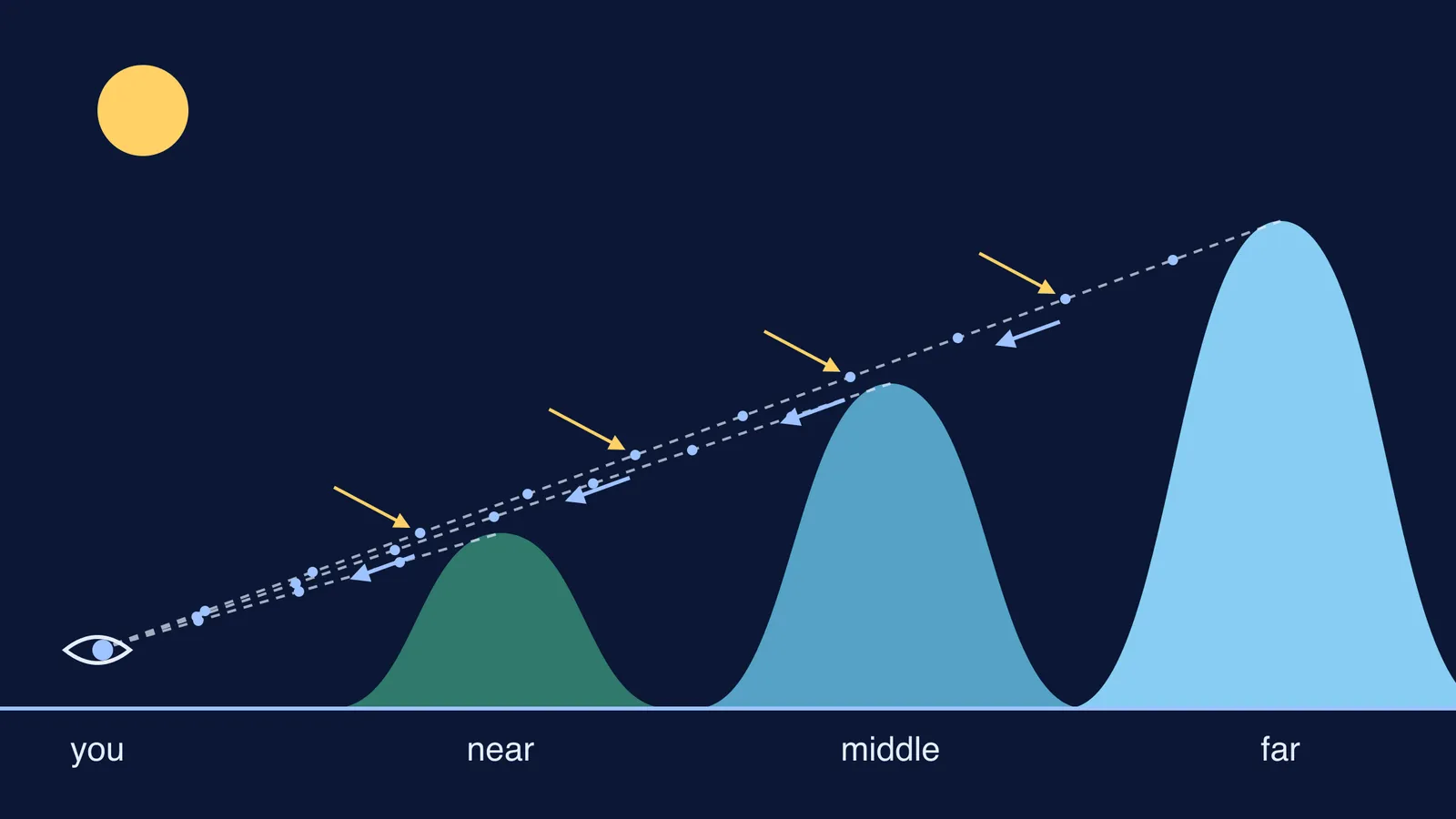
Two things happen to light on its way from a distant hill to your eye. First, some of the green and brown light from the hillside is knocked out of your line of sight by the air, so the hill looks dimmer and less sharp. Second, sunlight falling on the air in front of the hill is scattered sideways, and some of it is sent straight into your eyes. That added light is mostly blue.
It is blue for the same reason the sky is. NCERT's Class 10 science chapter The Human Eye and the Colourful World explains that molecules of air and other fine particles are smaller than the wavelength of visible light, and scatter shorter blue wavelengths more effectively than longer red ones.
The blueing and slight blurring of distant things is called aerial perspective, as this Hanover College perception page explains.
What is airlight, and why does it grow with distance?
Airlight is sunlight scattered towards you by the air molecules themselves, according to the Atmospheric Optics site, which also notes that it is strongest when the sun is high. Every stretch of air along your line of sight adds a little of it.
So distance works like stacking sheets of thin blue tissue paper in front of a picture. A nearby hill has a few sheets in front of it; a far ridge has many more. Each extra sheet adds blue and dims the green behind it. Eventually almost all the light you receive from the farthest ridge is airlight, and it blends into the pale sky near the horizon.
How much more is blue scattered than red?
The rule is Rayleigh's law: the intensity of scattered light is inversely proportional to the fourth power of the wavelength, the relation the IIT Kanpur Virtual Labs scattering experiment is designed to test.
Here is a worked example using NCERT's figure that the wavelength of red light is about 1.8 times that of blue light (NCERT Class 10, section 10.6):
Write the ratio: I(blue) / I(red) = (λ red / λ blue)⁴.
Substitute the NCERT value: (1.8)⁴.
Square twice: 1.8 × 1.8 = 3.24, then 3.24 × 3.24 ≈ 10.5.
Read the answer: blue light is scattered about 10 times as strongly as red.
Now try it yourself with 450 nm for blue and 700 nm for red: (700 / 450)⁴ ≈ 5.9. Either way blue wins by several times, which is why the airlight in front of a hill looks blue rather than white.
Why do hills sometimes look grey or white instead?
Because the particles in the air change. NCERT notes that very fine particles scatter mainly blue light, larger particles scatter longer wavelengths too, and if the particles are large enough the scattered light may even look white (NCERT Class 10). Dust, smoke and water droplets on a humid or polluted day are much larger than air molecules, so the haze turns milky grey and far hills can fade from view. The same chapter explains why danger signals are red: red light is scattered least by fog or smoke.
Pollution makes a real difference. The US National Park Service says the Blue Ridge Mountains are named for a bluish haze caused by hydrocarbons released by trees, and that over the last 50 years visibility in the Southern Appalachians has decreased 40% in winter and 80% in summer because of man-made pollutants.
How can you check this on your next trip?
Try this five-minute hill-watch from a hill station, train window or rooftop:
Find three ridges at different distances. Rank them by how blue and how faint they look.
Hold a dark green leaf next to your view of the nearest ridge, then the farthest. The leaf stays green; only the ridges change.
Look again at midday and near sunset. Airlight is strongest when the sun is high.
Compare a clear day after rain with a dusty or humid day. Expect blue on the clear day and grey-white on the hazy one.
Write one sentence for each observation and name the cause: wavelength, distance or particle size.
If you are revising for CBSE boards, the same idea gives a clean three-part answer. Air molecules are smaller than the wavelength of light. They scatter blue far more than red, following the 1/λ⁴ rule. More air between you and a distant hill means more scattered blue light reaches your eye.
Scattering is easier to see than to read about. The Fermi Simulation Lab has interactive simulations for ideas like this one. If wavelength or scattering still feels fuzzy, the Fermi Concept Library gives each concept its own lesson and shows its place in the map.