On this page
Stand on a beach at Marina, Kovalam or Puri when the Sun is low, and its reflection is not a round spot. It is a long, narrow road of glitter running from the horizon almost to your feet. A calm lake gives one sharp image of the Sun. A sea with waves gives this stretched path. The reason is the law of reflection applied to millions of tilted wave faces, and it shows something the usual flat-paper diagrams miss: tilting a mirror sideways moves the reflection much less than tilting it towards you.
Before anything else: never look at the Sun, or at its bright reflection on water, directly. The glitter path sends a lot of sunlight into your eye. Look at the Moon's path at night instead; the geometry is exactly the same.
Why does a calm sea show only one image of the Sun?
A flat sea is a horizontal plane mirror. If the Sun is at elevation e, its image is at the same angle e below the horizon, straight towards the Sun. Every other patch of water sends sunlight past your eye, so you see one round image.
How do waves stretch the reflection towards you?
Each wave face is a small mirror tilted by some angle. You already know what a tilted mirror does from why the reflected ray turns 2θ when a mirror rotates by θ: turn a mirror by β and the reflected ray turns by 2β.
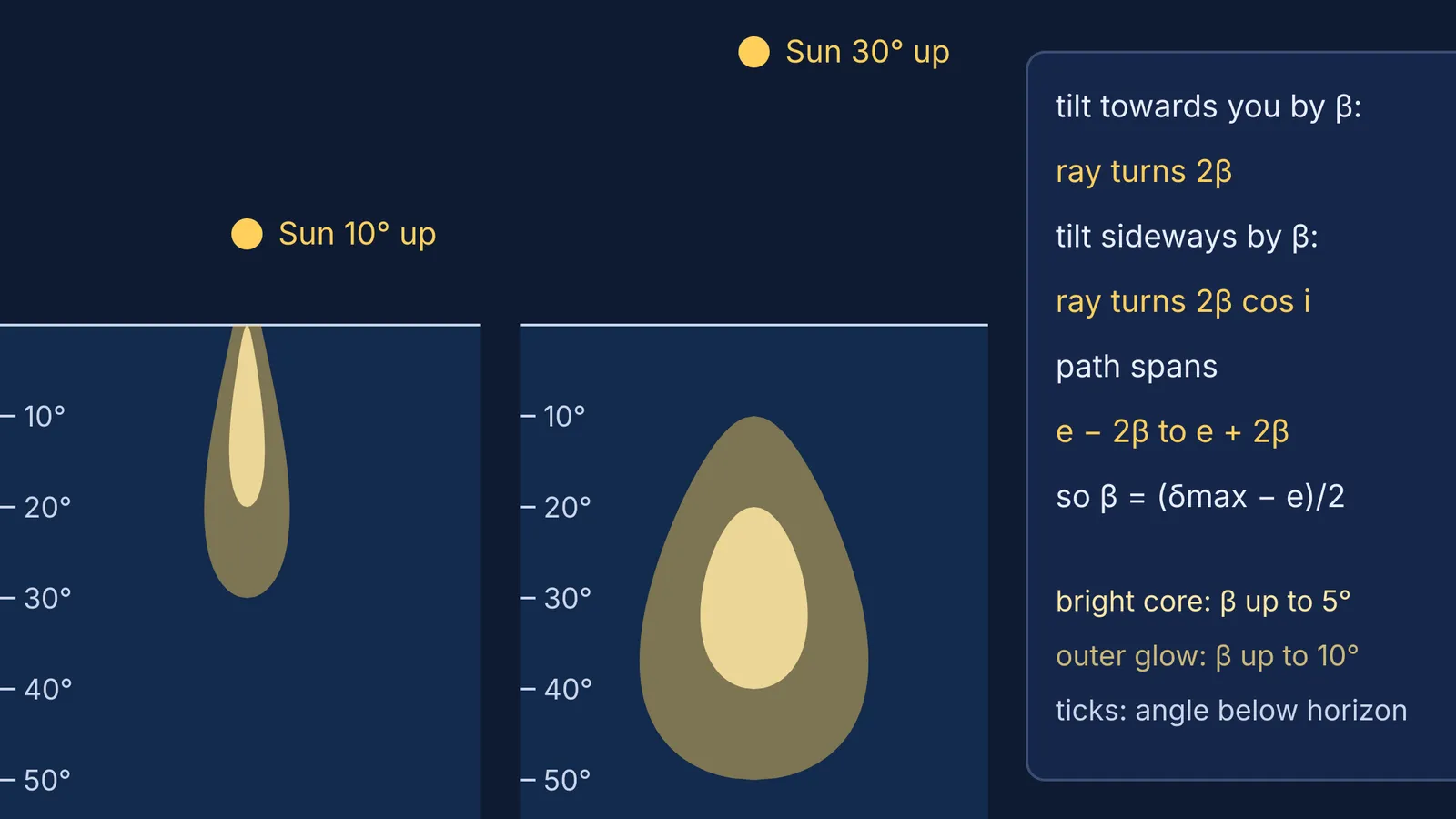
Look along the line towards the Sun. A wave face tipped towards you or away from you by up to β sends the Sun's light to your eye from any point between depression angles e − 2β and e + 2β. If e − 2β is negative, that end is cut off by the horizon. So the glitter runs a long way up and down.
Why is the glitter path so narrow sideways?
Now tilt a wave face sideways by β, about an axis lying in the plane that contains the Sun, the face and your eye. The 2β rule does not apply here, because that rule is for an axis perpendicular to the plane of incidence. Use the vector form of reflection instead, r = d − 2(d·n)n, explained in how to find a reflected ray's direction with vectors.
A small sideways tilt changes the normal by Δn, a vector of size β (in radians) perpendicular to the plane of incidence, so d·Δn = 0. The change in the reflected direction is then Δr = −2(d·n)Δn, whose size is 2β cos i, where i is the angle of incidence.
When the Sun is low and you look at the sea near the horizon, the light strikes the water almost at grazing incidence: i is close to 90°, so cos i is small. A sideways tilt of 10° then moves the reflection by only a couple of degrees. Tilts towards you still move it by 2β. That is the whole reason the path is long and thin.
Glints from small tilted faces are also why a silk saree shines in bands as you turn it.
Worked example: a low Sun over the sea
Take the Sun 10° above the horizon and wave faces tilted up to β = 10°.
Calm-sea image: 10° below the horizon.
Along the line to the Sun: the ray turns by up to 2β = 20°, so the glitter could span 10° − 20° = −10° to 10° + 20° = 30° below the horizon. Negative depression means above the horizon, which the sea cannot reach, so the path runs from the horizon to 30° below it.
Sideways, at 10° below the horizon: sunlight arriving 10° above the horizontal and leaving 10° below it meets a level facet at a grazing angle of 10°, so i = 80°. The sideways shift is 2β cos i = 2 × 10° × cos 80° ≈ 3.5°.
Sideways, at 2° below the horizon: the grazing angle is (10° + 2°)/2 = 6°, so i = 84° and 2 × 10° × cos 84° ≈ 2.1°.
Check by tracing rays: we checked these numbers by tracing rays in three dimensions, testing every direction for a facet with a tilt of 10° or less. The traced half-widths are 3.5° at 10° below and 1.9° at 2° below, close to the estimates; the widest point is 4.4° each side, at about 20° below.
Shape: about 30° long and at most about 9° across. A long, thin path.
Now raise the Sun to 30°, keeping β = 10°. The glitter runs from 10° to 50° below the horizon, and at 30° below it is i = 60°, so 2 × 10° × cos 60° = 10° to each side (ray tracing gives 10.1°). That is about 40° long and 20° wide: a broad, blobby patch. So midday glitter is a wide pool and evening glitter is a road.
Can the glitter tell you how rough the sea is?
Yes. Run the example backwards. If the path reaches 30° below the horizon while the Sun is 10° up, the steepest common wave faces are tilted by (30° − 10°)/2 = 10°.
Charles Cox and Walter Munk did it properly in a 1954 paper in the Journal of the Optical Society of America: they photographed the Sun's glitter from an aircraft near Hawaii, measured the wind from a ship, and worked out how often each slope occurs. Their abstract reports that the mean square slope rises linearly with wind speed, reaching (tan 16°)² at 14 m/s. The fit usually quoted from their data, summarised in the Ocean Optics Web Book, is mean square slope ≈ 0.003 + 0.00512 U, with U the wind speed in m/s measured 12.5 m above the sea. At 5 m/s that is 0.0286, so the root-mean-square slope is √0.0286 ≈ 0.169, a tilt of tan⁻¹ 0.169 ≈ 9.6°. A gentle breeze gives about the 10° we assumed.
Why are the edges of the glitter soft?
Wave slopes do not stop at a sharp maximum. Cox and Munk found that they follow a roughly bell-shaped (Gaussian) spread. Facets near zero tilt are common, so the glitter is brightest near the calm-sea image; steep facets are rarer, so the glitter thins out and fades instead of ending at a clean edge. The β in the worked example is a typical steep tilt, not a hard limit.
To see how a ray turns as a mirror tilts, the Fermi Simulation Lab has interactive simulations of ideas that are easier to see than to read, and the Fermi Concept Library places reflection and the plane of incidence in the map of physics.
Quick checklist
Calm sea: one image of the Sun, as far below the horizon as the Sun is above it.
Tilt towards you by β: the reflection moves by 2β, so the path is long.
Tilt sideways by β: it moves by only 2β cos i, small at grazing incidence, so the path is thin.
Path from e − 2β to e + 2β below the horizon; β = (δ_max − e)/2.
A 5 m/s wind gives a root-mean-square tilt near 10° (Cox and Munk).
Never look at the Sun or its reflection directly; practise on the Moon's path.