

On this page
Hold a silk saree under a tube light and tilt it. Bright bands slide across the fabric, then vanish. The difference starts with the shape of a single fibre, and it is a real-life example of the reflection chapter in your physics book.
Why does silk cloth look shiny?
In textiles, lustre is the property that makes a fabric look bright, glossy and shiny (Luster (textiles))). Silk has a lot of it, and the main reason is geometry.
A silkworm (Bombyx mori) spins a cocoon filament made of two protein strands called fibroin, covered by a gum called sericin (FAO silk reeling and testing manual). The same FAO manual says that, seen in cross-section, the two strands have “the appearance of equilateral triangles with rounded corners”. For univoltine and bivoltine silkworms, the whole filament averages 15 to 20 microns across, the manual adds.
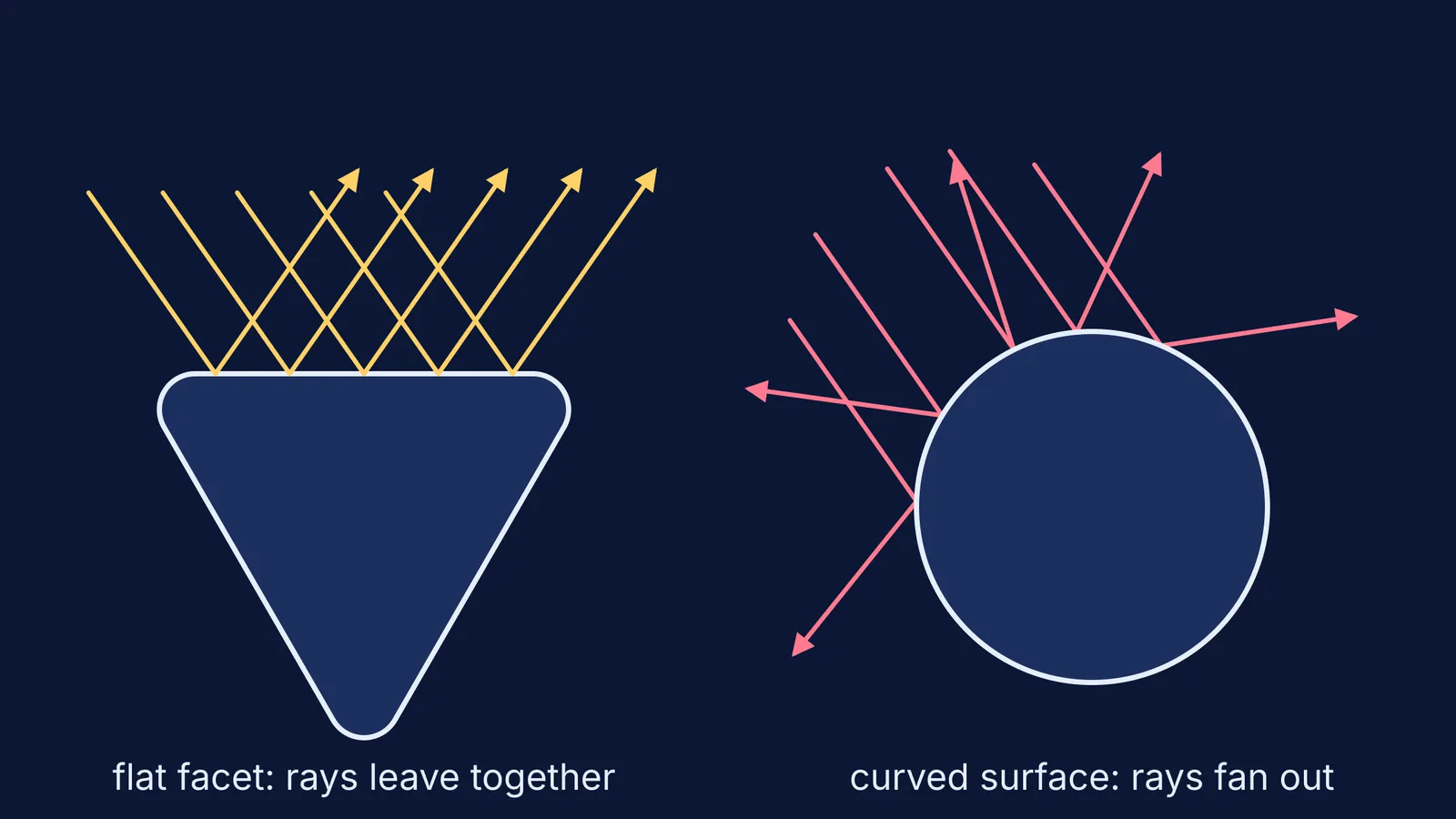
Flat faces matter because of the law of reflection: the angle of incidence equals the angle of reflection, both measured from the normal. When parallel rays from a lamp hit one flat face, every ray meets the same normal, so they all leave in the same direction, as the diagram above shows. Your eye catches that bundle as a bright glint. A curved or wrinkled surface has a different normal at every point, so the same rays fan out and the light looks softer. Our explainer on regular and diffuse reflection covers both kinds.
Textile references say the rounded edges and triangular cross-section of silk contribute to its lustre, and that some synthetic fibres copy a three-lobed (trilobal) shape to look silk-like (Luster (textiles))).
Do silk fibres really act like tiny prisms?
Partly. A teaching page from the University of the Arts London describes silk's rounded triangular shape as a “prism”-like structure that refracts incoming light at several different angles (UAL: silk properties). The picture is useful: a triangle has three flat faces at fixed angles, so a thread of such fibres throws light back in a few favoured directions instead of everywhere.
The inside of the fibre may matter too. In a 2018 study in Nature Communications, Seung Ho Choi, Young L. Kim and colleagues examined native Bombyx mori silk and estimated that a filament about 20 µm across can contain roughly 3,800 nanofibrils, each about 25 nm wide (Choi et al., 2018). The authors suggest that silk's “silvery” and “lustrous” reflection may come from strong light scattering in these densely packed, disordered nanostructures. They found that the inner and outer layers of a silk cocoon, about 400 µm thick, reflect about 80% of light on average between 0.4 and 1 µm wavelength, visible plus near-infrared (full text of the study).
Why does finished silk shine more than raw silk?
Silk straight off the cocoon still wears its gum. Sericin makes up 19 to 28 percent of the cocoon shell (FAO manual). It is removed by degumming, and a 2022 review in Polymers explains that this step is needed to get silk fibroin filaments with an excellent hand and “elegant luster” (Zhu et al., 2022). With the gum gone, the smooth fibroin faces meet the light directly.
The kind of silk matters as well. The Press Information Bureau describes mulberry silk as soft, smooth and shiny, and non-mulberry (vanya) silk from wild silkworms as having “less shine” (PIB Research Unit, April 2025). The same report says 92% of India's raw silk production comes from mulberry. For where filaments come from, see the silkworm life cycle, from egg to cocoon, and compare how cotton fibre grows as a seed hair.
How can you test silk's shine at home?
You need a phone torch, a silk dupatta or saree, a cotton cloth and a dark room.
Lay both fabrics flat, side by side, and hold the torch at an angle about an arm's length away.
Look from the opposite side, roughly where the light should go if the angle of incidence equals the angle of reflection.
Tilt each cloth slowly. Note where the brightest patch appears and how quickly it moves.
Crumple both fabrics and look again.
On flat silk you are likely to see a bright band that jumps as you tilt, because many flat faces point the same way. Cotton tends to brighten more evenly, and crumpling, which gives the faces many different normals, softens the silk's glint.
If a test asks why silk is lustrous, a three-line answer covers it:
Silk fibroin fibres have a smooth, roughly triangular cross-section with flat faces.
Flat faces give regular reflection, so parallel rays leave in the same direction and reach the eye as a bright glint.
Degumming removes the sericin coat and exposes these smooth faces, so finished silk is more lustrous than raw silk.
Ray diagrams are easier to see than to read. The Fermi Simulation Lab has interactive simulations for ideas like that, and if the law of reflection itself is shaky, the Fermi Concept Library gives each physics concept its own lesson.
Next time a saree catches the light at a wedding, look for the glint, then tilt your head and watch it move.


