On this page
A cotton T-shirt is made of seed hairs. That is the short answer to a common school science question in the "fibre to fabric" topic. Here is where the fibre grows, how it is picked, what ginning does, and how to write the answer in a test.
Cotton fibre comes from which part of the plant?
Cotton fibre comes from the seed. Each fibre is one long cell growing out of the seed's outer skin (the epidermis). A 2014 paper in Nature Communications describes cotton fibres as "unusually long, single-celled epidermal seed trichomes", and trichome is the botanist's word for a plant hair.
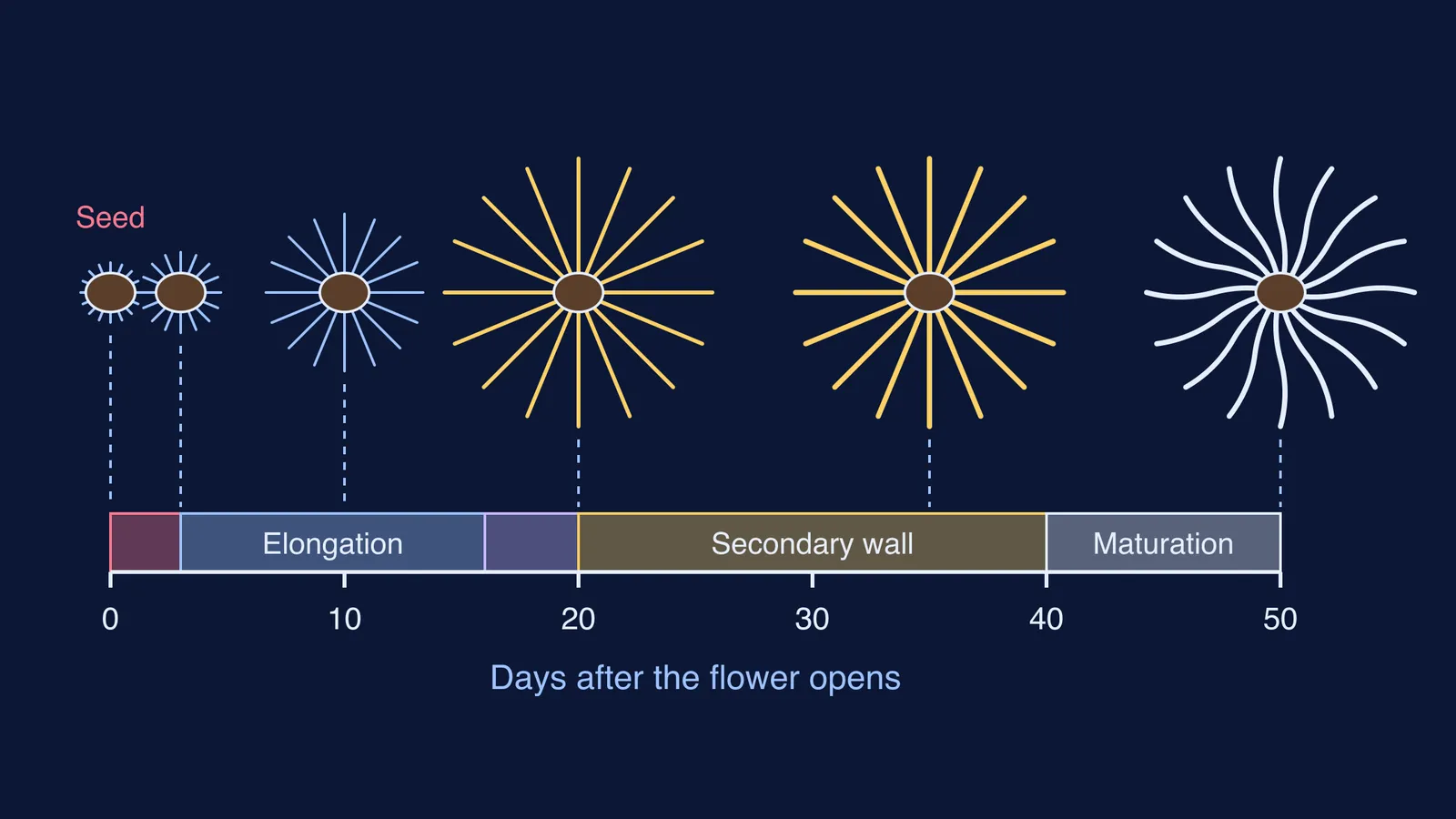
The hairs start forming while the seed is still a tiny ovule inside the flower. A 2022 study in Plant Biotechnology Journal reports that the long lint fibres begin on the day the flower opens and up to 3 days after, and that lint usually starts from about 25% of the ovule's epidermal cells. Shorter fuzz fibres start later.
Michael Stiff and Candace Haigler of North Carolina State University note in a review chapter that each lint fibre comes from a single epidermal cell, and that by about 5 days after the flower opens, each ovule of modern varieties has about 16,000 fibre initials.
To see how stem fibres differ, read how jute fibre is extracted from stems by water retting.
How does a cotton fibre grow inside the boll?
The seeds sit inside the boll, the pod that forms after the flower. Stiff and Haigler's chapter splits fibre growth into overlapping stages:
Initiation: some epidermal cells bulge out from the ovule.
Elongation: each cell grows long and thin.
Transition: the primary cell wall is remodelled.
Secondary wall: the cell lays down thick layers of cellulose.
Maturation: the fibre is a dead cell that collapses into a kidney-bean-shaped cross-section.
The same chapter says these stages typically last at least 50 days. A 2021 preprint on bioRxiv adds that mature fibres reach about 3 cm in the cultivated species Gossypium hirsutum and about 5 cm in Gossypium barbadense.
How are cotton bolls picked?
When the bolls open, the white fluffy mass inside is seed cotton: fibre still attached to seed. In India it is mostly picked by hand, in rounds, because bolls on one plant open at different times. A technical report from CSIR-CMERI, Punjab Agricultural University and ICAR-CICR cites a 1999 study that found three manual pickings about 15 days apart, giving 35%, 50% and 15% of the crop. The report names the staggered blooming of Indian varieties as one challenge for machine picking here.
In the United States, cotton is machine-harvested: spindle pickers pull fibre from open bolls, while strippers remove the whole boll, says the National Cotton Council. For where the crop grows, see why black soil suits cotton.
What is ginning of cotton?
Ginning is the separation of the fibre (lint) from the seed. The National Cotton Council explains that seed cotton is first dried and cleaned, then revolving circular saws pull the lint through closely spaced ribs that stop the seeds from passing. The lint is pressed into bales of about 500 pounds.
In India, the Cotton Corporation of India describes its cotton purchase operations, its work with ginning and pressing factories, and separate sales of cotton seed.
After ginning, the lint is spun into yarn and woven into fabric. For why that fabric feels good in summer, read why cotton absorbs sweat better than polyester.
How much fibre does one cotton boll give?
The CSIR-CMERI report quotes a 1970 estimate that it takes about 100,000 bolls to make one 225 kg bale of lint, with 4 or 5 locks (sections) in each boll.
Lint per boll: 225 kg = 225,000 g, and 225,000 g ÷ 100,000 bolls = 2.25 g.
Lint per lock: 2.25 g ÷ 5 = 0.45 g, and 2.25 g ÷ 4 ≈ 0.56 g.
So each boll gives a little over 2 grams of fibre, and one bale means picking about 100,000 bolls.
How do you write this answer in a science test?
For a 2 or 3 mark question, cover these points:
Name the part: cotton fibres are hairs on the seeds.
Say where the seeds are: inside the cotton boll, which bursts open when mature.
Picking: the seed cotton is picked from the open bolls, usually by hand in India.
Ginning: the fibres are separated from the seeds.
Next steps, if asked: spinning into yarn, then weaving into fabric.
A model answer: "Cotton fibre comes from the seeds of the cotton plant. When the bolls burst open, the cotton is picked, usually by hand, and ginning separates the fibres from the seeds."
Then close this page and explain, out loud, the difference between lint, seed cotton and cotton seed.
If words like epidermis or cellulose are new, the Fermi Concept Library gives each biology concept its own lesson and its place in the map. If you don't know where to start on a chapter, Fermi's AI tutor works out what you already know and builds a plan for the session.