

On this page
Why is black soil so uniquely matched to cotton? Across Maharashtra, Gujarat, and Madhya Pradesh, cotton fields thrive under erratic monsoon rains that would wither crops in ordinary loam or sand. The secret lies in a 65-million-year-old geological legacy: weathered Deccan basalt that formed deep, clay-dense Vertisols endowed with expanding lattice minerals.
What makes black soil retain water for months?
Black soil, known scientifically as a Vertisol and locally as regur, owes its dark hue and fine texture to weathered basaltic lava flows. According to the FAO World Reference Base for Soil Resources, Vertisols require a clay fraction of at least 30%, but Indian black soils typically contain between 40% and 60% fine clay.
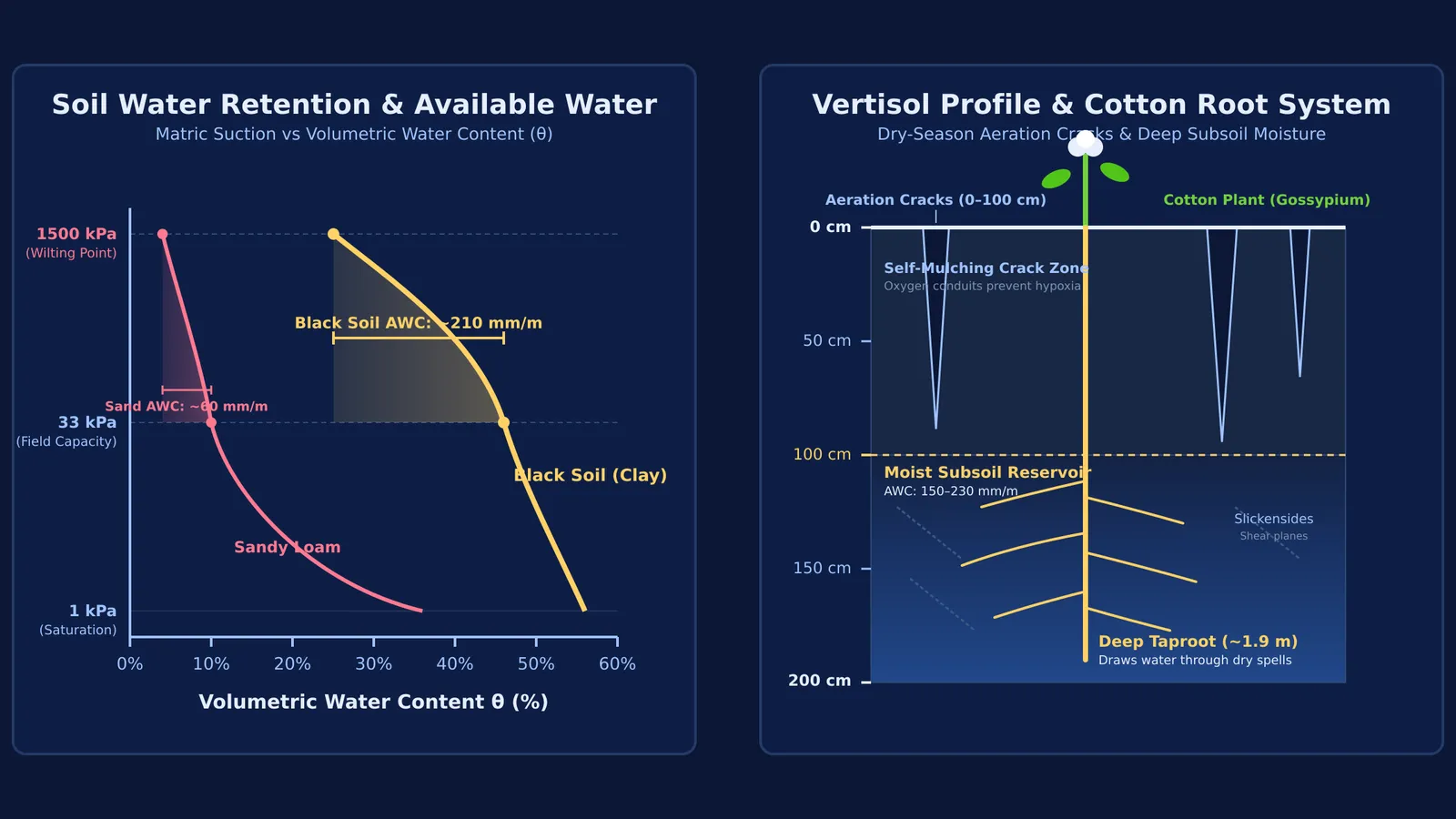
The dominant mineral in this clay is montmorillonite, a smectite with a 2:1 expanding sheet structure. As documented by D. K. Pal, S. P. Wani, and K. L. Sahrawat (2012) in Geoderma, water molecules penetrate between the crystal sheets, expanding the lattice. This gives black soil an Available Water Capacity (AWC) between 150 mm and 230 mm per metre of soil depth, compared to under 60 mm per metre in sandy soils. The high surface charge binds capillary water tightly against gravity, creating a subterranean reservoir. This volcanic weathering is part of the broader physical systems examined in Nature's treasures in Class 6.
Why does cotton require expanding clay and deep subsoil moisture?
According to NCERT Class 10 Geography, cotton (*Gossypium*) is a long-duration kharif crop that requires 210 frost-free days and 6 to 8 months (180 to 240 days) to mature, with seasonal water demand typically ranging from 500 mm to 800 mm in rainfed dryland farming. Its growth cycle matches the post-monsoon dry season: while early vegetative growth relies on monsoon showers, the critical flowering and boll development stage—occurring between days 70 and 120—frequently coincides with rain cessation.
Moisture stress during boll filling triggers boll shedding, reducing lint yields by over 40%. Cotton thrives because it sends a vertical taproot 1.5 to 2.0 metres into the profile, bypassing lateral soil shear. Long-term evaluations of cotton-based cropping systems on rainfed semi-arid Vertisols by K. L. Sharma et al. (2011) in Communications in Soil Science and Plant Analysis demonstrate that subsoil moisture reserves sustain crop productivity across extended dry intervals. The deep taproot draws moisture long after the surface layer has baked dry, mirroring the transpiration dynamics studied by Stephen Hales and the first measurements of transpiration.
How does the self-ploughing crack mechanism aerate the soil?
While dense clay usually suffers from poor aeration, black soil possesses an autonomous aerating cycle. Under dry winter heat, the montmorillonite lattices contract. As noted in the FAO World Reference Base for Soil Resources, this shrinkage splits the surface into fissures 5 to 10 cm wide and up to 1.2 metres deep.
As documented in pedological surveys cited by the FAO World Reference Base for Soil Resources, this fissure network drives self-ploughing, or pedoturbation. Dried surface crumbs and plant debris fall into the open cracks. When rains arrive, the clay swells up to 25% by volume and seals the cracks, carrying organic matter into the subsoil along polished shear planes called slickensides. These fissures also provide oxygen pathways that prevent root hypoxia in the dense clay.
What nutrients are found in Deccan trap black soil?
Beyond moisture storage, black soil provides rich mineral nutrition from basalt weathering. According to NCERT Class 10 Geography, black soils are rich in calcium carbonate, magnesium, potash, and lime, though deficient in nitrogen, phosphorus, and organic matter.
According to mineralogical analyses in Geoderma, potash (potassium) is critical for cotton, which absorbs 3 to 5 kg of potassium per hectare daily during boll filling to maintain cell turgor and build cellulose fibres. The high Cation Exchange Capacity (CEC) of montmorillonite—40 to 80 cmol(+)/kg—protects these cations from leaching. Managing nutrient balance with legume rotations reflects the practices highlighted in George Washington Carver and the science of rebuilding worn-out soil.
How can students calculate soil water capacity for crops?
Students can model whether cotton survives a 40-day dry spell using a four-step water balance grounded in Vertisol hydrological data from Geoderma:
Root Zone Depth: A mature cotton taproot accesses 1.2 metres of active profile depth.
Available Water Storage: Multiply depth by soil AWC: 1.2 m × 190 mm/m = 228 mm of stored water in black soil.
Daily Evapotranspiration: Average cotton crop water demand (ET_c) is 4.2 mm/day during boll formation.
Drought Tolerance: Divide storage by daily demand: 228 mm / 4.2 mm/day ≈ 54 days of water reserves.
This calculation demonstrates why cotton survives a 40-day rainless interval in black soil, where 54 days of stored water sustains transpiration until harvest. In contrast, coarse sandy soil with an AWC of only 50 mm/m holds just 60 mm across the same 1.2-metre root zone (1.2 m × 50 mm/m), which exhausts its reserves in approximately 14 days and triggers severe boll shedding. Long-term field trials by K. L. Sharma et al. (2011) in Communications in Soil Science and Plant Analysis confirm that maintaining soil quality and root-zone moisture in these rainfed Vertisols is essential to protect cotton yields against recurring drought spells.
For concepts that are easier to see than to read, the Fermi Simulation Lab provides interactive simulations to visualize matric potential curves, clay swelling dynamics, and soil water retention. When tackling numericals on capillary suction and plant available water, the Fermi Problem Library offers worked problems with a step-by-step solver that explains the reasoning rather than printing an answer.


