

On this page
On a humid 35 °C afternoon in Delhi or Chennai, wearing a pure cotton shirt feels completely different from wearing a 100% polyester jersey. One fabric drinks in perspiration almost instantly, while the other leaves moisture trickling down your skin. The difference begins with a standard textile metric known as moisture regain.
Why does cotton soak up moisture while polyester repels it?
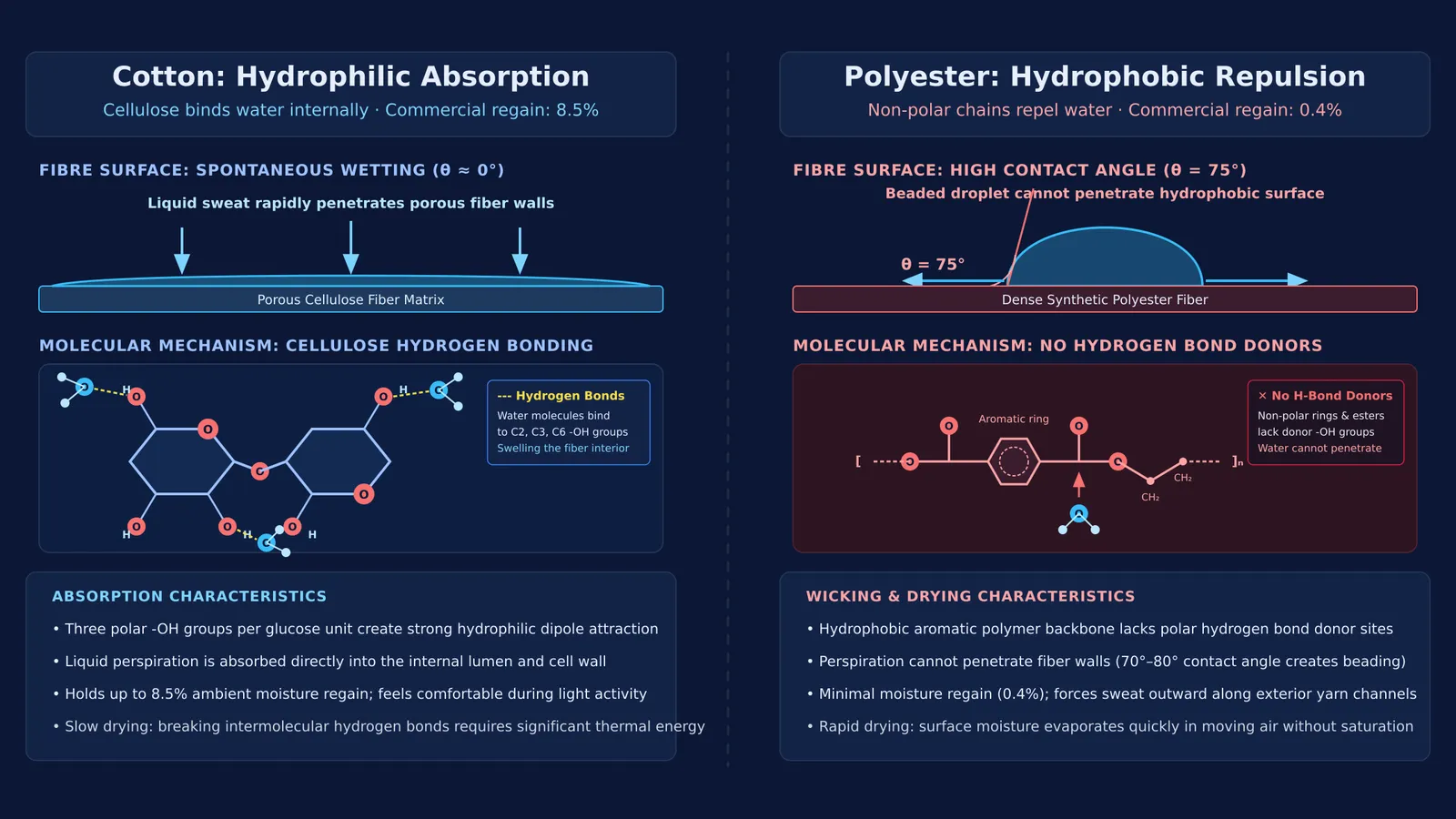
In textile science, moisture regain measures the percentage mass of water an oven-dry fiber absorbs from standard air (65% relative humidity at 21 °C). Under the ASTM D1909 standard table of commercial moisture regains, natural cotton has a commercial moisture regain of 8.5%, whereas synthetic polyester has a regain of just 0.4%. Cotton holds more than twenty times as much ambient moisture inside its fiber structure as polyester.
A laboratory study by Meritxell Martí and colleagues in *Polymers* confirmed that untreated polyester absorbs only 0.4% to 0.5% water by weight, leaving the bulk fiber interior dry. When liquid sweat meets scoured cotton, it penetrates immediately with an apparent contact angle near 0°. By contrast, fiber-wetting research by You-Lo Hsieh and collaborators in the *Textile Research Journal* showed that polyester fibers exhibit an intrinsic water contact angle of 70° to 80°, forcing droplets to bead rather than sink in.
How do cellulose hydroxyl groups form hydrogen bonds with sweat?
The root of this difference is chemical polarity. Cotton consists predominantly of cellulose, a polymer of repeating β-D-glucose units. In synchrotron diffraction studies by Yoshiharu Nishiyama, Paul Langan, and Henri Chanzy in the *Journal of the American Chemical Society*, each glucose unit presents three polar hydroxyl (-OH) groups at the C2, C3, and C6 carbon positions.
Because oxygen is far more electronegative than hydrogen, each O-H bond forms a permanent dipole. Because human perspiration consists predominantly of water, polar water molecules readily form hydrogen bonds with exposed hydroxyl groups in cotton's amorphous zones. Spectroscopic measurements by Stefan Cichosz and Anna Masek in *Materials* showed that water sorption broadens the 3000 cm⁻¹ to 3700 cm⁻¹ infrared band, physically swelling the fiber. This matches the dipoles explored in understanding intramolecular hydrogen bonding, where localized bonding shapes boiling points and volatility.
Polyester, or polyethylene terephthalate (PET), has an entirely different structure. Built from terephthalic acid and ethylene glycol joined by ester linkages (-COO-), its chain is dominated by non-polar benzene rings. Without donor hydroxyl groups, PET cannot form hydrogen bonds with water, leaving the plastic bulk hydrophobic.
Why does Class 8 Science contrast natural and synthetic fibres?
Indian curricula introduce this contrast early. In the Class 8 Science unit on synthetic fibres, preserved in the NCERT Exemplar for Class VIII Science, students learn that cotton is a natural polymer made of glucose units, while polyester is an artificial polymer built from ester units.
The curriculum pairs this molecular distinction with everyday performance. Synthetic fibers offer high tensile strength and dry quickly, but fail to absorb water. In Class 10 chemistry, students revisit polarity when studying how soap micelles separate hydrophilic and hydrophobic phases; polyester's hydrophobic surface binds stubbornly to oily sebum, which is why synthetic sportswear retains sweat odors after washing.
Does absorbing sweat always make a fabric cooler to wear?
Absorbing sweat is not always identical to keeping cool. In dry heat or during quiet study sessions, cotton keeps you comfortable by pulling perspiration off your skin into its internal lumen, letting it evaporate steadily.
During intense workouts, however, cotton's high absorbency becomes a drawback. In moisture transport research by Ching-Iuan Su and colleagues in the *Textile Research Journal*, pure cotton knits demonstrated high water absorption capacity but significantly slower drying and diffusion rates compared to polyester composite fabrics. Because water molecules form strong hydrogen bonds within the amorphous cellulose network, releasing trapped moisture requires continuous thermal energy. Saturated cotton clings to the skin, collapses its insulating air gaps, and dries slowly.
Polyester manages heavy sweating differently. Because water cannot enter the fiber, sweat is driven along outer yarn channels by capillary action. This wicking spreads moisture across a wide exterior surface where moving air evaporates it quickly. For students visualizing how molecular structures drive macroscopic properties, the Fermi Simulation Lab offers interactive simulations for ideas that are easier to see than to read. You can also explore how bonding principles connect across chemistry and biology in the Fermi Concept Library, which covers every concept in physics, chemistry, biology, mathematics and computing, each with its own lesson and its place in the map.
How can you test fabric absorbency at home with a beaker test?
You can test these principles using a simple school laboratory protocol inspired by NCERT practicals:
Cut identical swatches: Prepare a 10 cm × 10 cm square of 100% cotton fabric and a 10 cm × 10 cm square of 100% woven polyester.
Record dry weight: Weigh each sample on a digital balance to record base mass in grams.
Submerge in water: Immerse both swatches into separate beakers of 100 mL of water for 2 minutes.
Measure liquid retention: Remove both samples with tongs, let excess water drip for 30 seconds, and re-weigh immediately.
Cotton emerges substantially heavier, saturated with water bound inside its swollen cellulose fibres, while polyester sheds liquid rapidly and holds only superficial moisture trapped between adjacent yarn filaments. This capillary behavior mirrors paper chromatography using cellulose fibres, where solvents travel along cellulose channels. When tackling reasoning questions on polymers and intermolecular forces, the Fermi Problem Library provides worked problems with a step-by-step solver that explains the reasoning rather than printing an answer.


