

On this page
Commercial jute fibre, known as the "golden fibre," is harvested from the stems of two cultivated species: *Corchorus olitorius* (tossa jute) and *Corchorus capsularis* (white jute). Extracting lustrous, spinning-grade fibre requires a delicate biological process called water retting. Understanding the stem's cellular architecture, enzymatic pectin digestion, and regional agricultural conditions connects classroom plant anatomy directly to Indian agriculture.
Which plant tissue produces commercial jute fibre?
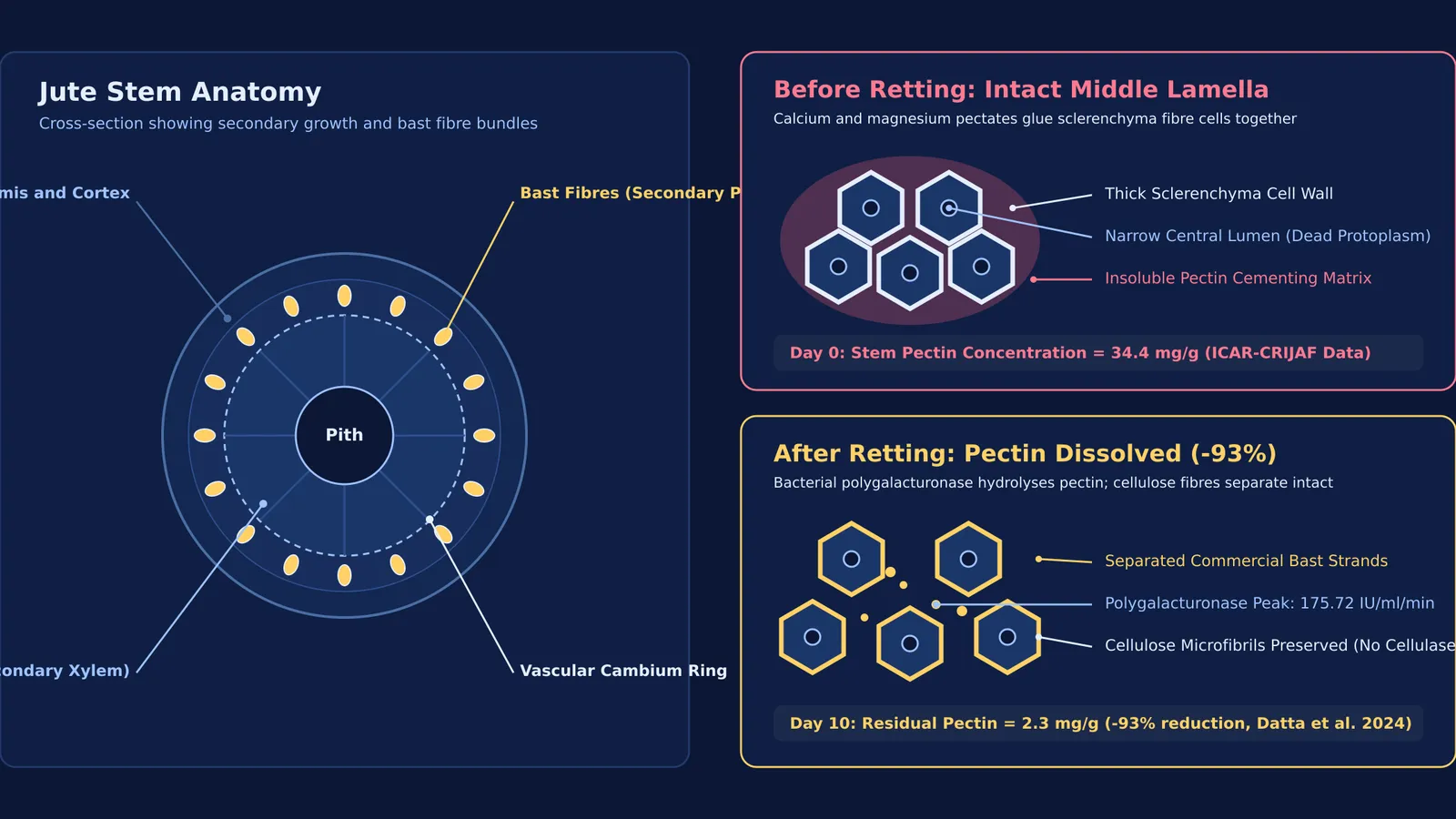
Commercial jute consists of bast fibres located in the secondary phloem, formed as the vascular cambium produces secondary xylem (the woody "jute stick") inward and secondary phloem outward. According to the NCERT Class 11 Biology curriculum, phloem fibres are sclerenchyma cells that lose their protoplasm at functional maturity, becoming dead structural elements with thick lignified walls. Single cells measure 1 to 5 millimetres in length, but overlap longitudinally to form continuous commercial strands 2 to 3.5 metres long.
In the living plant, the middle lamella acts as an intercellular cementing layer composed of calcium and magnesium pectates, complex pectins, and hemicellulose. This matrix glues fibre bundles together and binds them to the inner wood. For students reviewing plant tissues across Class 9 and 11, remembering that jute is secondary phloem sclerenchyma is key: unlike cotton seed hairs, jute fibres are multi-cellular vascular bundles. If you find it challenging to picture how stem tissues develop, the Fermi Concept Library breaks down plant anatomy into visual lessons mapping each cell layer to its developmental origin.
How does the water retting process loosen the fibre?
Because mechanical peeling tears bast strands, farmers rely on water retting: controlled microbial decomposition that dissolves cementing pectins without destroying cellulose. In a study published in BMC Plant Biology (2024) by Subhojit Datta and colleagues at ICAR-CRIJAF, harvesting occurs around 120 days after sowing at the 50% flowering stage, when stems reach 3 to 4 metres before secondary walls become overly lignified. Farmers submerge stalk bundles ("jaks") in fresh water, where inoculated or native *Bacillus* strains (*B. safensis*, *B. velezensis*, and *B. altitudinis*) secrete extracellular pectinases.
Datta et al. found that bacterial polygalacturonase activity surged from 3.08 to 175.72 IU/ml/min, rapidly cleaving the middle lamella's pectic chains. Stem pectin dropped from 34.4 mg/g down to 7.4 mg/g on Day 7 (a 78% reduction) and reached 2.3 mg/g on Day 10—a 93% total drop. Traditional retting without bacterial inoculants follows the same pathway over 18 to 21 days. Because these bacteria lack cellulases, crystalline cellulose walls remain unharmed. Once fibres slip freely from the woody core, workers extract, wash, and sun-dry them. This demonstrates an industrial application of microbial decomposition in ecosystems, where saprophytic enzymes recycle complex carbohydrates.
Why do West Bengal and Assam dominate Indian jute production?
Raw jute cultivation is intensely concentrated in eastern India. According to data from the Press Information Bureau, 82% of India's jute farmers belong to West Bengal, while Assam and Bihar each account for a 9% production share. The Union Cabinet approved a Minimum Support Price of ₹5,650 per quintal for raw jute for the 2025-26 season to support nearly 40 lakh farming families dependent on the crop. This concentration reflects three essential requirements:
Alluvial floodplains renewed by silt: The lower Gangetic delta in West Bengal and the Brahmaputra valley in Assam receive annual river silt deposits during seasonal floods, renewing soil fertility for this nutrient-demanding crop without heavy chemical fertilization.
Tropical warmth and pre-monsoon showers: *Corchorus* requires temperatures between 24 °C and 37 °C and relative humidity above 70%. Pre-monsoon showers (*Kalbaisakhi*) in March and April provide essential germination moisture. Unlike storage forms in stem modifications in angiosperms, the jute stem grows straight and unbranched, maximizing unbroken bast length.
Vast freshwater networks for retting: Traditional retting requires roughly 20 to 25 cubic metres of fresh water per tonne of green stalks, as documented by ICAR-CRIJAF. Extensive rivers, canals, and oxbow lakes (*beels*) across Bengal and Assam provide warm, accessible water directly adjacent to crop fields.
How should students revise bast fibre anatomy for exams?
For board and entrance examinations, questions on plant fibres test cellular origin and retting biochemistry. Use this checklist for quick revision:
Tissue classification: Sclerenchyma bast fibres in the secondary phloem, formed by the vascular cambium.
Cell properties: Narrow lumen, thick cellulose-lignin walls, tapering pointed ends, and dead at maturity.
Target of retting: Pectic polysaccharides in the middle lamella, digested by bacterial pectinases without damaging cellulose.
Harvest timing: Harvesting at early flowering balances maximum stem height with minimal wall lignification.
When practicing questions on stem tissue layers or industrial retting kinetics, the Fermi Problem Library provides step-by-step worked problems that explain the underlying scientific reasoning rather than just printing an answer.


