On this page
Tissues look like a list to memorise, and learned that way the names blur together by exam week. The chapter makes more sense if you learn each tissue by the question it answers: how does a plant grow taller, why does a fresh twig bend, why does your knee stop where it does? This post sets out the chapter that way, works one data question, and ends with a recall routine.
What is in the Class 9 tissues chapter now?
From 2026-27, Class 9 uses NCERT's new science book, Exploration. Chapter 3, "Tissues in Action", covers plant tissues, animal tissues, the musculoskeletal system, types of joints and the skeletal system. CBSE's Class IX Science syllabus for 2026-27 matches this: meristematic and permanent tissues, the four animal tissues, an "elementary idea of musculoskeletal system", and care of that system through posture, nutrition and exercise. The practical list includes identifying parenchyma, collenchyma, sclerenchyma and the three muscle fibres from prepared slides.
Joints and the musculoskeletal system are new compared with the old Class 9 chapter, so do not skip them if you use older notes.
How do plants grow, and which tissues are permanent?
Growth happens in meristems, groups of cells that keep dividing. Their cells are small with thin walls, dense cytoplasm and a large nucleus, and vacuoles are generally absent.
Apical meristem at root and shoot tips: growth in length. In the chapter's onion activity, roots whose tips were cut stopped growing.
Lateral meristem in a ring in the stem: growth in girth.
Intercalary meristem at the base of an internode or just above a node: regrowth after cutting, as in grass.
Cells that stop dividing differentiate into permanent tissues:
Epidermis protects. It is one layer of cells, covered by a waxy cuticle, with stomata in leaves.
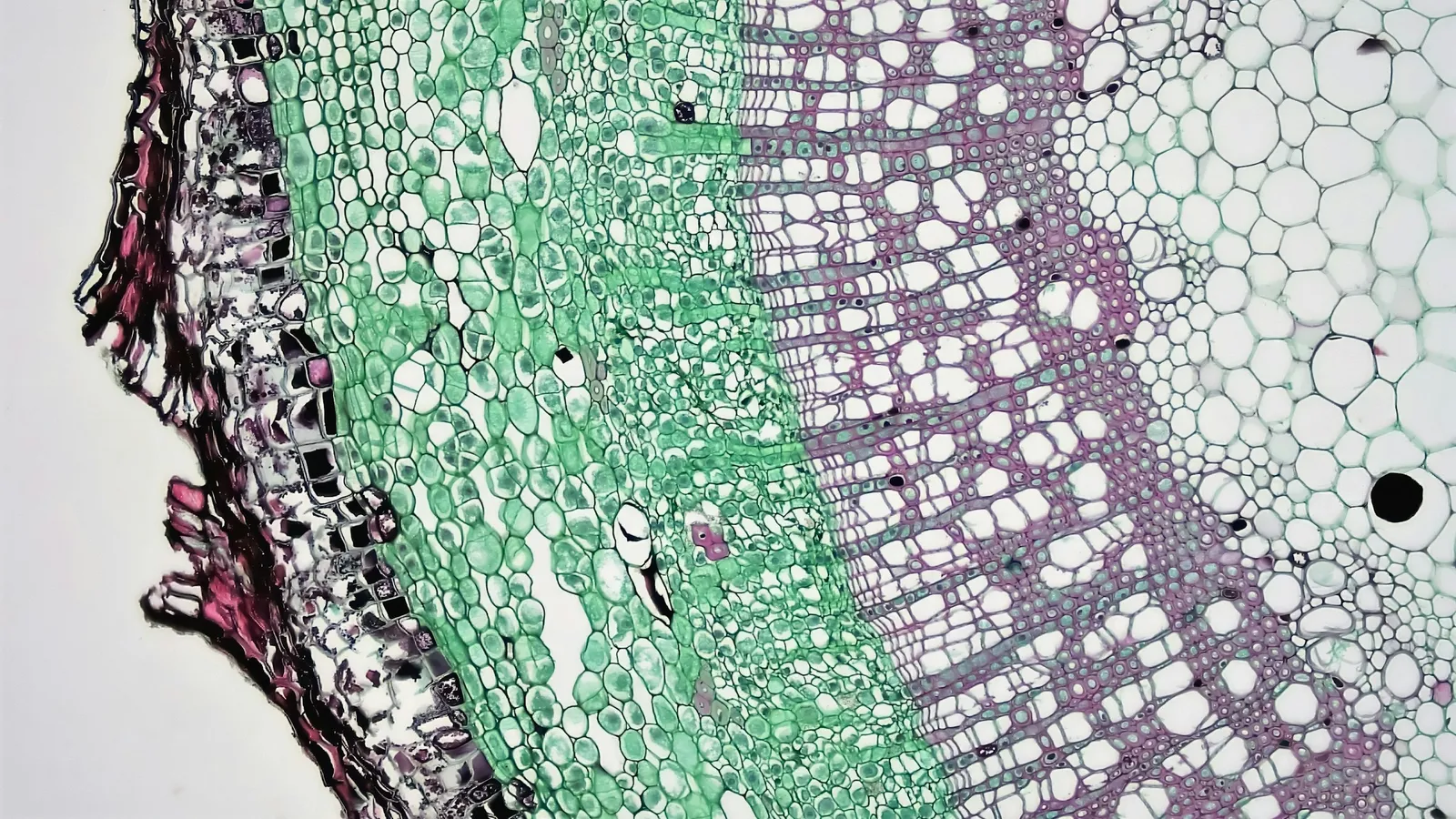
Parenchyma: living, thin-walled, loosely packed; stores food, makes food in green parts and forms air spaces in aquatic plants.
Collenchyma: living cells with corners thickened by pectin; support with flexibility, so stems and tendrils bend.
Sclerenchyma: thick walls of lignin, mostly dead cells; hardness, as in coconut husk.
Xylem (tracheids, vessels, xylem parenchyma, fibres) carries water and minerals; only xylem parenchyma is living. Phloem (sieve tubes, companion cells, phloem parenchyma, fibres) carries food and is mostly living.
What are the four animal tissues?
Epithelial tissue covers the body and lines organs. Its shape matches its job: a single layer of thin, flat cells for quick exchange in lungs and blood vessels, many layers in skin, and tall pillar-like cells for absorption in the small intestine.
Connective tissue joins and supports: blood (fluid matrix), bone (rigid matrix with calcium and phosphorus compounds), cartilage, tendons and ligaments.
Muscular tissue moves the body. Skeletal muscle is long, unbranched, multinucleate and striated, and voluntary. Smooth muscle is spindle-shaped with one nucleus and no striations. Cardiac muscle is branched with one nucleus and faint striations.
Nervous tissue is made of neurons, each with a cell body, dendrites and an axon.
The chapter also names four joints: ball and socket (shoulder), hinge (elbow and knee), pivot (where the skull meets the backbone) and fixed (between skull bones).
A worked data question: tree rings and girth
The chapter gives data for a teak tree. At 10 years its diameter at breast height is 8 cm, at 20 years it is 24 cm, at 30 years it is 32 cm and at 40 years it is 40 cm. The number of annual rings equals the age each time.
Question. How fast did the trunk widen in each decade, and which tissue is responsible?
Years 10 to 20: (24 − 8) ÷ 10 = 1.6 cm per year.
Years 20 to 30: (32 − 24) ÷ 10 = 0.8 cm per year.
Years 30 to 40: (40 − 32) ÷ 10 = 0.8 cm per year.
So girth grew fastest in the second decade, then more slowly and steadily.
The tissue is the lateral meristem, a ring of dividing cells in the stem that adds new cells inwards and outwards. One ring forms each year, which is why ring count matches age.
A good answer names the tissue, says where it is, and uses the numbers.
Which mistakes cost marks in this chapter?
Collenchyma versus sclerenchyma. Pectin, living, flexible, versus lignin, mostly dead, hard.
Calling all of xylem dead. Xylem parenchyma is living.
Muscle features in the wrong column. Make a three-row list of shape, nuclei and striations, and learn it as a set.
Meristem location. Intercalary meristem is near the nodes, not at the tip.
"A tissue does one job." Parenchyma alone stores food, makes food and helps aquatic plants float. The chapter itself asks you to question that statement.
If you get stuck on how structure links to function, the Fermi Concept Library covers every concept in biology and the other sciences, each with its own lesson, so you can revisit one tissue without rereading the whole chapter.
How should you revise tissues?
Test yourself instead of rereading. In Karpicke and Blunt (2011), students who practised retrieving what they had read learned more than students who built concept maps while studying. The advantage held even when the final test asked them to draw a concept map.
A one-week routine:
Day 1: Read the chapter once. Then, on a blank page, draw a tree diagram: plant tissues split into meristematic and permanent, permanent into simple and complex. Fill it in from memory.
Day 3: Make a blank table for the four animal tissues with columns for structure, function and one location. Fill it without notes, then check.
Day 5: Do the teak tree question and two "Revise, Reflect, Refine" questions without looking at the book.
Day 7: Redraw both tables from memory. Anything still missing goes on a card for next week.
If you have not done the chapter before this one, start with our guide to the cell in Class 9. For spacing these sessions out, see our spaced revision schedule.
Today, close your book and write down all the plant tissues you can remember, with one job for each.