On this page
The silk moth has a short life cycle with four clear stages, and one of them makes the thread that ends up in a Kanchipuram or Banarasi sari. Here is each stage, where the silk comes from, and a quick way to check the timings.
What are the four stages of the silkworm life cycle?
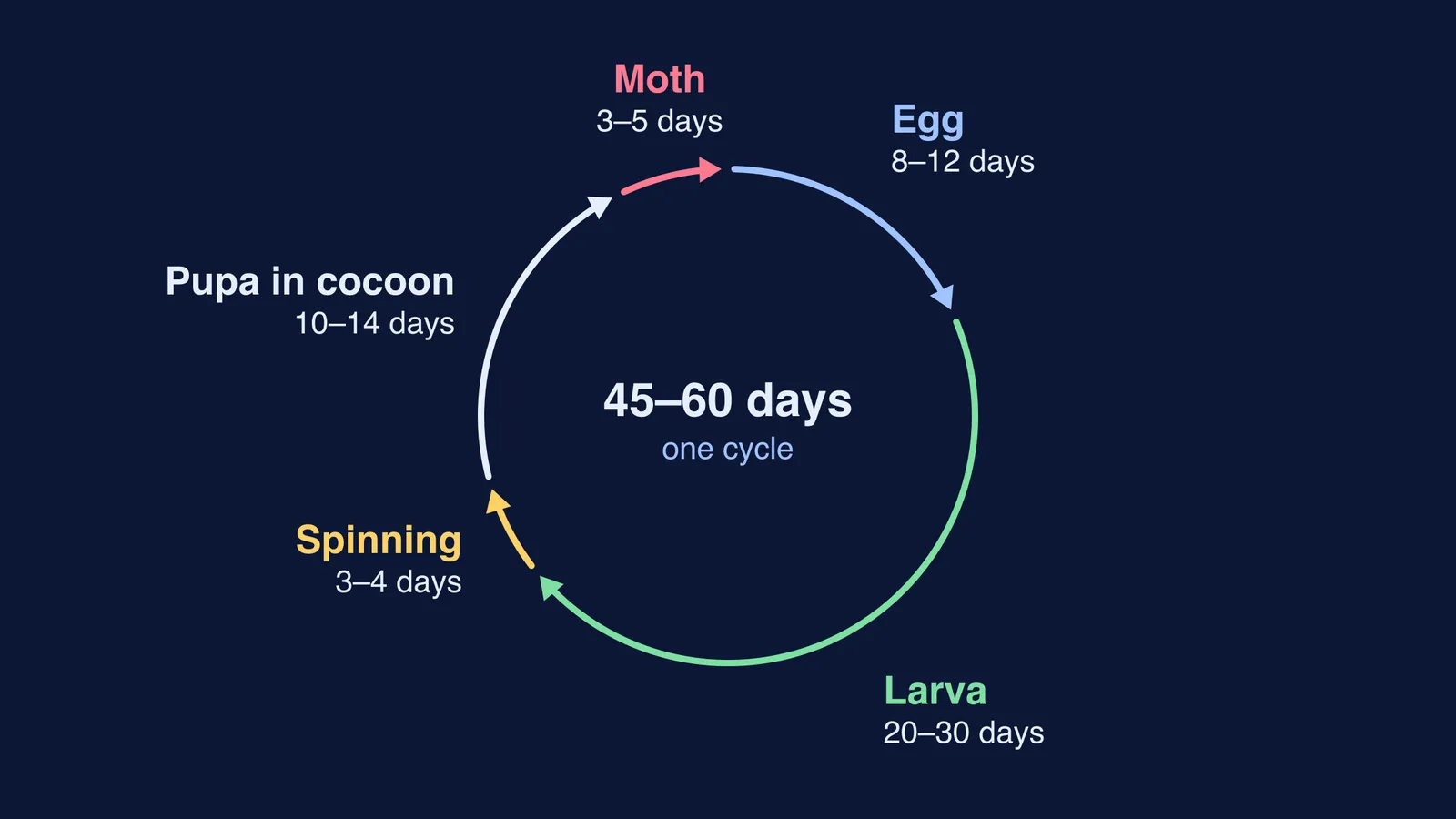
The mulberry silkworm, Bombyx mori, goes through complete metamorphosis: egg, larva, pupa and adult moth, according to lecture notes on mulberry silkworm biology from Shri Guru Ram Rai University. The same notes give these typical ranges, which shift with the silkworm race, temperature and humidity:
Egg: one female lays 400–600 tiny creamy-yellow eggs, which hatch in 8–12 days.
Larva (the silkworm): a white caterpillar that eats only mulberry leaves for 20–30 days, moulting between its 5 instars.
Pupa: the full-grown larva stops eating, spins a cocoon around itself and spends 10–14 days inside, turning into a moth.
Adult moth: a creamy-white moth that cannot fly and lives only 3–5 days. Moths mate soon after emerging, the female lays eggs and dies, and the cycle restarts.
The whole cycle takes about 45–60 days, the notes say.
The mosquito follows the same four-stage plan in water; compare the four stages of a mosquito's life cycle.
Where do silk threads come from?
Silk comes from the larva's own body. A 2024 review of sericin by Rony Aad, Ivana Dragojlov and Simone Vesentini in the Journal of Functional Biomaterials describes the silk gland in three parts: the posterior gland makes fibroin, the middle gland makes sericin, and the anterior part is the duct that carries the liquid out.
Fibroin, the strong core of the thread, makes up 70–75% of silk protein, according to the same review. Sericin, a gum that holds the two fibroin strands together, makes up the other 25–30%. As the larva spins, the sericin turns rigid and glues the cocoon into a hard shell, and the weaving stops after 3–4 days.
While spinning, the larva moves its head in a figure-of-eight pattern, according to the SGRRU notes. One cocoon is wound from a single filament 600–1200 metres long, the notes say.
Why are cocoons boiled before the moth comes out?
The National Innovation Foundation - India notes that cocoons are boiled before the moth can emerge, because a moth sometimes dissolves the silk to get out, and that these "cut or pierced" cocoons, though full of silk, cannot be reeled because the thread is broken on one side.
So silk farmers collect the cocoons and boil them to soften the silk; the threads are pulled out, twisted into yarn and woven into fabric, as a Ministry of Textiles explainer from the Press Information Bureau describes. India is the second-largest producer of silk in the world, and its raw silk production rose from 31,906 tonnes in 2017-18 to 38,913 tonnes in 2023-24, the same document says. Wild silkworms that eat oak, castor and arjun leaves give non-mulberry (vanya) silk.
The adult is a moth, not a butterfly: how to tell a butterfly from a moth lists the features to check, and how cotton fibre grows from the seed gives the plant-fibre comparison.
How long does each stage take? A worked example
Use the middle of each range from the SGRRU notes and the 3–4 day spinning time from the sericin review. Suppose eggs are laid on 1 June.
Egg, about 10 days: the larvae hatch around 11 June.
Larva, about 25 days: feeding ends and spinning begins around 6 July.
Spinning, about 3 days: the cocoon is finished around 9 July.
Pupa, about 12 days: moths emerge around 21 July.
Moth, about 4 days: eggs for the next batch are laid by about 25 July.
That is 54 days, inside the 45–60 day range: a quick check that your stages are in order. It also shows when farmers must act: the cocoons are boiled in the pupa window, before 21 July here. Real batches vary with temperature, so treat these dates as estimates. The diagram at the top draws the same five arcs to scale.
How do you write a silkworm life cycle answer in an exam?
Use this checklist:
Draw a loop with arrows: egg, larva, pupa in cocoon, moth, back to egg.
Name the food: mulberry leaves.
Say the larva is the silkworm, and that the larva, not the moth, spins the silk.
Say the cocoon is boiled before the moth emerges, and why.
In higher classes, name the two proteins: fibroin (the core) and sericin (the gum).
If a word like instar, metamorphosis or fibroin still feels fuzzy, the Fermi Concept Library gives every biology concept its own lesson and its place in the map. To test yourself, Fermi's AI tutor decides whether to explain, ask or show, and checks understanding as it goes.
Tonight, draw the cycle from memory, add the day ranges, and check it against the list above.