On this page
Butterflies and moths both belong to the insect order Lepidoptera. A 2019 study in PNAS put the order at nearly 160,000 described species. The Australian Museum says that in Australia, moths make up over 95% of the order's species diversity. So when you meet an unknown one on a balcony in Pune or in a CBSE practical, the odds favour "moth". Four quick checks let you do better than guess.
What is the main difference between a butterfly and a moth?
Look at the antennae first. According to the Australian Museum, butterflies and skippers have a thickened club or hook at the tip of each antenna, while moths have simple thread-like or feathery antennae without a club.
The same museum page lists the other differences you will be asked about:
Activity: butterflies and skippers fly during the day; moths fly at night.
Wings at rest: butterflies hold their wings together above the body; moths hold them flat.
Wing coupling: in moths a bristle-like structure called a frenulum links the wings together; butterflies have no frenulum.
Pupa: a butterfly pupa (a chrysalis) is not in a cocoon; moth pupae spin one.
Colour: moths tend to be duller, butterflies brighter. Many moths are brilliantly coloured, so this is the weakest clue.
Why are there so many exceptions?
Butterflies are not a separate branch from moths. The Australian Museum calls butterflies and skippers "groups of specialised moths", so every rule above describes a trend, not a law. The same page gives the exceptions:
Several moth families have clubbed antennae, most notably the sun moths (Castniidae).
Many moths fly by day, and a few butterflies and skippers are active at dusk.
Many moths, including geometrid moths, rest with their wings held up, like a butterfly.
Many moths spin no cocoon, and many butterflies and skippers make a silken shelter.
Australia's Regent Skipper is the only skipper in the world with a frenulum.
Evolution helps explain the day-and-night split. A study of 2,098 genes from 186 species, with Akito Kawahara as first author and published in PNAS in 2019, found that the ancestor of butterflies was likely nocturnal. The authors estimate that butterflies became day-flying in the Late Cretaceous, about 98 million years ago. A day-flying moth is not breaking a rule. It is a reminder that "butterfly" is one twig on the moth tree. If you want the bigger picture of where this order sits, our post on why Arthropoda is the largest animal phylum covers it.
Chrysalis or cocoon: what is the difference?
Both are the pupa stage of complete metamorphosis (egg, larva, pupa, adult). The difference is the wrapping. A butterfly chrysalis is the pupa itself, with its hardened skin exposed. A cocoon is a silk case that a moth caterpillar spins around itself before it pupates.
India's silk industry runs on this. The domestic silk moth, Bombyx mori, encloses itself in a cocoon made of a thread of raw silk from 300 to about 900 metres long. That is why the silk we use comes from a moth caterpillar, the "silkworm", rather than from a butterfly. For the scientist who first drew these stages from life, read our profile of Maria Sibylla Merian and metamorphosis.
How do you tell a butterfly from a moth in a photo?
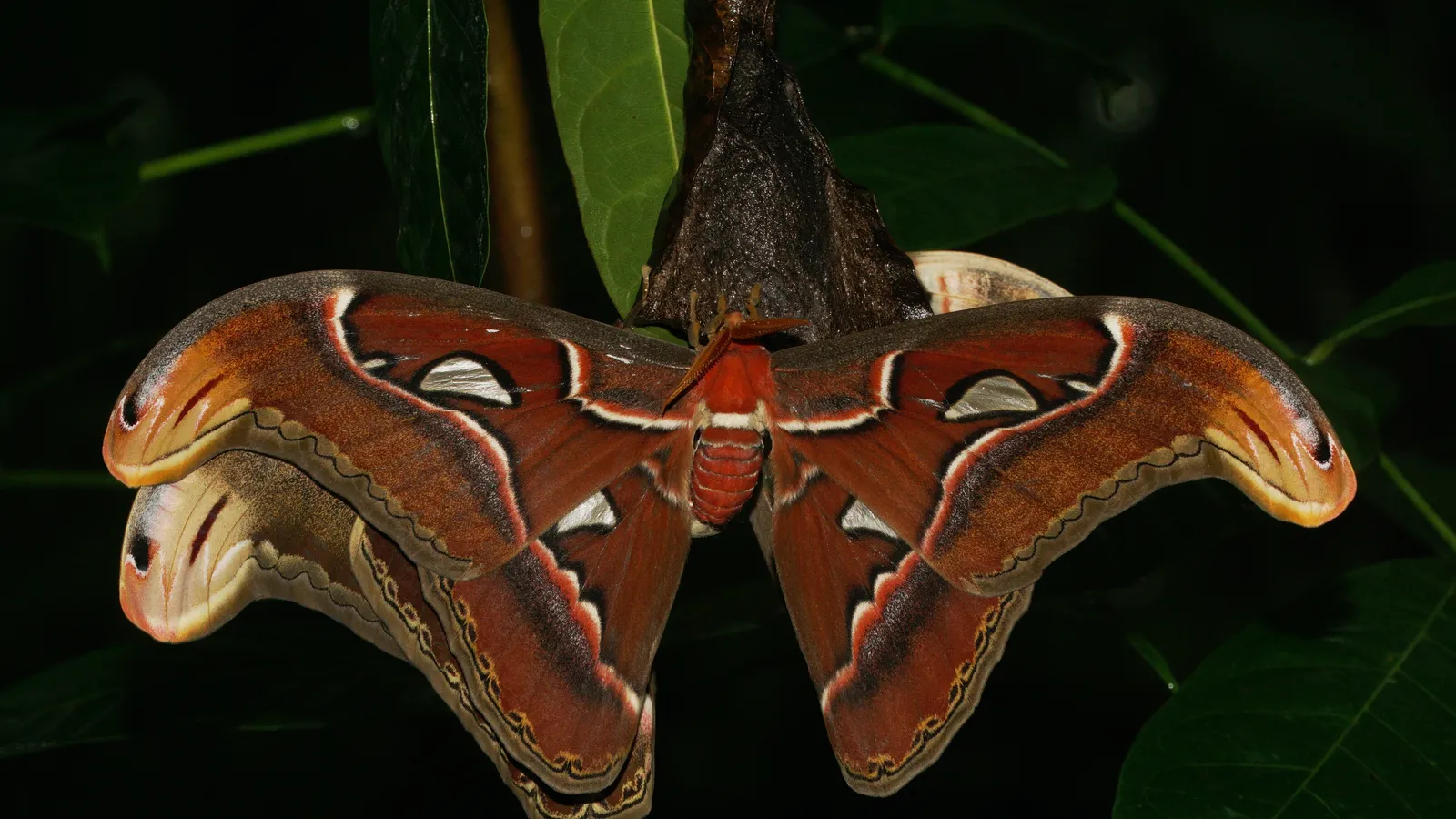
Take the hero photo above. It was taken in Kerala and shows a large reddish-brown insect hanging below a dark, papery case.
Antennae: short and comb-like, with no club. Points to moth.
Timing: a single photo cannot tell you. Skip this check rather than guess.
Wings at rest: spread flat, not folded upright. Points to moth.
Pupa: the papery case above it is a cocoon spun with silk. Points to moth.
All three usable checks agree, so the answer is a moth. Its Commons record names it Attacus taprobanis, a close relative of the atlas moth, native to southern India and Sri Lanka. When the checks disagree, rely on the antennae more than colour, and say in your answer that exceptions exist.
How should you write this in an exam?
For a 3-mark "distinguish between" question, use matching pairs, one line each:
Butterfly: clubbed antennae. Moth: feathery or thread-like antennae, no club.
Butterfly: diurnal. Moth: mostly nocturnal.
Butterfly: wings held together above the body at rest. Moth: wings held flat.
Butterfly: chrysalis with no cocoon. Moth: pupa usually inside a silk cocoon.
Keep both columns on the same feature in each line; a mixed pair such as "butterflies are colourful, moths have cocoons" does not compare anything. If a question moves on to why birds avoid some butterflies, that is a different idea, explained in our post on why monarch butterflies are distasteful to predators.
If metamorphosis, pupation or insect body plans still feel shaky, the Fermi Concept Library has a lesson for every concept in biology and shows where each one sits in the map, so you can fill the gap before you revise the comparison.