

On this page
Why are monarch butterflies distasteful to predators?
The bright orange, black, and white pattern of the adult monarch butterfly (*Danaus plexippus*) signals danger to insectivorous birds. In landmark feeding experiments published in Science, Lincoln Brower and his colleagues demonstrated that the monarch's foul taste and physiological toxicity stem directly from what it eats as a larva. Monarch caterpillars feed almost exclusively on milkweed plants (such as *Asclepias curassavica* and *Calotropis* species), which produce secondary plant metabolites known as cardenolides, or cardiac glycosides.
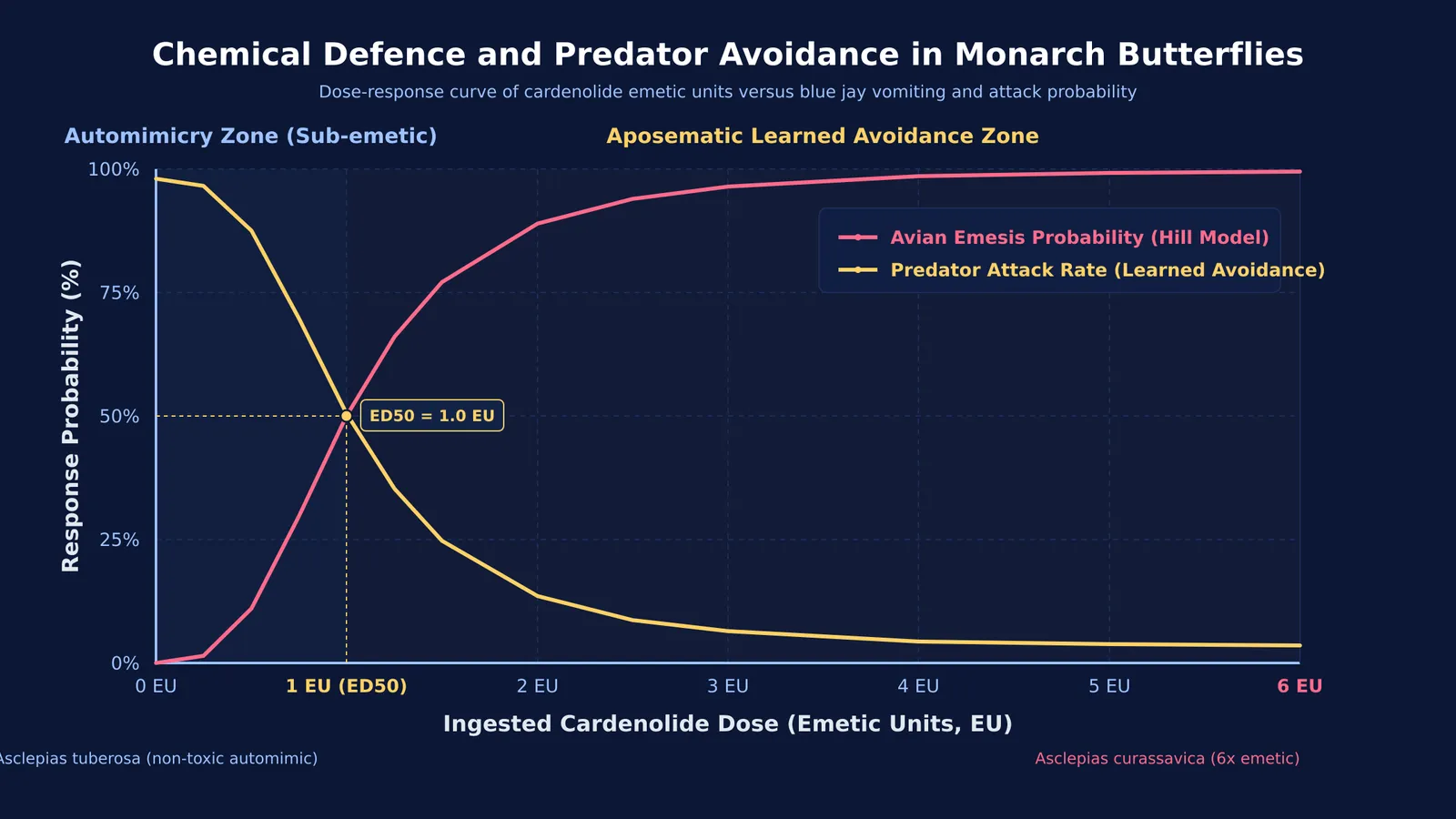
Instead of breaking down or excreting these poisons, monarch larvae sequester them into their own tissues. The cardenolides persist through pupation and remain concentrated in the wings and abdominal cuticles of the adult butterfly. When an inexperienced predator such as a blue jay (*Cyanocitta cristata*) attacks and eats a toxic monarch, the ingested cardenolides induce severe retching and emesis within 15 minutes, according to Brower's findings in Science. Brower discovered that monarchs reared on *Asclepias curassavica* were 6 times as emetic as those reared on less potent species, defining an "emetic unit" as the dose required to trigger vomiting in 50% of tested birds. After a single emetic episode, the bird forms an immediate, long-lasting aversion, refusing to touch monarchs on sight.
How do caterpillars tolerate lethal cardiac glycosides?
In vertebrates and most insects, cardiac glycosides are lethal because they bind to and inhibit the sodium-potassium pump (Na⁺/K⁺-ATPase), an essential membrane enzyme that maintains cellular ion gradients across nerves and muscles. A study in Nature by Marianthi Karageorgi and colleagues revealed that monarchs evolved insensitivity to these toxins through 3 specific amino acid substitutions in the alpha subunit of their sodium pump. By reconstructing the evolutionary history using CRISPR gene editing, the team showed that these mutations altered the toxin-binding pocket without disabling essential ion transport.
Because their own sodium pumps are genetically protected, monarch caterpillars can store high concentrations of cardenolides in their fat bodies and integument. Interestingly, not all milkweed plants possess identical chemical profiles. Monarchs that happen to feed on cardenolide-free species, such as *Asclepias tuberosa*, develop into completely edible adults. Yet these non-toxic individuals survive because predators cannot distinguish them visually from toxic peers, an evolutionary phenomenon known as automimicry.
For students exploring ecological adaptations, understanding how molecular changes drive whole-organism interactions is a recurring theme. The Fermi Concept Library covers every concept in physics, chemistry, biology, mathematics and computing, each with its own lesson and its place in the map.
Camouflage or warning colour: which defence works best?
Prey organisms face an evolutionary dilemma: is it better to hide from predators or to warn them away? While the monarch relies on aposematism—conspicuous warning signals paired with chemical unprofitability—many palatable insects rely instead on crypsis, or camouflage.
According to an analysis of protective colouration in the Proceedings of the Royal Society B by Martin Stevens, the two strategies exploit different stages of predator perception:
Camouflage operates before detection: cryptic prey match their background colour, disrupt body contours, or mimic inedible objects (like bird droppings or dry twigs) to reduce the likelihood that a hunting predator detects them at all.
Aposematism operates after detection: warning colouration makes no attempt to hide; instead, high-contrast colours and bold geometries accelerate predator learning, ensuring that any sampling predator quickly identifies the prey as unpalatable and aborts future attacks.
The evolutionary trade-offs are pronounced. Cryptic animals must remain motionless on matching backgrounds, restricting their feeding times and foraging range. Aposematic animals, backed by sequestered plant toxins, can forage and fly openly during broad daylight. Furthermore, conspicuous patterns can drive the evolution of mimicry complexes. In Nature, David Ritland and Lincoln Brower demonstrated that the viceroy butterfly (*Limenitis archippus*), long assumed to be a harmless imposter, is itself unpalatable to birds, making it a Müllerian co-mimic of the monarch. To explore how mimicry patterns spread through natural selection, see our history of Henry Walter Bates and the butterflies that copy others.
How can you analyse anti-predator adaptations in four steps?
When evaluating predator-prey adaptations in exam questions or field biology, students often confuse defensive mechanisms. Use this diagnostic sequence to classify any defensive trait:
Identify the perceptual stage: Does the trait act before detection (primary defense, like background matching in peppered moths) or after detection (secondary defense, like chemical spray)?
Determine profitability: Does the prey possess authentic chemical, mechanical, or physical unprofitability (cardenolides, spines) or is it completely edible?
Check signal honesty: If conspicuous, is the signal honest (aposematism), parasitic (Batesian mimicry, where an edible mimic copies a toxic model), or mutualistic (Müllerian mimicry, where multiple toxic species share a warning pattern)?
Trace dietary origin: Is the chemical defense synthesised de novo or sequestered from host plants (like monarch cardenolides from milkweed)?
Practising these distinctions helps prevent common traps on competitive tests. You can review how natural selection shapes evolutionary pressures in our guide to evolution for NEET and our breakdown of stabilising, directional and disruptive selection. If you need help untangling multi-step biology problems, the Fermi Problem Library offers worked problems with a step-by-step solver that explains the reasoning rather than printing an answer.


