On this page
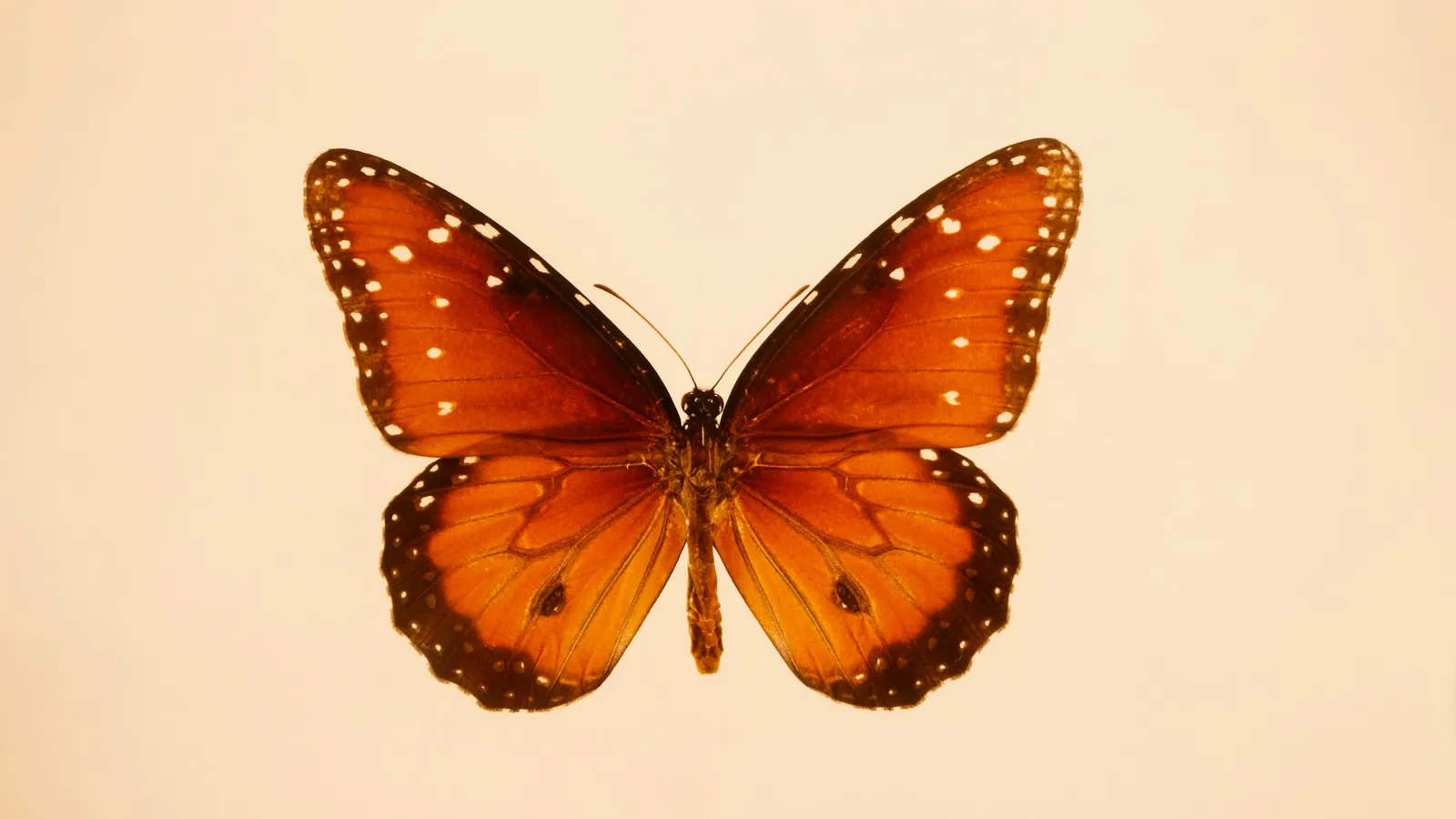
Some butterflies in the Amazon forest look almost exactly like butterflies from a completely different family. Henry Walter Bates noticed this while collecting there in the 1850s, and in 1861 he gave one of the first clear explanations of it using Darwin's new theory. This post covers who he was, what he saw, how his argument works, a simple model of the selection involved, and what students can learn from how he worked.
Who was Henry Walter Bates?
The Dictionary of National Biography (1901) says he was born in Leicester on 8 February 1825, the son of a small hosiery manufacturer. He was apprenticed to a hosier at 13, sweeping the warehouse before work, and educated himself at the town's Mechanics' Institute. He collected insects in Charnwood Forest and published his first short paper in 1843.
In Leicester he met Alfred Russel Wallace. The two sailed from Liverpool on 26 April 1848 and reached Pará (now Belém) on 27 May. They split up in March 1850 to collect separately. Bates stayed until 1859, spending long periods at Ega, about 1,400 miles up the river, where the DNB says he found 550 distinct species of butterflies. He later became assistant secretary of the Royal Geographical Society, was elected a Fellow of the Royal Society in 1881, and died on 16 February 1892.
How much did he collect?
His book The Naturalist on the River Amazons appeared in 1863. Darwin's 1863 appreciation of it in the Natural History Review, reprinted at the front of the 1910 edition on Project Gutenberg, says the collections contained "no less than 14,712 species", "of which about 8000 were previously unknown to science", and about 14,000 of them insects. In the book Bates wrote of butterfly wings that "Nature writes, as on a tablet, the story of the modifications of species".
What did he notice about the butterflies?
Bates's paper, Contributions to an Insect Fauna of the Amazon Valley. Lepidoptera: Heliconidae, was read to the Linnean Society on 21 November 1861 and printed in its Transactions in 1862. The scanned paper shows the key observations.
The Heliconid butterflies, including Ithomia, were abundant and slow-flying. He never saw their flocks chased by birds or dragonflies, though they would have been easy prey, and he judged it "probable" that they were unpalatable to insect enemies. They had a peculiar smell, and their dead specimens were less often eaten by pests.
Leptalis, a genus from a different family, was rare. Most Leptalis look nothing like Ithomia, but some forms copied the local Ithomia closely, and the copy changed from district to district as the local Ithomia changed.
How did he explain it?
Bates argued that the copies could not come from the direct action of climate, because very different varieties lived together within a mile of each other in the same forest. Nor could each copy appear in one jump. His conclusion: "This principle can be no other than natural selection, the selecting agents being insectivorous animals, which gradually destroy those sports or varieties that are not sufficiently like Ithomiae to deceive them."
The DNB records Darwin's response to the paper: "one of the most remarkable and admirable papers I ever read in my life." Today a harmless species resembling a protected one is called a Batesian mimic. For how this fits into the theory Darwin and Wallace announced in 1858, see our post on Darwin, Wallace and natural selection.
Worked example: how fast could selection build a mimic?
Bates gave no numbers for survival, so here is a model with sample numbers to show how his "gradual" selection works.
Start. In a Leptalis population, 10% are good copies of the local Ithomia and 90% are poor copies.
Survival. Suppose birds let 90% of good copies survive to breed, but only 60% of poor copies.
One generation. Good: 0.10 × 0.9 = 0.090. Poor: 0.90 × 0.6 = 0.540. New share of good copies = 0.090 / (0.090 + 0.540) = 0.143, or 14.3%.
The shortcut. The ratio good:poor is multiplied by 0.9/0.6 = 1.5 each generation. It starts at 0.10/0.90 = 0.111. After 5 generations it is 0.111 × 1.5⁵ = 0.844, so good copies make up 0.844 / 1.844 = 46%. After 10 generations they are about 86%.
Even a modest survival edge, repeated every generation, changes a population quickly. Common mistake: thinking the butterflies "try" to look like Ithomia. In Bates's argument, variation happens anyway, and predators remove the poor copies.
For NEET, natural selection and adaptation are core ideas; our guide to evolution for NEET covers the syllabus side.
If you want to check each step of a calculation like this one, the Fermi Problem Library has worked problems with a step-by-step solver that explains the reasoning.
What can a student take from how he worked?
Stay long enough to see patterns. Eleven years let him compare the same species across many districts.
Watch what predators do. His case rested on what birds, lizards and flies did and did not attack.
Rule out the alternatives. He showed why climate and single jumps could not explain the copies before he argued for selection.
Background is not destiny. A hosier's apprentice who studied at night became a Fellow of the Royal Society.
Next step: redo the model with survival of 0.8 and 0.7 and find how many generations it takes for good copies to pass 50%.