

On this page
For centuries, many people believed that insects were born of mud through spontaneous generation. The careful work of Maria Sibylla Merian (1647–1717), a German-Dutch naturalist and scientific illustrator, helped overturn this idea (Wikipedia). In 1699, she travelled to Dutch Guiana to observe tropical insects in their natural habitats. Her field studies culminated in her 1705 book, *Metamorphosis insectorum Surinamensium*, which established that insects have distinct and predictable life cycles.
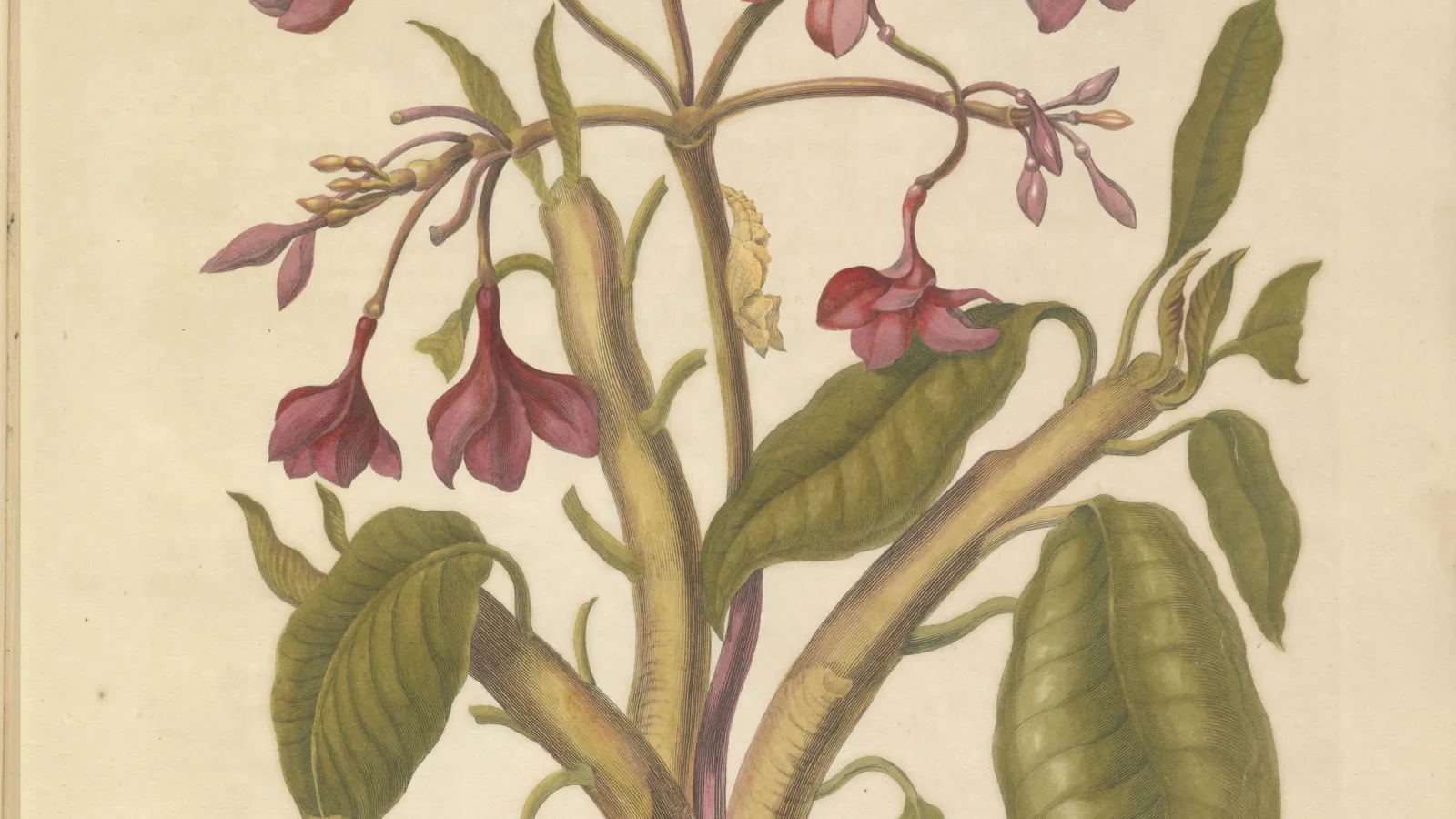
Merian's approach was unusual for her time because she did not study insects in isolation. Instead, she documented the entire process of metamorphosis—from egg to larva to pupa and finally to adult—while also drawing the specific plant hosts that each insect relied upon. By illustrating the insect life cycle directly on the host plant, Merian provided early evidence of ecological relationships. This focus on how organisms interact with their environment paved the way for later naturalists, much like Christian Konrad Sprengel and how flowers recruit insects or John Ray's seed test: an early definition of species.
What did Maria Sibylla Merian discover about insect metamorphosis in Surinam?
Before her expedition, Merian had already spent decades observing European insects. She documented the metamorphosis and plant hosts of 186 European insect species (Wikipedia). She began by raising silkworms at age 13, and later published a two-volume series on caterpillars featuring 50 engraved plates in each volume. Her early work focused on raising live specimens, allowing her to capture accurate behaviours that were lost in the dried collections favoured by other naturalists.
Her journey to Surinam allowed her to apply this rigorous observation to unfamiliar tropical species. The trip was self-funded, a rare achievement for a scientific expedition at the time. To raise the necessary capital, she sold 255 of her own paintings. Once in South America, she travelled into the interior, often assisted by local people who helped her find specimens and shared their knowledge of the tropical plants.
Her resulting 1705 book contained 60 detailed plates that she engraved and etched herself. Her detailed documentation dispelled the notion of spontaneous generation for insects, a concept that was also being challenged in other areas, such as by Francesco Redi and the covered jars of rotting meat. Merian proved that caterpillars do not simply appear; they hatch from eggs laid by adult butterflies or moths, feed on specific plants, and undergo a predictable physical transformation.
How did her work influence the classification of species?
Merian was one of the first naturalists to observe insects directly and empirically, rather than relying on preserved specimens or ancient texts. By conducting experiments, she demonstrated that certain caterpillars would only feed on specific plants and would die if those plants were unavailable. This insight was foundational for the field of ecology.
Her careful records also provided a baseline for later taxonomists. Decades after her death, Carl Linnaeus used her detailed illustrations to identify and name nearly 100 new species, including 56 animals and 39 plants (Wikipedia). Her work predated the famous expeditions of later explorers by a century, establishing her as a foundational figure in entomology.
Why does studying the whole biological system matter for students?
Merian’s success came from observing the whole system rather than isolating a single variable. When students learn biology by memorising disconnected facts—such as a list of insect parts or a series of terms—they often struggle to remember them. Learning how the parts interact, such as why a specific caterpillar requires a specific leaf to survive, makes the information stick.
If you find it difficult to picture how biological systems interact, Fermi's AI tutor can help. The tutor works out what you already know and builds a plan for the session, teaching through the material by drawing figures and checking your understanding as it goes.
For ideas that are hard to visualise from text alone, the Fermi Simulation Lab offers interactive simulations for the ideas that are easier to see than to read. Additionally, the Fermi Concept Library contains every concept in biology, each with its own lesson and its place in the map, so you can see the broader ecological picture just as Merian did.


