

On this page
Tiny moving specks in a balcony bucket are often a mosquito life cycle in progress. Mosquitoes change through four stages, and three of those stages happen in water. That one fact explains both the exam answer and the monsoon chores.
What are the four stages of a mosquito's life cycle?
The CDC's Anopheles life-cycle fact sheet and India's NCVBDC handbook on dengue in schools describe the same four stages:
Egg. Laid on or just above water. Anopheles females lay 50–200 eggs at a time, one by one, and the eggs float on the surface.
Larva. Hatches from the egg, lives in water and feeds. Larvae shed their skin (moult) four times before becoming pupae.
Pupa. Lives in water but does not eat, because it has no external mouthparts.
Adult. Emerges from the pupa and flies away. Females need blood to produce eggs.
How long does each stage take?
For Aedes, the mosquito that spreads dengue, the NCVBDC handbook gives these timings: the egg hatches in 2–3 days, the four larval stages last 4–5 days, and the pupa becomes an adult in about 1–2 days. The same handbook says the whole cycle from egg to adult can take 7–8 days, and that adults live around three weeks.
The CDC says a Culex egg takes 7–10 days to become an adult, and its Anopheles fact sheet says this usually takes 10–14 days.
What are wrigglers and tumblers?
Larvae are commonly called “wigglers” or “wrigglers”; they live in water and breathe air from the surface, according to the Alameda County Mosquito Abatement District. Most larvae breathe through a siphon tube, but Anopheles larvae have no siphon, so they lie parallel to the water surface. The CDC fact sheet adds that Anopheles larvae breathe through spiracles on the abdomen. For the wider picture, see how insects breathe through spiracles and tracheae.
Pupae are commonly called “tumblers”. The same district explains that a pupa takes in oxygen through two breathing tubes called “trumpets”, does not feed, and takes about two days to become a fully developed adult. The NCVBDC handbook notes that the pupa, though it does not feed, actively swims and floats.
Why does stagnant water matter for mosquito breeding?
Because the egg, larva and pupa all need water, any container of still water can become a nursery.
The CDC says Aedes females lay eggs on the inner walls of containers just above the waterline, and these eggs can survive drying out for up to 8 months. When rain or a refill covers them, larvae hatch. So a dry bucket is not always a clean one: eggs may still be stuck to its side.
The NCVBDC handbook lists the everyday places where Aedes breeds: water coolers, drums, tanks, discarded cups and bottles, flower vases, earthen pots, plant trays, coconut shells and old tyres. It also gives the reason for a weekly routine: Aedes completes its life cycle from egg to adult in one week, “so the weekly monitoring of premises is needed”.
Anopheles, the malaria mosquito, prefers marshy areas and the banks of shallow creeks and streams, and its eggs do not tolerate drying out, according to the CDC fact sheet above. For the history of how Anopheles was linked to malaria, read about Giovanni Battista Grassi and the mosquitoes that carry malaria.
Worked example: why a weekly dry day works
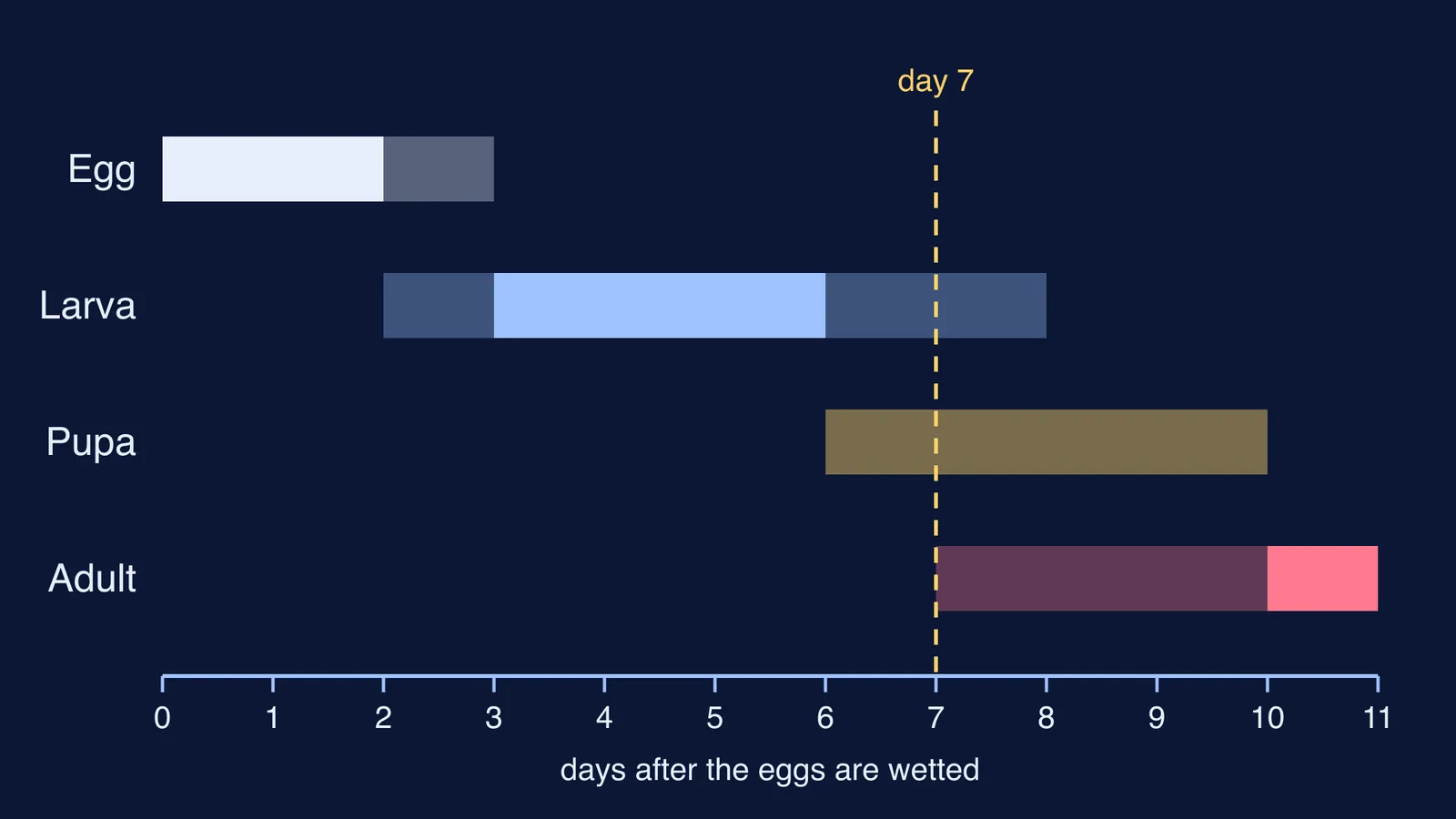
Use the Aedes timings from the NCVBDC handbook. Suppose eggs on the inside wall of your cooler get wet on a Sunday (day 0).
Day 2–3: the eggs hatch into wrigglers.
Day 6–8: the larvae turn into tumblers.
Day 7 at the earliest: the first adults can fly out (2 + 4 + 1 days, the shortest time for each stage).
Empty the cooler before day 7 and the larvae and pupae inside go down the drain. Scrub too, because eggs glued above the waterline survive a simple tip-out.
A weekly checklist from the handbook's do's and don'ts, done on one fixed day:
Coolers: empty, scrub the inside walls, dry, then refill.
Flower vases, plant pots and bird baths: change the water.
Tanks and drums: check that lids fit tightly.
Roof and balcony: get rid of tyres, coconut shells, cups and bottles that hold rain.
Going away? Cover the toilet seat.
The handbook asks that children do these checks under adult supervision.
How do you remember the mosquito life cycle for exams?
Learn the sequence with its nicknames: egg, wriggler, tumbler, adult. Then attach one fact to each: eggs on water, larvae feed and moult four times, pupae breathe through trumpets and do not eat, adult females need blood to make eggs. When you draw the cycle, put the first three stages below a water line and the adult above it.
If complete metamorphosis still feels shaky, the Fermi Concept Library gives each biology concept its own lesson and its place in the map, so you can close the gap before your next test. For the household side, see how liquid mosquito vaporisers work.


