

On this page
By the late 1890s, scientists knew that malaria was caused by a parasite in the blood. In 1897, Ronald Ross demonstrated in India that mosquitoes transmitted malaria in birds. But the exact vector for human malaria remained an unsolved mystery. Giovanni Battista Grassi, a distinguished Italian zoologist and physician, took up the puzzle.
Which mosquito carries human malaria?
Grassi suspected that a specific type of mosquito was responsible, rather than just any biting insect. He systematically mapped the distribution of different mosquito species across Italy, comparing them against areas with high malaria rates. He noticed a clear pattern: human malaria only occurred in regions where the *Anopheles* mosquito lived.
To prove his theory definitively, Grassi teamed up with physicians Amico Bignami and Giuseppe Bastianelli at the Santo Spirito Hospital in Rome. They needed to show that a mosquito could carry the parasite from a sick person to a completely healthy one.
How was the human malaria cycle proved?
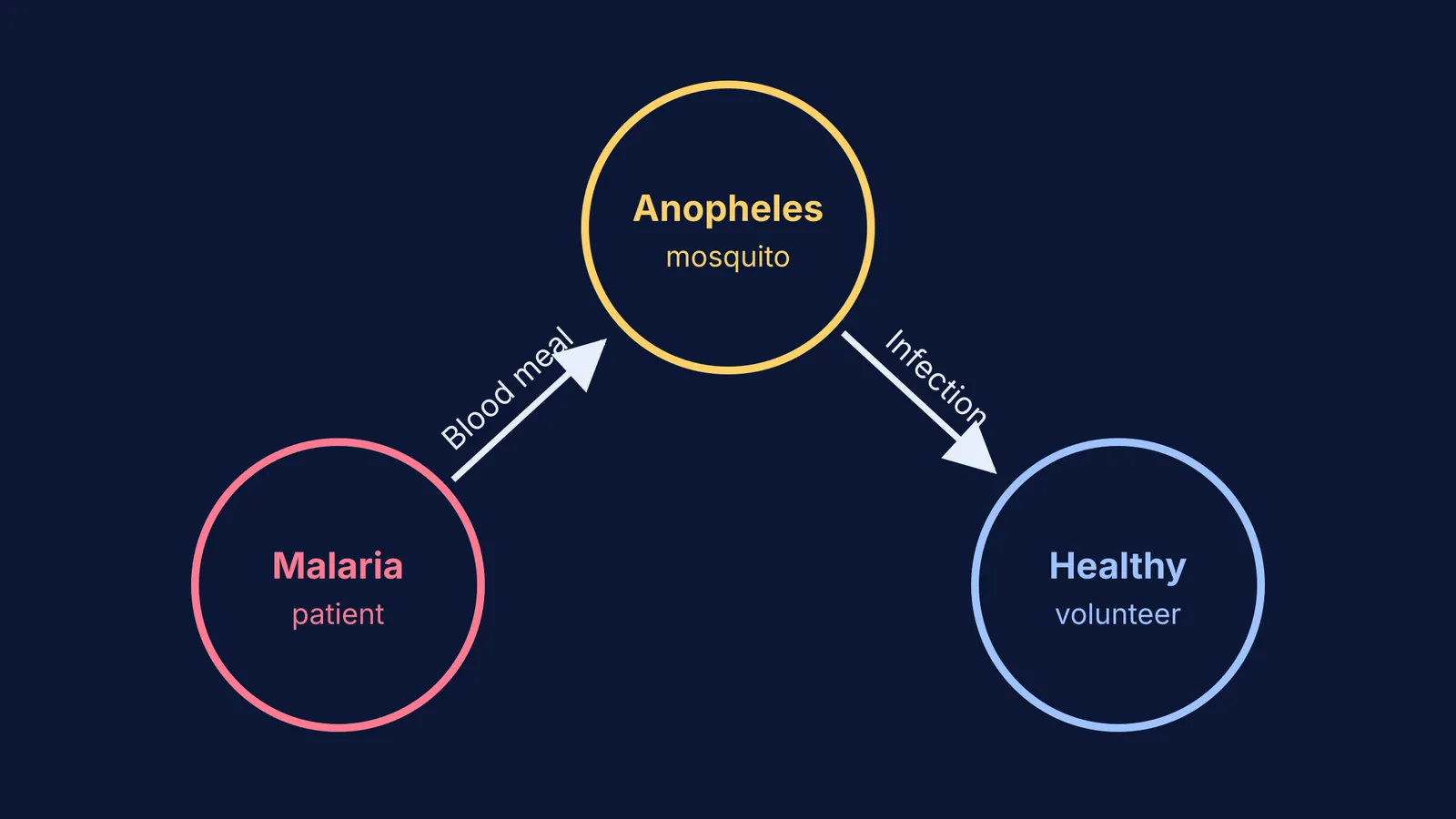
In late 1898, the team conducted a rigorous test. Their volunteer was Abele Sola, a patient who had been at the hospital for 6 years for a nervous disorder, according to Capanna's 2006 historical review. Sola had no history of malaria, and the hospital was located in a part of Rome completely free of the disease.
The researchers brought in *Anopheles* mosquitoes (then classified as *Anopheles claviger*) that had fed on patients actively infected with malaria. They released the insects into Sola's room every night for 10 nights. After ten nights of being bitten, Sola developed a high fever and chills. A blood test confirmed he had contracted *Plasmodium falciparum*, proving beyond doubt that *Anopheles* mosquitoes transmit the disease to humans.
This groundbreaking finding led to what became known as Grassi's Law: an infected human plus *Anopheles* mosquitoes equals malaria. The discovery firmly established the mosquito-malaria theory for human populations.
Why do some Anopheles mosquitoes not cause malaria?
Grassi soon noticed a strange pattern during his field research: some areas of Italy were swarming with *Anopheles* mosquitoes, yet the local people did not suffer from malaria. This paradox was widely called "anophelism without malaria", as outlined in a history of malaria in Italy.
Grassi hypothesised that the mosquitoes in these areas belonged to different "races" that looked identical under the microscope but had very different feeding habits. He was entirely right. Decades later, scientists proved that the *Anopheles maculipennis* group is actually a complex of several different species. Some strongly prefer to feed on animals (zoophilic), while others have a strict preference for humans (anthropophilic). In regions where the zoophilic mosquitoes lived, human malaria was naturally rare.
Today, the World Health Organization notes that malaria mostly spreads to people through the bites of infected female *Anopheles* mosquitoes (WHO).
How to study the malaria life cycle for NEET-UG?
The transmission of the malaria parasite is a central topic in school biology and the NEET-UG syllabus. Tracing the parasite's journey from the mosquito's salivary glands into the human liver, and then into the red blood cells, requires keeping multiple steps and forms straight.
Instead of just reading a textbook, you can use the Fermi Concept Library to explore every concept in biology, each with its own lesson and its place in the map. If you are practising past exam questions and make a mistake on the *Plasmodium* life cycle, the Fermi Problem Library has worked problems with a step-by-step solver that explains the reasoning rather than printing an answer.


