

On this page
An insect has no lungs. It breathes through small holes in its sides and a network of air pipes that reaches almost every cell. For Class 11 biology or NEET-UG revision, this is where the rule "blood carries oxygen" breaks down.
How do insects breathe through spiracles?
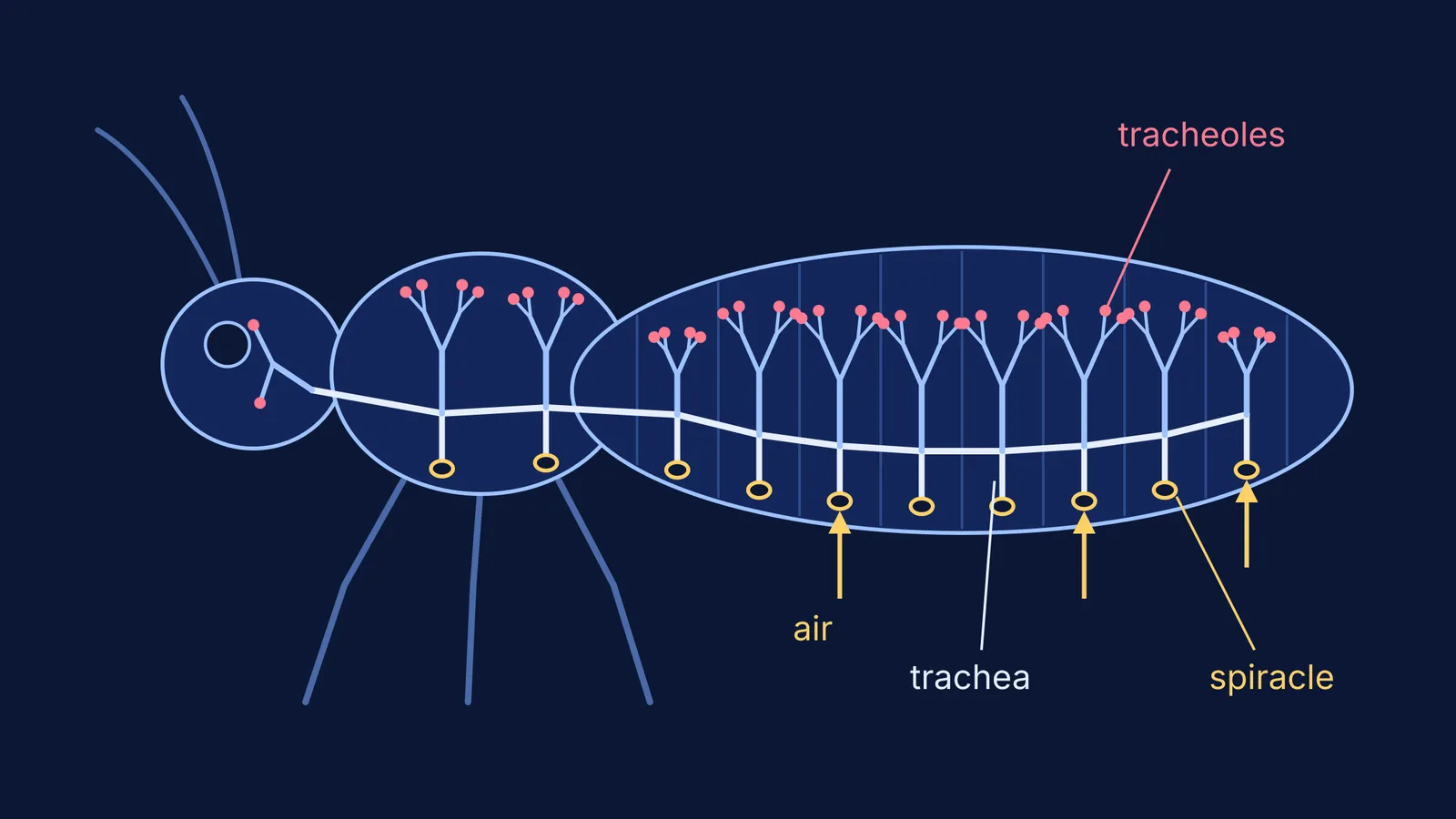
Spiracles are the openings in an insect's body wall where air enters the breathing system. According to the University of California, Riverside insect respiration notes, insects have at most two pairs of spiracles on the thorax and eight pairs on the abdomen, and each has a closing apparatus of valves, often cuticle plates worked by muscles.
Kimball's Biology Pages describes spiracles as guarded by valves controlled by muscles, with hairs that filter out dust.
What do tracheae and tracheoles do?
Each spiracle leads into a trachea, an air-filled tube formed from the body wall, lined with cuticle and stiffened by spiral thickenings called taenidia (UCR notes). The tracheae branch again and again into finer tubes.
The finest branches, called tracheoles, are less than 1 µm across, about 1/60 of the tube's diameter at the spiracle (UCR notes). In muscle and some other tissues they may push into cells near the mitochondria, where oxygen is used.
How does the air move? Smaller or less active insects rely on simple diffusion, while active insects such as grasshoppers pump air by squeezing their abdominal muscles (Biology Pages). In 2003, Mark Westneat and colleagues filmed living beetles, crickets and ants with synchrotron X-rays and saw rapid cycles of tracheal compression and expansion in the head and thorax, a kind of breathing they compared to the inflation and deflation of vertebrate lungs.
Why don't insects need blood to carry oxygen?
In you, the lungs load oxygen into blood and the heart pumps it to the tissues. Insects skip that step. As a 2007 PNAS study puts it, gas exchange in insects is almost exclusively determined by the tracheal system.
In most insects, haemolymph has no oxygen-carrying capacity, no more than water with proteins and sugars (UCR notes). The notes give one exception: chironomid (midge) larvae, which carry haemoglobin and live in mud where oxygen is scarce. See why insect blood is colourless and open vs closed circulation for how haemolymph moves.
Why does tracheal breathing keep insects small?
Diffusion is quick over short distances and slow over long ones, the idea behind Adolf Fick's law of diffusion. A bigger insect needs longer tubes.
In the 2007 PNAS study, Alexander Kaiser, Jon Harrison and colleagues used synchrotron X-rays to image the tracheae of four darkling beetle species whose body mass differed by 3 orders of magnitude. Tracheal volume scaled with mass to the power 1.29, so larger beetles devote a greater fraction of their body to the breathing system, the opposite of the pattern in vertebrates. In the legs, the tracheae's cross-section scaled with mass to the power 1.02, but the leg opening they pass through scaled only with mass to the power 0.77. The authors suggest the space for tracheae inside the legs may ultimately limit the maximum size of today's beetles.
Here is what those powers mean for one beetle 1,000 times heavier than another:
Tracheal volume: 1,000 to the power 1.29 is about 7,400 times larger.
Share of the body: 7,400 divided by 1,000 is about 7.4, so tracheae fill roughly seven times more of its body.
Leg crowding: 1,000 to the power 1.02 is about 1,150; 1,000 to the power 0.77 is about 200. Its leg tubes are about 5.6 times more crowded.
A 2010 review in Proceedings of the Royal Society B by Harrison, Kaiser and John VandenBrooks notes that the giant insects of the late Palaeozoic lived when the air held more oxygen than today. Most insects develop smaller bodies in low oxygen, and some grow larger in high oxygen. They add that the fossil record is too patchy to settle the oxygen-size link either way.
How do you write a full-marks answer on insect breathing?
Use this checklist:
Name the path in order: spiracle, trachea, tracheole, cell.
Say that oxygen reaches the cells as a gas, not through the blood.
Mention how air moves: diffusion, helped by pumping body movements in active insects.
Add the contrast: haemolymph has no oxygen-carrying pigment in most insects.
For questions on size, link it to diffusion distance.
A model 3-mark answer: "Air enters through spiracles and passes into tracheae, which branch into fine tracheoles that reach the tissues. Oxygen diffuses straight into the cells, so in most insects the blood plays no part in carrying it. Active insects pump air with body movements."
If diffusion itself feels shaky, the Fermi Concept Library has every concept in biology with its own lesson and its place in the map, so you can see how diffusion connects to respiration. To practise the power arithmetic above, the Fermi Problem Library has worked problems with a step-by-step solver that explains the reasoning rather than printing an answer.
Next time you see a grasshopper, look along its sides with a hand lens: the row of tiny openings is where it breathes.


