

On this page
If you are studying animal classification for NEET or your school exams, one of the most frequent points of comparison is how different animals pump blood. NCERT Biology Class 11 (Chapter 4) groups circulatory systems into two types: open and closed.
The distinction lies in whether the fluid ever leaves the transport vessels to bathe the tissues directly. Here is a breakdown of open vs closed circulatory system examples and why this matters for the animal's survival.
What are open vs closed circulatory system examples?
The animal kingdom is sharply divided on how it transports nutrients and gases.
Open circulatory system examples:
Arthropods: This is the largest phylum of animals. Insects (like cockroaches and butterflies), arachnids (spiders), and crustaceans (prawns) all have an open system.
Molluscs (mostly): Most molluscs, such as snails (*Pila*), freshwater mussels (*Unio*), and pearl oysters (*Pinctada*), rely on an open system.
Hemichordates: Worm-like marine animals, such as *Balanoglossus*, also pump fluid into open spaces.
Closed circulatory system examples:
Annelids: Segmented worms like the earthworm (*Pheretima*) and leech (*Hirudinaria*) are the first phylum to evolve a closed network of vessels.
Chordates: All vertebrates—including fish, amphibians, reptiles, birds, and mammals—use a closed system.
If you struggle to recall which phylum uses which system during mock tests, mapping out the evolutionary timeline in the Fermi Concept Library can help you see the pattern rather than just memorising the list.
Do molluscs have an open or closed circulatory system?
A common trap in assertion-reason questions is the Phylum Mollusca. Most molluscs possess an open circulatory system. However, the class Cephalopoda (squids, octopuses, and cuttlefish) has a completely closed circulatory system.
Cephalopods are highly active predators that require rapid oxygen delivery to their tissues, which a low-pressure open system cannot provide. Their closed vessels allow them to sustain high metabolic rates. If you are comparing animal features across phyla, you can also review how waste excretion adapts to different environments in our guide to ammonotelic, ureotelic and uricotelic animals.
Why do arthropods have an open circulatory system?
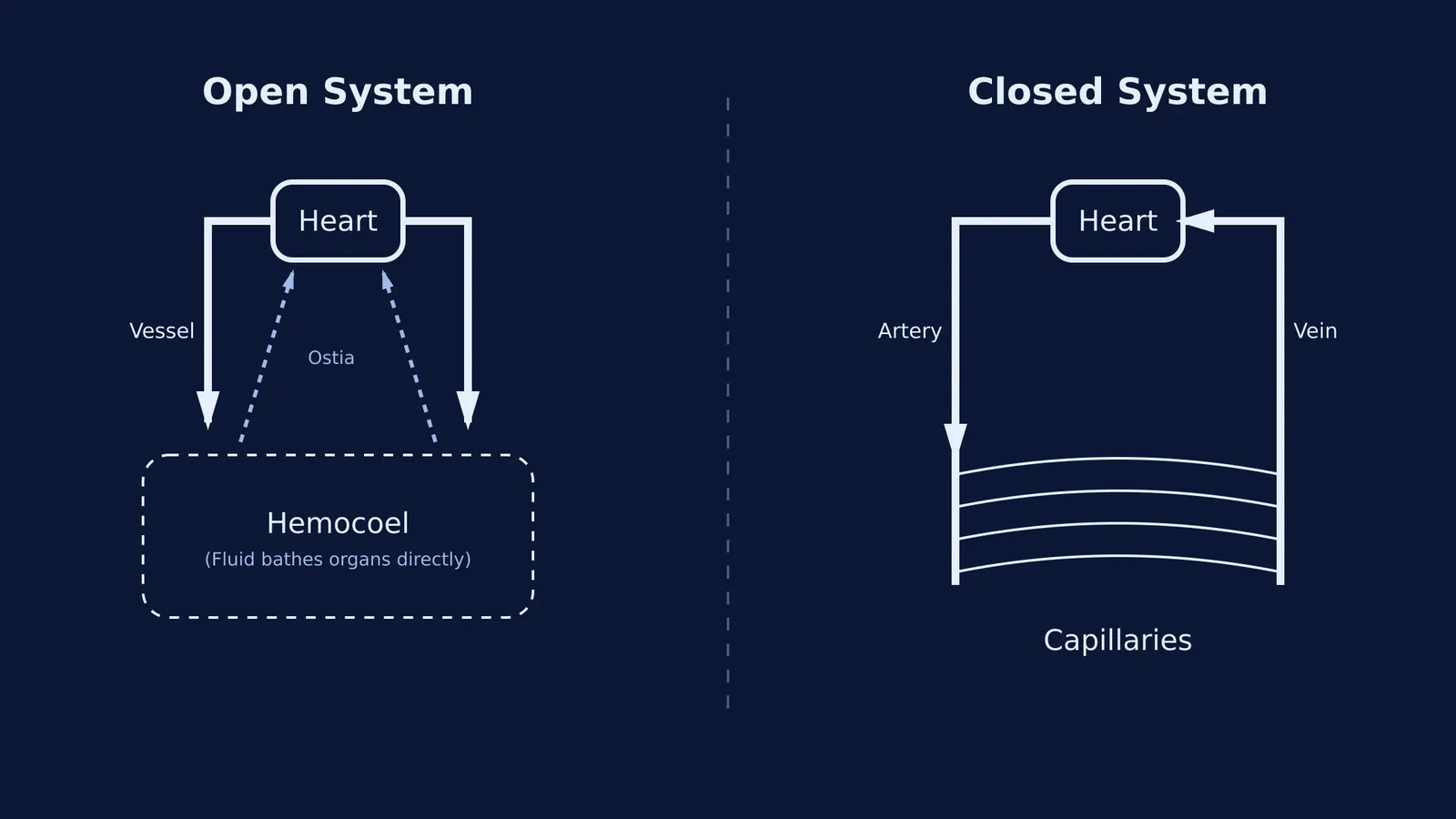
In a closed system, blood flows exclusively through a continuous loop of arteries, veins, and capillaries. Tissues are never in direct contact with the blood. This high-pressure system is highly efficient, which is why humans and other chordates can function with blood making up a relatively small fraction of their body weight.
In contrast, an open circulatory system pumps a fluid called hemolymph out of a tubular heart and directly into large body cavities called sinuses (collectively known as the hemocoel). The tissues are directly bathed in this fluid. Once the fluid exchanges nutrients with the cells, it slowly seeps back into the heart through small pores called ostia, which are equipped with valves to prevent backflow during the next heartbeat.
Because hemolymph is not confined to narrow vessels, the system operates at very low pressure. To ensure all cells receive sufficient nutrients, the animal requires a massive volume of fluid. For instance, researchers measuring the hemolymph volume of the Atlantic horseshoe crab (*Limulus polyphemus*) found that the fluid makes up 25% of the animal's wet body weight (Hurton et al., 2005). This is a stark contrast to vertebrates, where blood volumes are kept low and flow rates are kept high.
This massive volume of fluid also acts as a hydrostatic skeleton, giving shape and support to soft-bodied arthropods like caterpillars. If you get stuck on the mechanical physics of fluid pressure in these systems, the step-by-step solver in the Fermi Problem Library can help break down the forces at play.
A practical framework for revision
When studying Animal Kingdom classifications, group exceptions and transitional features together.
Start with the rule: Most lower invertebrates (Arthropods, non-cephalopod Molluscs) have open systems; higher invertebrates and vertebrates (Annelids, Chordates) have closed systems.
Note the exceptions: Cephalopods are molluscs but have closed systems. Annelids are relatively simple worms but evolved closed systems early.
Connect to lifestyle: Fast, active animals (vertebrates, octopuses) need the high pressure of a closed system.
Link structure to function: Think about how the lack of a respiratory pigment like haemoglobin in most insect hemolymph means their circulatory system only needs to transport nutrients, leaving gas exchange to their separate tracheal tube system.
Compare with other systems: Just as circulatory systems break the standard rules, you can explore biological outliers in our post on viruses, viroids and lichens.


