

On this page
The year was 1855, and the German physiologist Adolf Fick was only 26 years old when he published his seminal paper *Ueber Diffusion* (On Diffusion) (DOI). By looking closely at how heat travels through a solid object and how electricity flows along a conductive wire, Fick deduced the universal rules for how molecules spread out in a fluid.
He built his theory by examining the prior experimental work of the Scottish chemist Thomas Graham. Graham had meticulously observed and documented how salt diffuses through long tubes of water, but he had not formulated a rigorous mathematical law to predict the specific rates of movement. Fick, recognising a profound mathematical analogy, applied Joseph Fourier's equations of heat conduction to Graham's physical data to prove his new laws. He reasoned that just as heat flows from a region of high temperature to a region of low temperature, chemical substances must diffuse from areas of high concentration to areas of low concentration.
What is Fick's first law of diffusion?
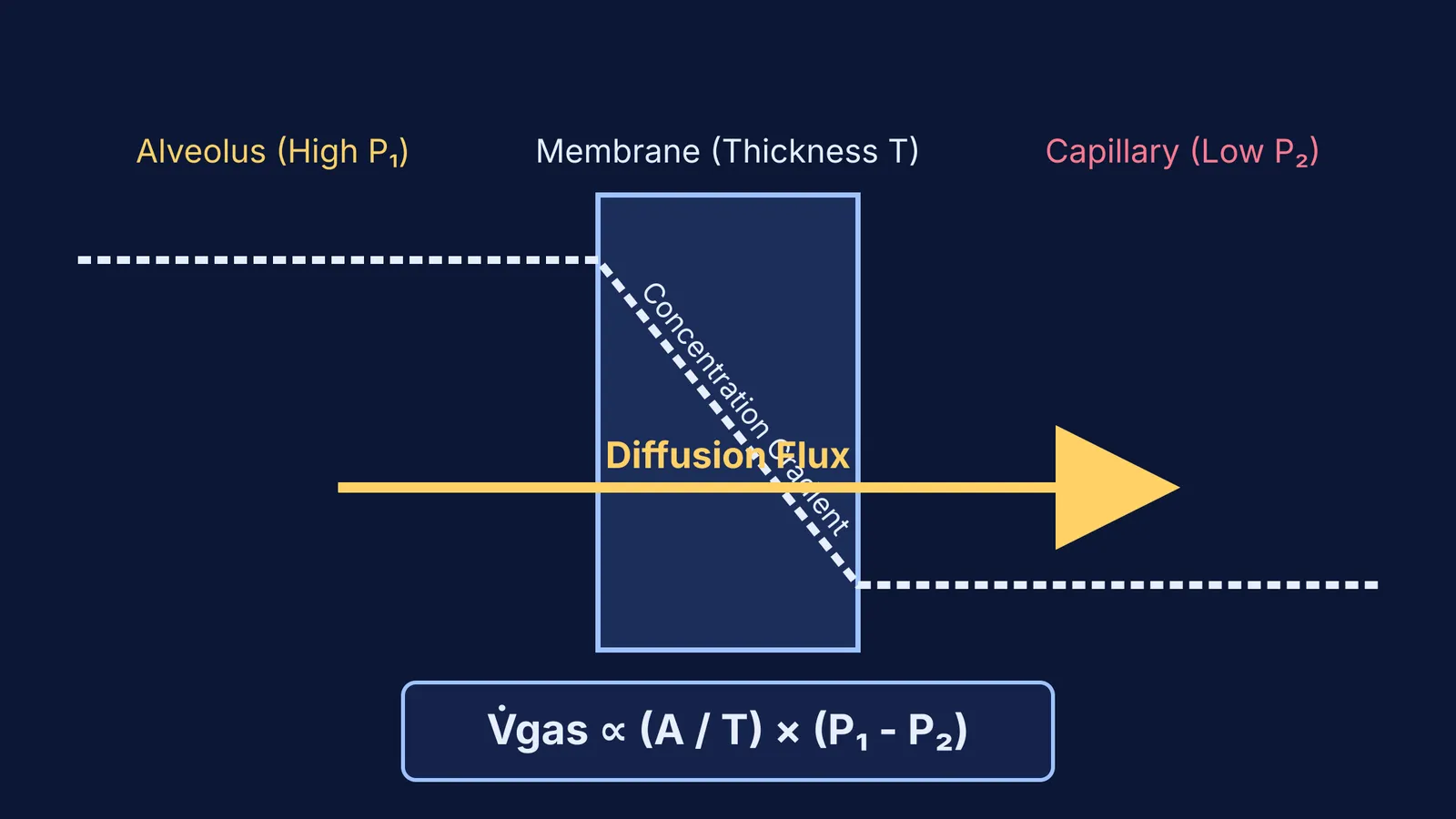
Fick observed that particles naturally move from regions where they are highly crowded to regions where they are comparatively scarce. He proposed that the rate of this movement—the diffusive flux—is directly proportional to the concentration gradient.
If there is a steep difference in concentration over a very short distance, diffusion happens rapidly. As the concentration difference evens out and particles distribute themselves evenly, the flow slows down until it reaches a state of dynamic equilibrium. This straightforward but powerful mathematical relationship became known as Fick's first law.
If visualising the random walk of particles down a gradient is tricky, the Fermi Simulation Lab has interactive models to help you see it happen in real time.
How does Fick's law explain gas exchange?
While Fick formulated his law for the fields of physics and chemistry, its most critical application today is in respiratory biology. Every time you take a breath, oxygen must move from the air spaces in your lungs (the alveoli) into your bloodstream, while carbon dioxide must move in the reverse direction to be successfully exhaled.
According to Fick's law, the rate of gas transfer across a membrane depends on four physical factors:
Surface area: The greater the area available for gas exchange, the faster the diffusion.
Membrane thickness: A thinner membrane allows a faster transfer because molecules have a shorter distance to travel.
Partial pressure gradient: The difference in gas pressure between the alveoli and the blood provides the driving force for the movement.
Diffusion coefficient: A property unique to each gas, depending on its molecular weight and solubility within the barrier tissue.
The ultrastructure of the normal human lung has evolved precisely to maximise the variables found in Fick's equation. Morphometric research confirms that the vast alveolar surface area paired with an incredibly thin membrane creates the ideal physical conditions for rapid and highly efficient gas exchange to sustain life.
Why does carbon dioxide diffuse faster than oxygen?
You might wonder how carbon dioxide, which is a heavier molecule than oxygen, can diffuse efficiently out of the blood when the pressure gradient pushing it is relatively small compared to oxygen. The answer lies in the diffusion coefficient.
Fick's principles dictate that a gas's ability to diffuse through a tissue membrane also depends heavily on its inherent solubility. Carbon dioxide is much more soluble in body fluids than oxygen. This high solubility means the overall diffusion coefficient for carbon dioxide is significantly larger, allowing it to easily outpace oxygen across the alveolar-capillary membrane despite its heavier molecular weight.
How is Fick's law used in modern medicine?
Understanding this physiological math is not just an academic exercise. Fick's fundamental principles remain central to modern medical diagnostics and the ongoing treatment of respiratory diseases.
When a doctor suspects lung disease, they often perform a test called DLCO (Diffusing Capacity of the Lung for Carbon Monoxide). This test relies entirely on Fick's parameters. By inhaling a tiny, safe amount of carbon monoxide—a gas whose uptake is limited strictly by the membrane's diffusion properties—doctors can accurately measure the structural integrity of the alveolar-capillary interface.
Diseases alter the crucial variables in Fick's equation with severe clinical consequences:
Emphysema destroys delicate alveolar walls, which drastically reduces the total surface area available for gas exchange.
Pulmonary fibrosis involves extensive tissue scarring that increases the thickness of the membrane, forcing the gas molecules to travel a much longer distance.
Supplemental oxygen therapy works by artificially raising the partial pressure of oxygen within the lungs, intentionally widening the pressure gradient to force more oxygen into the blood when the membrane is compromised.
By describing diffusion mathematically, Fick's 1855 discovery gave generations of biologists and doctors a vital tool to measure and understand gas transfer from a perspective of diffusion (Green, 2025).
You can read more about the early study of this respiratory anatomy in our piece on Ibn al-Nafis and the flow of blood through the lungs. For a closer look at lung volumes, explore our guide to Breathing and gas exchange: lung volume sums and oxygen transport. And if you need to revise transport phenomena or respiratory physiology from first principles, the Fermi Concept Library holds a lesson for each topic and its place in the broader map.


