

On this page
A liquid mosquito vaporiser has no smoke and no flame, just a bottle and a warm top. Inside, three pieces of school science run all night: capillary action, evaporation and diffusion.
How does a liquid mosquito vaporiser work?
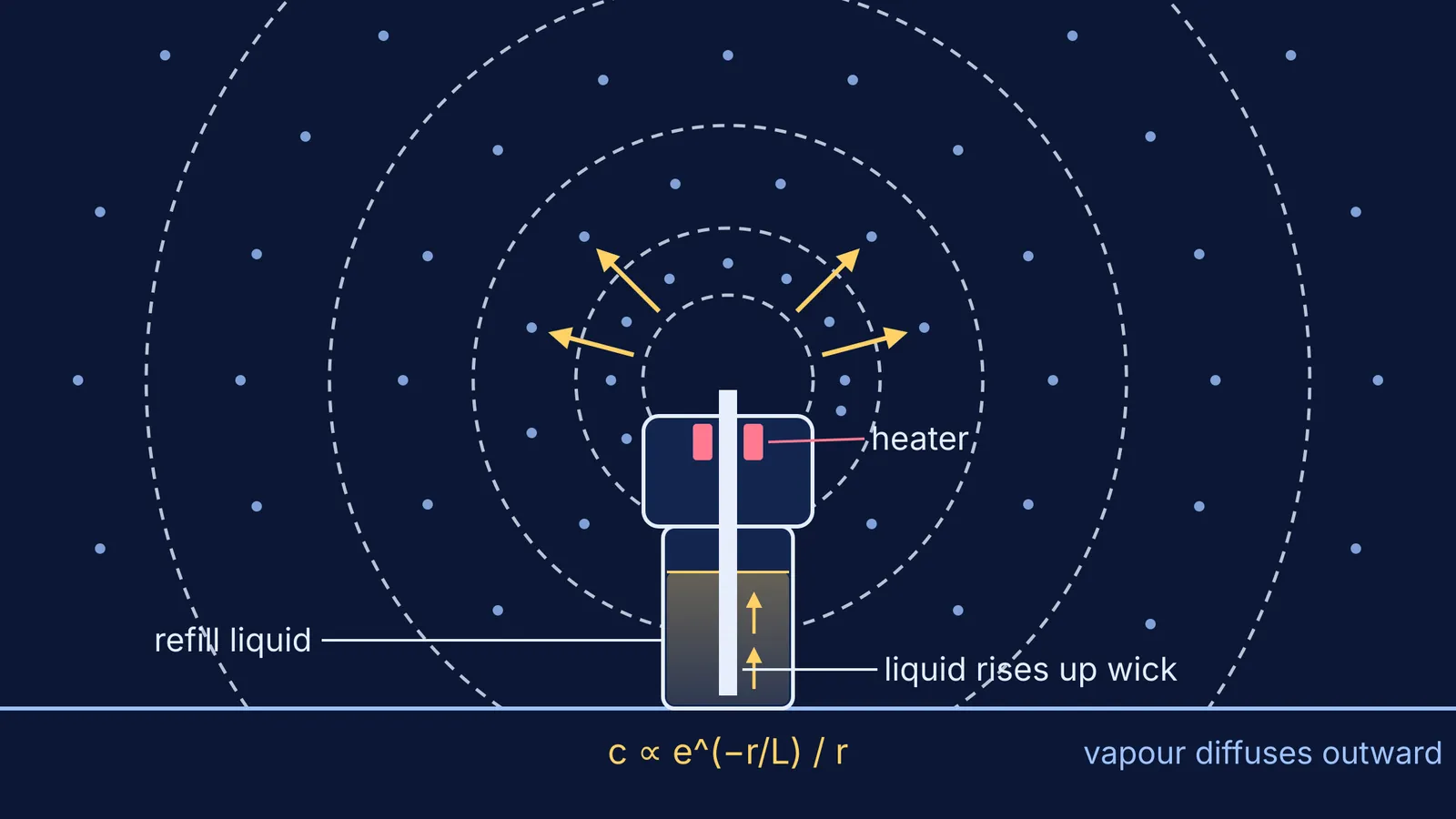
It has three parts, each described in a patent from the maker Dainihon Jochugiku.
The refill is mostly solvent with a little insecticide. In one formulation in the patent, the liquid is 0.9% transfluthrin by mass, 50% a glycol ether solvent and 49% water.
The wick is a porous rod dipping into the liquid. The patent describes a rod 7 mm across and 66 mm long, made mostly of mica powder and clay, through which the liquid rises to the top.
The heater is a ring around the top of the wick. In the patent's test it was set to 130 °C, and the patent gives 60 to 130 °C as the range for the wick surface.
The liquid climbs for the same reason oil climbs a cotton wick: narrow pores pull liquid upwards by surface tension, as we explain in why a diya wick draws up oil. At the hot tip the liquid evaporates, and the pores pull up more, until the bottle runs dry.
Why does a mosquito vaporiser need a heater?
Transfluthrin is a pyrethroid insecticide used in homes against mosquitoes, flies, moths and cockroaches, according to the Pesticide Properties Database at the University of Hertfordshire. Its vapour pressure is only 0.1 mPa at 20 °C, its molar mass is 371.15 g/mol and its boiling point is 242 °C.
You can turn that vapour pressure into a concentration with the ideal gas law, c = pM/RT. Put in p = 0.0001 Pa, M = 0.371 kg/mol and T = 293 K, and saturated air at room temperature holds about 1.5 × 10⁻⁸ kg per cubic metre. That is roughly 15 micrograms.
That is tiny, so an unheated wick would release it very slowly. Vapour pressure rises steeply with temperature (the Clausius-Clapeyron relation), so heating the tip makes molecules escape much faster. Nothing boils: the patent's 130 °C setting is well below transfluthrin's boiling point.
Once the vapour leaves the tip, rising warm air and slow diffusion carry it outward, the same way a smell travels in how perfume spreads across a room. A coil does the same job by burning instead, which we cover in why a mosquito coil burns slowly for hours.
If diffusion still feels abstract, the Fermi Simulation Lab has interactive simulations for ideas that are easier to see than to read.
How much insecticide is actually in the room air?
Very little. Researchers in Poland measured transfluthrin in room air while electric vaporisers were running. Liquid refills gave 3.8 to 5.2 micrograms per cubic metre and gels gave 1.3 to 2.4, and no insecticide was found in the air 18 to 24 hours after use stopped, according to their 2011 paper in Annals of Agricultural and Environmental Medicine.
How much insecticide does your bedroom air hold?
Use air levels from the 2011 Polish study and the patent's refill:
Room: 4 m × 3 m × 3 m = 36 cubic metres.
Air level: 5 micrograms per cubic metre, the top of the liquid-refill range in that paper.
Insecticide in the air at any moment: 36 × 5 = 180 micrograms, or 0.18 mg.
Insecticide in one gram of a 0.9% refill: 9 mg.
So at any moment the room's air holds about a fiftieth of the insecticide in one gram of refill. Vapour keeps leaving with air through doors, gaps and windows, and some settles on surfaces and dust. The heater keeps replacing what is lost, so the level settles where input balances loss.
Is it safe to keep a mosquito vaporiser on all night?
A 2013 study in Environment International ran two electric transfluthrin vaporisers in a full-scale test room with controlled air exchange (Vesin and colleagues). It estimated average inhaled concentrations of 8.3 micrograms per cubic metre over one hour and 1.8 over a week or five months. They put the margins of exposure at 1,000 to 10,000, which they read as no expected effect from breathing it, but noted that skin contact and swallowed dust looked non-negligible.
Sensible use, then:
Follow the refill label for hours per night. A 2008 conference poster reported manufacturers claiming about 45 days at 8 to 10 hours a day; your label is the figure that counts.
Plug it in where air moves freely, not behind a curtain or beside a pillow.
Keep normal airflow: don't seal every gap or open every window.
Switch it off in the morning and air the room.
Keep refills away from children, never top one up with another liquid, and don't touch the hot top.
If someone coughs, wheezes or feels unwell when it is on, switch it off, open the windows and talk to a doctor.
If vapour pressure or the ideal gas law tripped you up, the Fermi Concept Library has a lesson for every concept in physics and chemistry.


