

On this page
Science textbooks often use the scent of perfume crossing a room to introduce diffusion—the movement of molecules from an area of high concentration to an area of low concentration. But if you have ever noticed a perfume within seconds of it being sprayed, pure molecular diffusion is not what you were smelling. The physics of how smells spread involves a fascinating interplay between the rapid microscopic speeds of individual molecules and the bulk movement of the air that carries them.
How fast do gas particles move?
At room temperature, the average speed of air molecules (mostly nitrogen and oxygen) is roughly 500 meters per second, which is significantly faster than the speed of sound in air (roughly 343 m/s).
Perfume molecules are larger and heavier than nitrogen and oxygen. Because they are more massive, they move a bit more slowly according to Graham's Law, which states that the speed of a gas particle is inversely proportional to the square root of its molar mass. However, even these heavy aromatic molecules still zip around at hundreds of meters per second. With individual particle speeds this high, you might expect the scent to cross a living room instantly.
Why is pure molecular diffusion so slow?
If the molecules are moving faster than a commercial airliner, why doesn't the smell reach you immediately? The answer lies in how crowded the air is at the molecular level.
A single scent molecule cannot travel in a straight line for long before it hits a nitrogen or oxygen molecule. In fact, it collides with air molecules constantly. The average distance it manages to travel between collisions—a distance known as its mean free path—is only about 68 nanometers.
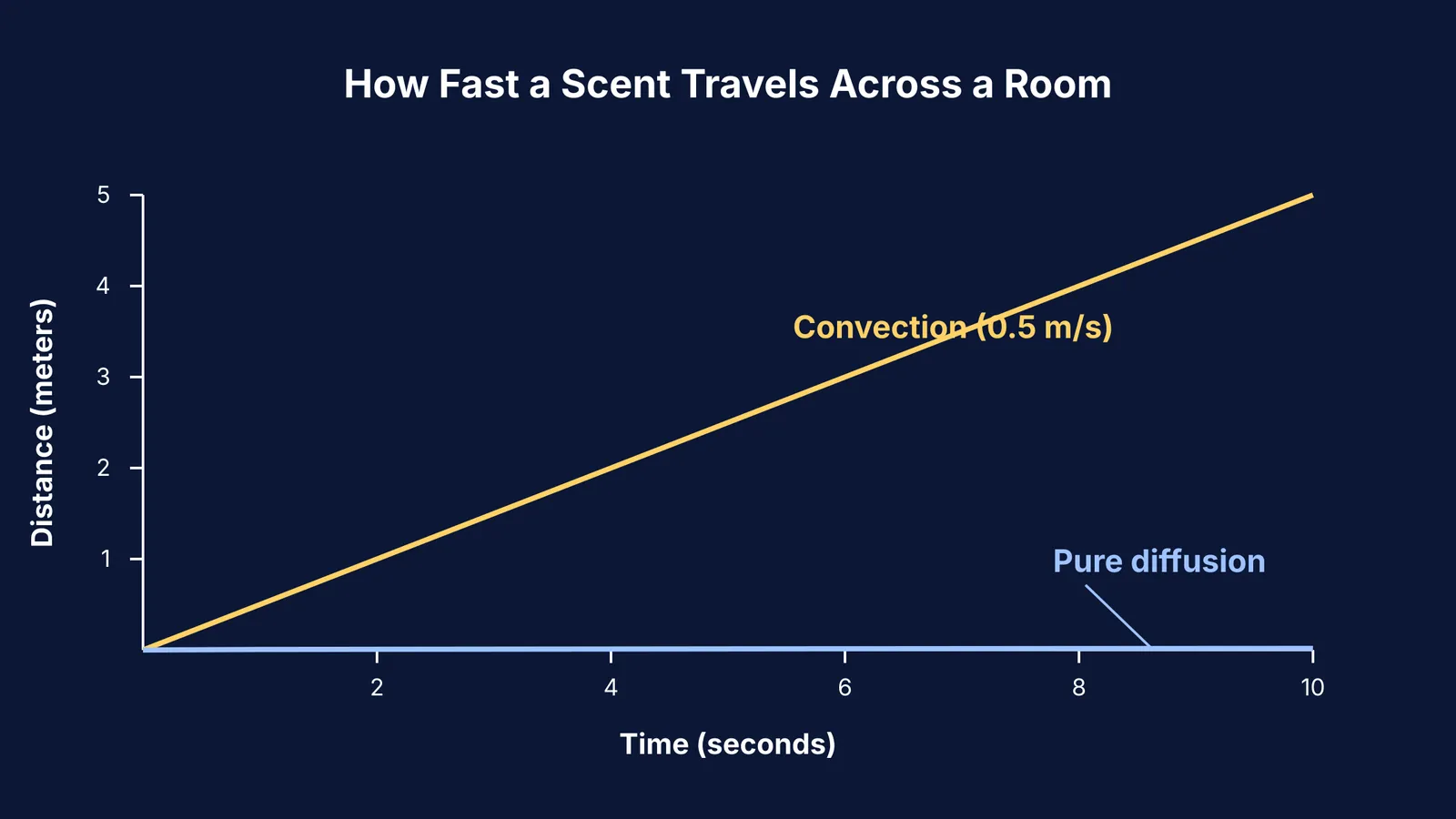
Because of these constant collisions, the molecule is continually knocked off course. Its path becomes a chaotic, tightly wound zig-zag called a random walk. This process of spreading out purely by random thermal motion is diffusion. In perfectly still air, diffusion is so spectacularly inefficient over macroscopic distances that physical calculations show it would take nearly a month for a scent to travel 5 meters across a standard room.
Convection: How the scent actually travels
The air in a normal room is never perfectly still. Small temperature differences from your body heat, a sunny window, a warm radiator, or a running laptop create convection currents—bulk movements of air where warm air rises and cool air sinks. Additionally, the simple act of walking through a room or opening a door creates turbulent drafts and wakes.
While this feels like a barely perceptible breeze to us, it acts like a high-speed transit system for gas molecules. Instead of bouncing its way across the room millimeter by millimeter through pure diffusion, the perfume is swept along by these invisible drafts like a leaf on a fast-flowing river.
Because of convection, a scent can cross a room in seconds. In real-world environments, molecular diffusion only handles the final microscopic step, moving the scent molecules from the air current through the thin layer of still air directly into the receptors in your nose.
Why this matters for your physics intuition
When you study transport phenomena, thermodynamics, or kinetic theory, distinguishing between random molecular motion (diffusion) and bulk fluid flow (convection) is a core scientific skill. Many students lose marks on exams because they mistakenly apply diffusion formulas to a convection problem, arriving at timelines of weeks instead of seconds.
Understanding this difference is crucial for setting up the correct mathematical models in fluid dynamics and chemistry. For more on how we treat the air itself in calculations, see our worked examples on finding the average molar mass of a gas mixture and how to approach converting PV, PT and VT graphs.
If you need a refresher on the math and formulas behind these concepts, the Fermi Concept Library has lessons for every concept in physics and chemistry, each with its place in the map. If you are struggling to picture the difference between these physical processes, the Fermi Simulation Lab provides interactive simulations for the ideas that are easier to see than to read.


