

On this page
When you sit down for a long evening study session, lighting a mosquito coil feels like a simple solution to an annoying problem. But the coil is actually a carefully engineered chemical device. It undergoes a process called smouldering, acting as a slow-release thermal vaporiser rather than a simple campfire.
Here is the science of why it burns so slowly, how it releases its repellent, and what you should know about the smoke filling your room.
Why does a mosquito coil burn slowly?
A standard mosquito coil is designed to burn steadily for 7 to 12 hours (Wikipedia). If it caught fire and burned with an open flame, the high heat would instantly destroy the active insecticidal chemicals and consume the fuel in minutes.
To prevent a flame, manufacturers rely on the physics of smouldering—a slow, low-temperature, flameless form of combustion. They achieve this using a specific mix of materials:
Biomass fuel: The base is usually fine sawdust, ground coconut shells, or dried mandarin peels. This provides the carbon-rich material needed to sustain a slow burn.
Binders: Starch powders or natural gums compress the sawdust into a dense, putty-like paste that is extruded into the familiar spiral shape.
Spiral design: The history of this shape is quite clever. In 1895, Yuki Ueyama, the wife of a Japanese entrepreneur, suggested forming the incense into a spiral inspired by a coiled snake. Before this, repellents were sold as straight sticks that only lasted about 40 minutes (Wikipedia). The spiral allowed a much longer, thicker continuous track of fuel to fit into a small space, keeping the coil burning through the entire night.
Oxygen restriction: Because the paste is so dense, oxygen cannot easily penetrate the interior. The combustion is forced to "walk" slowly along the surface, restricted by the rate at which oxygen from the surrounding air reaches the ember.
Combustion additives: A small amount of an oxidiser, such as potassium nitrate, is sometimes added to ensure the coil smoulders continuously without going out.
This slow oxidation is the same fundamental chemistry seen in other slow reactions, such as corrosion and rancidity.
How does the pyrethroid escape the heat?
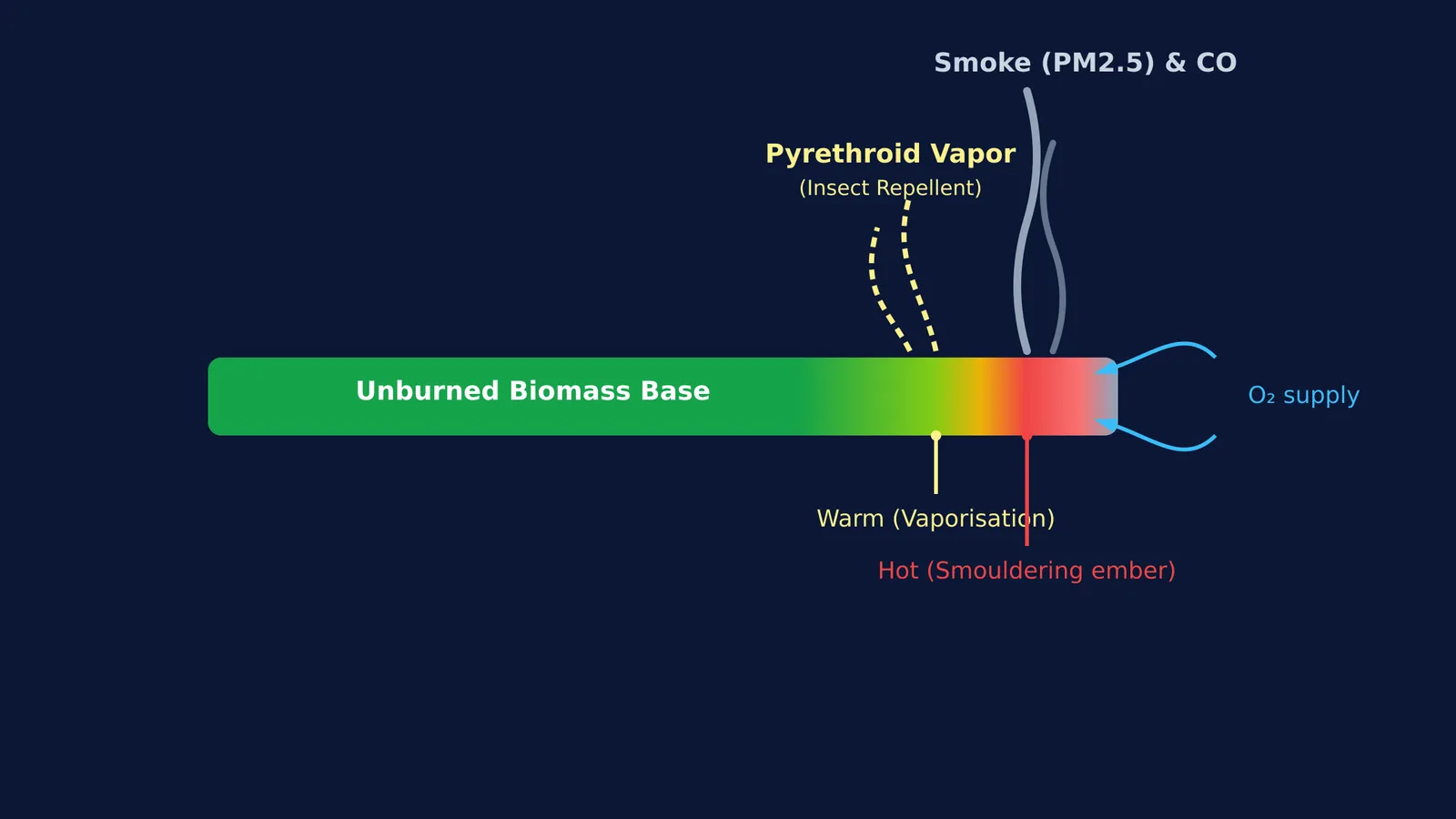
The tip of a burning mosquito coil is a glowing ember. At this extreme heat, the active ingredients—which can be natural pyrethrum derived from chrysanthemum flowers or synthetic pyrethroids like allethrin—would be incinerated and rendered useless if they were directly inside the ember.
Instead, the coil walks a "thermal tightrope." The heat radiating from the core warms the coil material just a few millimetres ahead of it. In this adjacent zone, the temperature is high enough to vaporise the pyrethroids, but low enough that they do not break down. The insecticide is released into the air as a gas before the burning ember ever reaches it. This creates a protective vapour shield around the room that disables the nervous systems of flying insects.
If you find it hard to picture heat gradients and combustion zones from a textbook, interactive visualisations can help. The Simulation Lab provides interactive simulations for the ideas that are easier to see than to read, helping you grasp complex thermal physics.
Is the smoke from a mosquito coil harmful?
While the vaporised pyrethroid creates a protective zone that repels or knocks down mosquitoes (a modern alternative to historical insecticides like DDT, which fought malaria), the visible smoke is a separate issue.
The smoke is a byproduct of the smouldering sawdust, and it carries significant health risks when inhaled in closed spaces. Because the combustion is incomplete and flameless, it generates high levels of fine particulate matter (PM2.5), carbon monoxide, and volatile organic compounds.
A landmark 2003 study in *Environmental Health Perspectives* by Liu et al. measured the emissions of coils in a closed room. The researchers found that burning a single mosquito coil emits the same amount of PM2.5 mass as burning 75 to 137 cigarettes (EHP, DOI: 10.1289/ehp.6286). Furthermore, one coil releases formaldehyde equivalent to 51 cigarettes. These ultrafine particles can settle deep in the lungs, triggering asthma and long-term respiratory issues, making a closed room with a coil a poor environment for focused studying or sleeping.
How can you create a safer study environment?
To balance mosquito protection with healthy indoor air quality, follow these steps:
Never use a coil in a sealed, air-conditioned room. The PM2.5 levels will rapidly exceed safe limits.
Ventilate actively. Open a window and use a fan to keep the air circulating. The pyrethroid vapor will still work locally, but the smoke will be diluted.
Switch to smokeless alternatives. For indoor study sessions, electric liquid vaporisers or mosquito nets are much safer, as they emit the repellent without the heavy particulate matter of smouldering wood.
Place the coil wisely. If burning one indoors, place it near a slightly open window where the draft pulls the visible smoke outward while the repellent diffuses inside.


