On this page
Table 6.8 in NCERT Class 11 Chemistry, Unit 6 (Equilibrium), gives ascorbic acid, which is vitamin C, a first ionization constant Ka₁ = 7.4 × 10⁻⁴. Two rows below, citric acid has Ka₁ = 7.4 × 10⁻⁴ too. Two acids can share a constant, so a repeat proves nothing alone, but it is a good place to start checking. Measured data put vitamin C's Ka₁ near 8 × 10⁻⁵, about ten times smaller than the printed value. Here is how to test that, and why vitamin C is acidic without a COOH group.
What does NCERT Table 6.8 list for ascorbic acid?
Table 6.8, "The Ionization Constants of Some Common Polyprotic Acids (298K)", is on page 200 of the Reprint 2026-27 of NCERT Class 11 Chemistry, Unit 6. Four of its rows read:
Oxalic acid: Ka₁ 5.9 × 10⁻², Ka₂ 6.4 × 10⁻⁵
Ascorbic acid: Ka₁ 7.4 × 10⁻⁴, Ka₂ 1.6 × 10⁻¹²
Citric acid: Ka₁ 7.4 × 10⁻⁴, Ka₂ 1.7 × 10⁻⁵, Ka₃ 4.0 × 10⁻⁷
Phosphoric acid: Ka₁ 7.5 × 10⁻³, Ka₂ 6.2 × 10⁻⁸, Ka₃ 4.2 × 10⁻¹³
It is easier to compare acids on the pKa scale, where pKa = −log Ka. NCERT's Ka₁ of 7.4 × 10⁻⁴ is pKa 3.13, for both acids. This post checks only the ascorbic row.
What is the measured Ka of vitamin C?
Two open sources agree closely:
The IUPAC Digitized pKa Dataset (version 2.4) lists L-ascorbic acid at 25 °C with pKa₁ = 4.04 and pKa₂ = 11.34. These are concentration constants measured in 0.1 M KNO₃.
PubChem's record for vitamin C quotes the Hazardous Substances Data Bank, citing the Merck Index: "pK1 = 4.17; pK2 = 11.57".
So pKa₁ is 4.0 to 4.2, which means Ka₁ is about 6.8 × 10⁻⁵ to 9.1 × 10⁻⁵, or roughly 8 × 10⁻⁵. NCERT's 7.4 × 10⁻⁴ is 8 to 11 times larger than this.
The second constant is in the right range. NCERT's Ka₂ of 1.6 × 10⁻¹² is pKa 11.80, within about 0.2 to 0.5 unit of the measured 11.34 to 11.57.
How can you check a Ka with a pH reading?
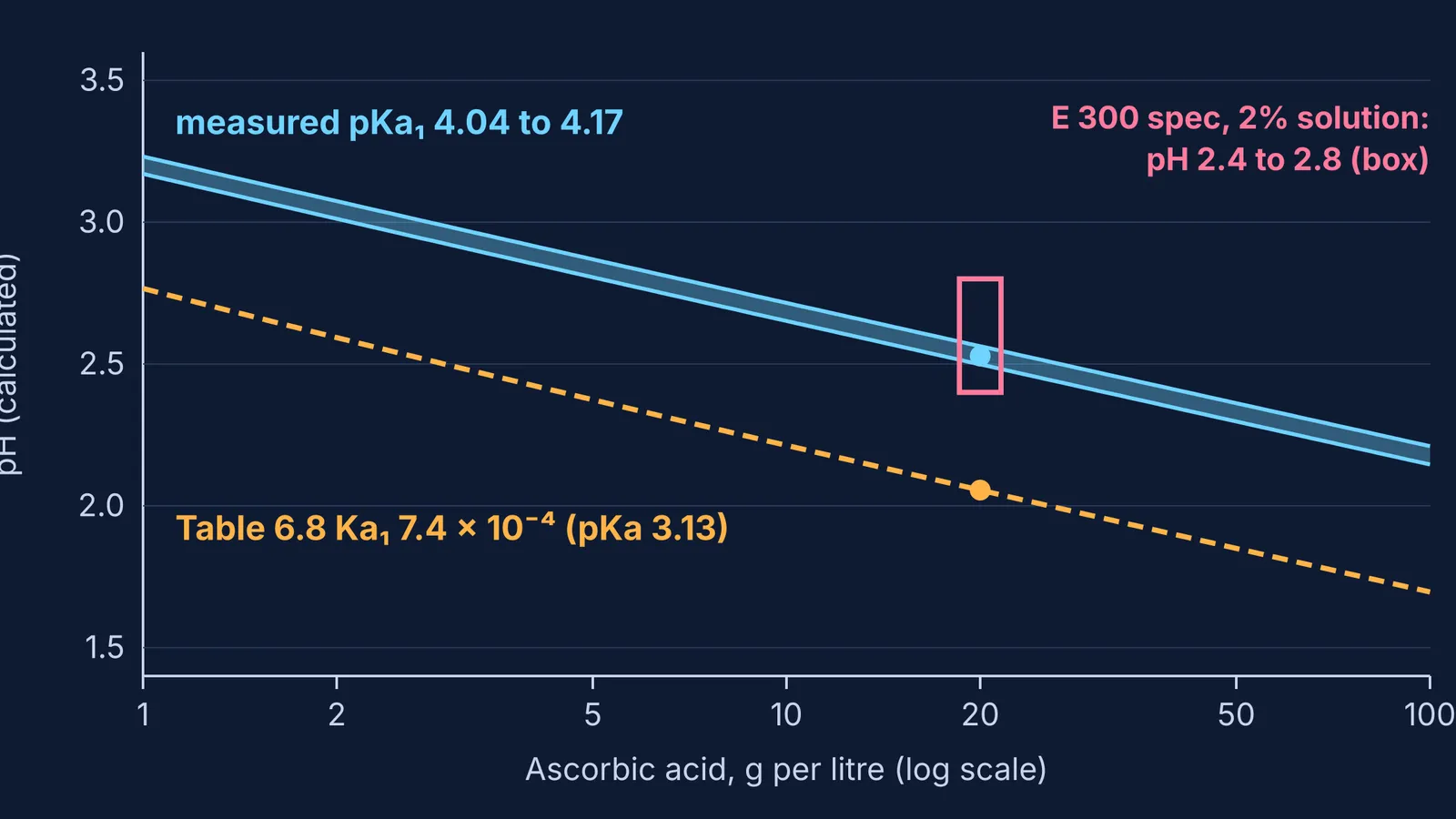
A pH value is an independent test. The EU food-additive specification for ascorbic acid (E 300), quoted on the same PubChem record, requires a 2% solution in water to have a pH "between 2,4 and 2,8". Work out what each Ka predicts.
Concentration. 2% is 20 g per litre. The molar mass of C₆H₈O₆ is 176.12 g/mol, so C = 20 ÷ 176.12 = 0.1136 mol/L.
Equilibrium. Treat it as a weak monoprotic acid, H₂A ⇌ H⁺ + HA⁻. Ka₂ is so small that the second step adds nothing measurable.
Set up Ka. With x = [H⁺] = [HA⁻], Ka = x² ÷ (C − x). Solve the quadratic, because x is not tiny when Ka is large.
With NCERT's Ka₁ = 7.4 × 10⁻⁴: x = 8.8 × 10⁻³ mol/L, so pH = 2.06. The acid is 7.7% ionised.
With pKa₁ = 4.04 (Ka = 9.1 × 10⁻⁵): pH = 2.50, 2.8% ionised.
With pKa₁ = 4.17 (Ka = 6.8 × 10⁻⁵): pH = 2.56, 2.4% ionised.
The measured constants land inside the 2.4 to 2.8 window. NCERT's constant predicts 2.06, below it.
You can also run the check backwards. Put pH 2.4 and pH 2.8 into Ka = x² ÷ (C − x). The window allows Ka from 2.2 × 10⁻⁵ to 1.4 × 10⁻⁴, which is pKa 3.84 to 4.65. A pKa of 3.13 is outside that range, while 4.04 and 4.17 are inside. The Merck Index entry on PubChem gives a second data point, pH 3 for a 5 mg/mL solution. The measured constants give 2.81 to 2.87 there, and NCERT's gives 2.37.
These sums ignore activity coefficients, so treat them as good to about 0.1 unit. Use fresh-solution figures, because vitamin C slowly oxidises in air and water. For more on this kind of reverse calculation, see how to find Ka from the pH of a weak acid solution.
Why is vitamin C acidic without a COOH group?
Ascorbic acid is a five-membered ring containing a cyclic ester (a lactone). Carbon 1 is the ester C=O. Carbons 2 and 3 are joined by a C=C double bond, and each carries an OH group. An OH on a C=C carbon is an enol.
The acidic proton is the OH on carbon 3. When it leaves, the negative charge does not stay on that oxygen. It spreads through the C=C onto the oxygen of the C=O:
⁻O–C3=C2–C1=O becomes O=C3–C2=C1–O⁻
Compare a carboxylate ion, where the charge is shared between two oxygens on the same carbon. In ascorbate it is shared between two oxygens separated by a C=C. Chemists call this a vinylogous carboxylic acid: a carboxylic acid with a C=C inserted between the C=O and the C–OH. The delocalisation works almost as well, which is why vitamin C's pKa (about 4.1) sits beside benzoic acid's. NCERT's Table 6.6 gives benzoic acid Ka = 6.5 × 10⁻⁵, pKa 4.19. A simple alcohol OH, with no C=C or C=O next to it, has a pKa near 16.
The second proton, on the carbon-2 OH, is much harder to remove: pKa₂ is about 11.3 to 11.6. NCERT's own reason applies. The proton now has to leave an ion that is already negatively charged. If resonance and charge delocalisation are where this stops making sense, the Concept Library gives each chemistry concept its own lesson.
Where does vitamin C sit among acids you know?
Put the numbers on one ladder, strongest first. The pKa values for citric, benzoic and acetic acid come from NCERT's Tables 6.6 and 6.8:
Citric acid, first step: pKa 3.13 (Ka 7.4 × 10⁻⁴)
Ascorbic acid, first step: pKa 4.0 to 4.2 (Ka ≈ 8 × 10⁻⁵)
Benzoic acid: pKa 4.19 (Ka 6.5 × 10⁻⁵)
Acetic acid: pKa 4.76 (Ka 1.74 × 10⁻⁵)
With the printed Ka, vitamin C would tie with citric acid, 11 times stronger than benzoic acid. With the measured value, it matches benzoic acid. On the reagent ladder in which compounds react with Na, NaOH and NaHCO₃, a pKa near 4 is below carbonic acid's 6.4, so vitamin C is expected to release CO₂ from sodium hydrogencarbonate even though it has no COOH group.
What should you write in the exam?
"Calculate the pH, Ka₁ = ..." is a method question: use the printed number. "Which is the stronger acid?" or "Why is vitamin C acidic?" is a chemistry question: use pKa₁ ≈ 4.1 and the enol explanation. If you are preparing for JEE and want numericals paired with the chemistry behind them, Fermi Test Prep covers JEE Main and Advanced preparation.
Quick checklist
NCERT Table 6.8 lists ascorbic acid Ka₁ = 7.4 × 10⁻⁴, the same as citric acid's Ka₁.
Measured pKa₁ is 4.04 to 4.17, so Ka₁ ≈ 8 × 10⁻⁵, about ten times smaller.
A 2% solution should be pH 2.4 to 2.8. The measured Ka gives 2.50 to 2.56, NCERT's gives 2.06.
The acidic H is the enol OH on carbon 3. The anion is delocalised onto the lactone C=O.
In numericals, use the Ka the question gives.