On this page
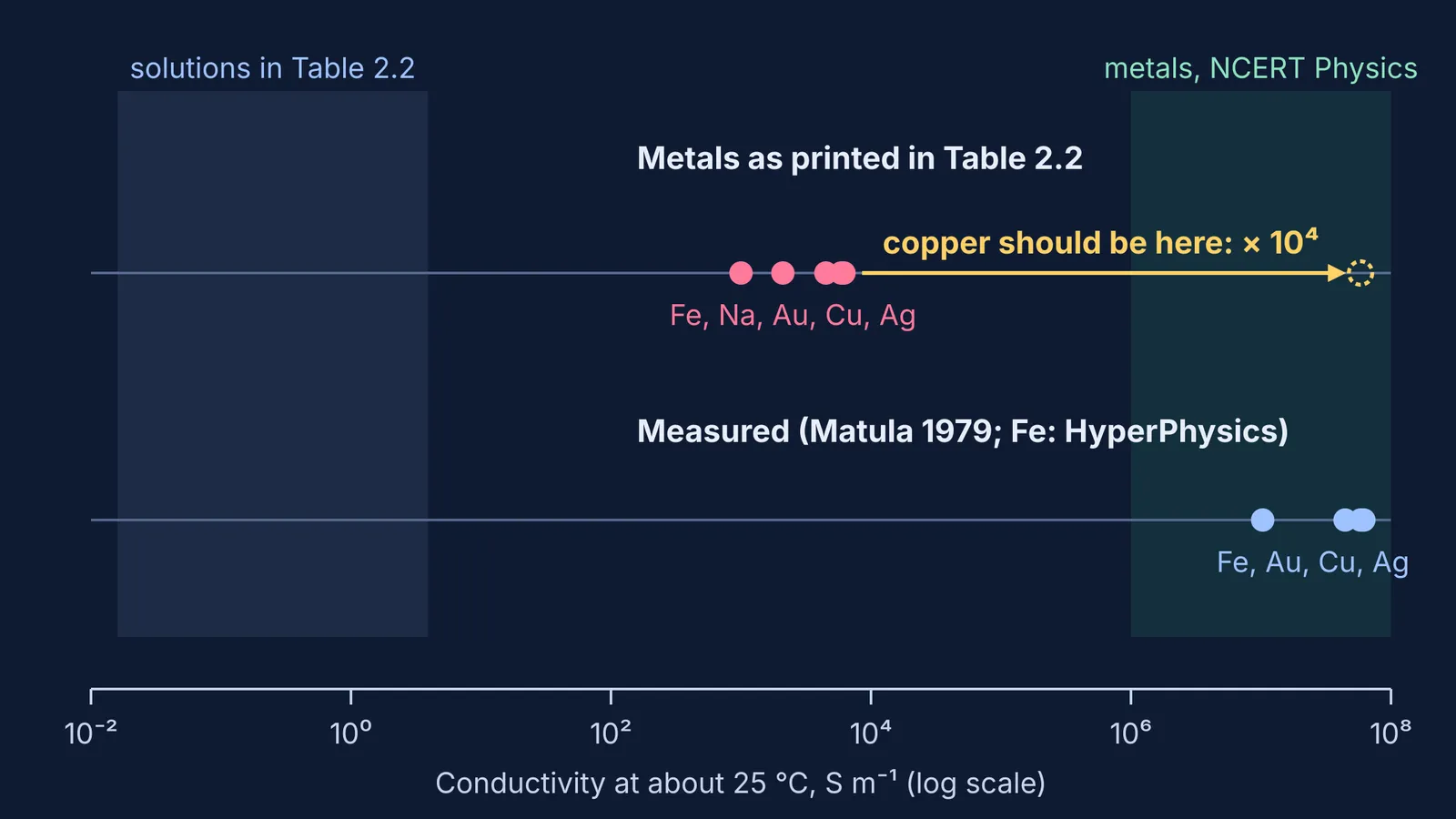
Table 2.2 in NCERT's Class 12 electrochemistry chapter lists copper's conductivity as 5.9 × 10³ S m⁻¹. Measured values for pure copper at 25 °C are about 5.8 × 10⁷ S m⁻¹, so the printed figure is about 10,000 times too small, and silver, gold and iron in the same column show the same gap. You do not need a research paper to spot this. NCERT's own physics book gives you enough to check it. This post shows how, and it is a habit worth keeping: check every number's order of magnitude against a second source and against the other rows of its table.
What does NCERT Table 2.2 say?
Table 2.2 is titled "The values of Conductivity of some Selected Materials at 298.15 K" (page 42 of NCERT Class 12 Chemistry, Unit 2, Reprint 2026-27). All values are in S m⁻¹. The conductors are:
Sodium 2.1 × 10³
Copper 5.9 × 10³
Silver 6.2 × 10³
Gold 4.5 × 10³
Iron 1.0 × 10³
Graphite 1.2 × 10
The aqueous solutions in the same table include 0.1 M HCl at 3.91, 0.01 M KCl at 0.14 and 0.1 M acetic acid at 0.047. The table also has insulators and semiconductors.
How do you check copper's conductivity with NCERT Physics?
Class 12 Physics, chapter 3, section 3.7 (NCERT Class 12 Physics, Unit 3, Reprint 2026-27, page 90) says: "Metals have low resistivities in the range of 10⁻⁸ Ω m to 10⁻⁶ Ω m."
Conductivity is the reciprocal of resistivity, κ = 1/ρ. So the physics book puts metals between 1/10⁻⁶ = 10⁶ S m⁻¹ and 1/10⁻⁸ = 10⁸ S m⁻¹.
Now turn the table's copper value around: ρ = 1/(5.9 × 10³) = 1.7 × 10⁻⁴ Ω m. That is 170 times higher than the top of the physics range, and about 10⁴ times higher than the bottom, where good conductors like copper sit. Two NCERT books cannot both be right here, and the physics range matches measurements.
What are the measured conductivities of copper, silver and gold?
Recommended values for very pure (99.999%), annealed metals come from Matula's review, Electrical resistivity of copper, gold, palladium and silver (J. Phys. Chem. Ref. Data 8, 1147, 1979). Its tables give resistivity at 293 K and 300 K. Interpolating to 298.15 K and taking the reciprocal:
Copper: ρ = 1.713 × 10⁻⁸ Ω m, so κ = 5.84 × 10⁷ S m⁻¹. Ratio to the table: 9,900.
Silver: ρ = 1.618 × 10⁻⁸ Ω m, so κ = 6.18 × 10⁷ S m⁻¹. Ratio: 9,970.
Gold: ρ = 2.256 × 10⁻⁸ Ω m, so κ = 4.43 × 10⁷ S m⁻¹. Ratio: 9,850.
For iron, the HyperPhysics resistivity table gives 9.71 × 10⁻⁸ Ω m at 20 °C, which is about 1.0 × 10⁷ S m⁻¹, again about 10⁴ times the printed 1.0 × 10³. We did not check sodium against a primary source.
The first digits in Table 2.2 match the measured values closely, while the power of ten is 3 where it should be 7. Real samples vary with purity and temperature, so say "about 6 × 10⁷ S m⁻¹" for copper rather than quoting four figures.
Could it be S cm⁻¹ instead of S m⁻¹?
No. That is the first thing to rule out, and it does not fit. 1 S m⁻¹ = 0.01 S cm⁻¹, a factor of 100, not 10,000. Copper in S cm⁻¹ is 5.8 × 10⁵, not 5.9 × 10³. The factor-of-100 conversion is explained in conductivity units: S cm⁻¹ vs S m⁻¹.
Are the solution values in Table 2.2 right?
Yes, and checking them is good practice too.
0.01 M KCl: Table 2.2 gives 0.14 S m⁻¹. NCERT's Table 2.3, a few pages later, gives 0.141 S m⁻¹ for 0.010 M KCl. They agree.
0.1 M HCl: κ = 3.91 S m⁻¹ and c = 0.1 mol/L = 100 mol m⁻³. Λm = κ/c = 0.0391 S m² mol⁻¹ = 391 S cm² mol⁻¹. That is a little below NCERT's limiting value for HCl, 425.9 S cm² mol⁻¹, which is what you expect for a strong electrolyte at 0.1 M.
The pure-water row is a separate story, covered in finding Kw from the conductivity of pure water.
So the solution rows are fine, and only the metal rows are off. That matters when you compare rows. As printed, copper conducts about 1,500 times better than 0.1 M HCl (5.9 × 10³ / 3.91). With the measured value, the ratio is 5.84 × 10⁷ / 3.91 = 1.5 × 10⁷.
Worked example: does the table's copper make sense for a real wire?
Problem. Find the resistance of a copper wire 1 m long with a cross-section of 1 mm², using (a) Table 2.2's value and (b) the measured value. Then find the heat produced when it carries 5 A.
Convert units. A = 1 mm² = 1 × 10⁻⁶ m². R = L/(κA).
Table value. R = 1 / (5.9 × 10³ × 10⁻⁶) = 169 Ω.
Measured value. R = 1 / (5.84 × 10⁷ × 10⁻⁶) = 0.017 Ω.
Heat at 5 A. P = I²R. With the table value, P = 25 × 169 = about 4,200 W, the power of a large room heater. With the measured value, P = 25 × 0.017 = 0.43 W.
A short piece of 1 mm² wire carrying 5 A is not a 4 kW heater, so only the second answer fits. A quick physical check like this is often faster than looking up a second source. For more on why metals and electrolytes behave so differently, read metallic vs electrolytic conductance and temperature.
One more row to check: graphite. HyperPhysics gives graphite's resistivity as 3 to 60 × 10⁻⁵ Ω m, which is about 2 × 10³ to 3 × 10⁴ S m⁻¹, well above the printed 12 S m⁻¹. Graphite varies a lot with its form, so treat that only as a range.
What should you write in the exam?
To practise conductivity and resistance numericals with an AI tutor that checks each step, try Fermi Test Prep for JEE Main and Advanced preparation. For more R = ρL/A and Λm problems worked step by step, the Fermi Problem Library has a step-by-step solver that explains the reasoning.
Quick checklist for any conductivity value
Convert κ to ρ = 1/κ and compare with the physics range for metals, 10⁻⁸ to 10⁻⁶ Ω m.
Rule out S cm⁻¹ vs S m⁻¹: that is only a factor of 100.
Compare rows: copper should beat 0.1 M HCl by about 10⁷, not 10³.
Run a physical check, such as the heat in a 1 m wire.
In exams, use the given value; in comparisons, copper is about 6 × 10⁷ S m⁻¹.