

On this page
When you connect a copper wire to a voltage source, current flows through a fixed lattice of metal atoms. When you place electrodes into saltwater, current flows through mobile solvated ions. While both obey Ohm's law, they respond oppositely to heat: warming a metal wire lowers conductance, whereas warming an electrolyte raises conductance. This difference in temperature effect is a core topic in Class 12 physical chemistry and current electricity.
What is the difference between metallic and electrolytic conductance?
To contrast metallic and electrolytic conduction clearly, consider four core distinctions:
Charge carriers: In metals, current is carried by delocalized valence electrons drifting through a fixed lattice. In electrolytes, current is carried by mobile cations and anions.
Chemical change: Metallic conduction is purely physical. Electrolytic conduction causes chemical oxidation at the anode and reduction at the cathode.
Transfer of matter: Electrons drift with negligible mass transfer. Electrolytic conduction physically transports chemical ions to electrodes.
Magnitude: Metals exhibit high conductivity (10⁶ to 10⁸ S/m), whereas aqueous electrolytic conductivities rarely exceed 100 S/m.
Why does metallic conductance decrease with temperature?
In the Drude model, electrical conductivity is σ = n × e² × τ / m, where n is electron density, e is charge, m is electron mass, and τ is the mean relaxation time. In a pure metal, n remains constant across ordinary temperatures.
As temperature rises, lattice metal ions vibrate with larger thermal amplitudes. These lattice vibrations (phonons) scatter conduction electrons, shortening τ and lowering drift mobility.
According to Richard A. Matula in the Journal of Physical and Chemical Reference Data (1979), pure copper resistivity rises from 1.543 × 10⁻⁸ Ω·m at 0 °C to 1.712 × 10⁻⁸ Ω·m at 25 °C and 1.882 × 10⁻⁸ Ω·m at 50 °C. Copper's conductance drops by 9.9% between 0 °C and 25 °C, and by 18.0% at 50 °C. Copper has a positive temperature coefficient of resistance of roughly +0.00393 K⁻¹ near 20 °C, meaning conductance falls by roughly 0.39% per degree Celsius.
Why does electrolytic conductance increase with temperature?
In electrolytic solutions, conductivity κ depends on concentration cᵢ, charge zᵢ, and mobility uᵢ: κ = ∑ (cᵢ × zᵢ × F × uᵢ), where F is Faraday's constant. Heating accelerates conduction through three primary effects:
Lower solvent viscosity: Stokes' law gives the drag on an ion of radius r as F = 6 × π × η × r × v. Thermal energy disrupts intermolecular hydrogen bonds, lowering viscosity η and freeing ions to move faster.
Weaker interionic drag: Higher kinetic energy weakens ion-pairing, as shown in J. C. Ghosh's theory of strong electrolytes.
Greater weak electrolyte dissociation: Dissociation of weak electrolytes is endothermic, so heating produces more ions.
Formulations by M. L. Huber and colleagues in the Journal of Physical and Chemical Reference Data (2009) show liquid water viscosity drops from 1.792 mPa·s at 0 °C to 0.890 mPa·s at 25 °C (a 50.3% drop) and 0.547 mPa·s at 50 °C (a 69.5% drop). Under Walden's rule (limiting molar conductivity times viscosity is constant: Λ₀ × η ≈ constant), halving viscosity roughly doubles ionic conductance.
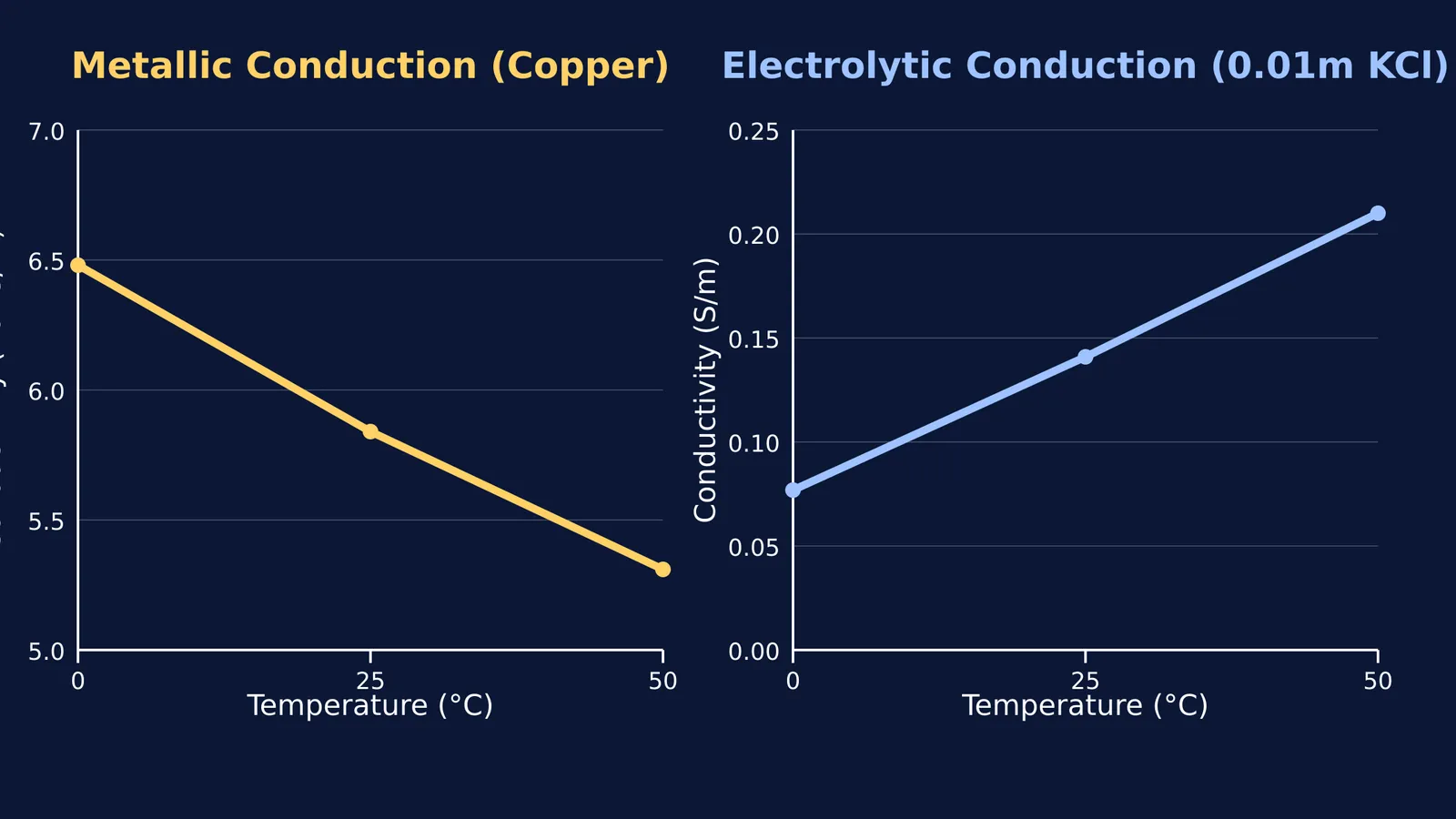
How do copper and potassium chloride compare across 0 °C to 50 °C?
To see this contrast in real measurements, compare pure copper against primary standards for 0.01 molal potassium chloride (KCl) solution from Y. C. Wu, W. F. Koch, and K. W. Pratt in the Journal of Research of the National Institute of Standards and Technology (1991):
At 0 °C: Copper conductivity is 6.481 × 10⁷ S/m; 0.01 molal KCl conductivity is 0.00077334 S/cm (0.07733 S/m).
At 25 °C: Copper conductivity drops to 5.841 × 10⁷ S/m (down 9.9%); KCl conductivity rises to 0.00140823 S/cm (0.14082 S/m, up 82.1%).
At 50 °C: Copper conductivity falls to 5.313 × 10⁷ S/m (down 18.0%); KCl conductivity reaches 0.00210065 S/cm (0.21007 S/m, up 171.6%), over 2.7 times its 0 °C value.
Near 25 °C, KCl conductance increases by roughly +2.1% per degree Celsius—over five times the sensitivity of copper, in the opposite direction. Temperature control is therefore vital when determining conductivity from measured cell constant and resistance or testing Kohlrausch's law of independent migration.
How should you solve conductance questions in JEE and NEET?
To solve examination questions reliably without confusing variables, follow this three-step checklist:
Identify the carrier: For metals, electrons carry current, and heating increases resistance (dR/dT > 0). For electrolytes, ions carry current, and heating increases conductance (dG/dT > 0).
Separate mobility from dissociation: In strong electrolytes like KCl, heating increases conductance primarily through reduced viscosity. In weak electrolytes like acetic acid, heating also increases dissociation.
Check units and reciprocal quantities: Distinguish conductance G (in Siemens, S) from resistance R (in Ohms, Ω), and conductivity κ (in S/m or S/cm) from resistivity ρ (in Ω·m).
When you study charge transport, the Fermi Concept Library organizes every concept across physics and chemistry into a connected map. For practicing quantitative problems, the Fermi Problem Library provides worked problems with a step-by-step solver that explains the reasoning rather than printing an answer.


