

On this page
When you hold a magnifying glass over a piece of paper on a sunny day, a bright, blinding dot appears. If you hold it steady, the paper begins to smoke and soon bursts into flames. This classic experiment is a perfect demonstration of ray optics and the immense power of our nearest star.
Did ancient scientists use burning glasses?
Using lenses to concentrate sunlight is an ancient practice. A burning glass is a large convex lens that concentrates the Sun's rays onto a small area to ignite a surface.
Greek and Roman writers described using glass spheres filled with water or shaped crystals to light fires. In the 18th century, before electric ignition and modern Bunsen burners existed, chemists used massive burning glasses to perform high-temperature experiments. Famous scientists like Joseph Priestley focused sunlight onto chemicals inside sealed glass vessels to observe their reactions, a method that eventually helped discover oxygen.
How does a convex lens bend light?
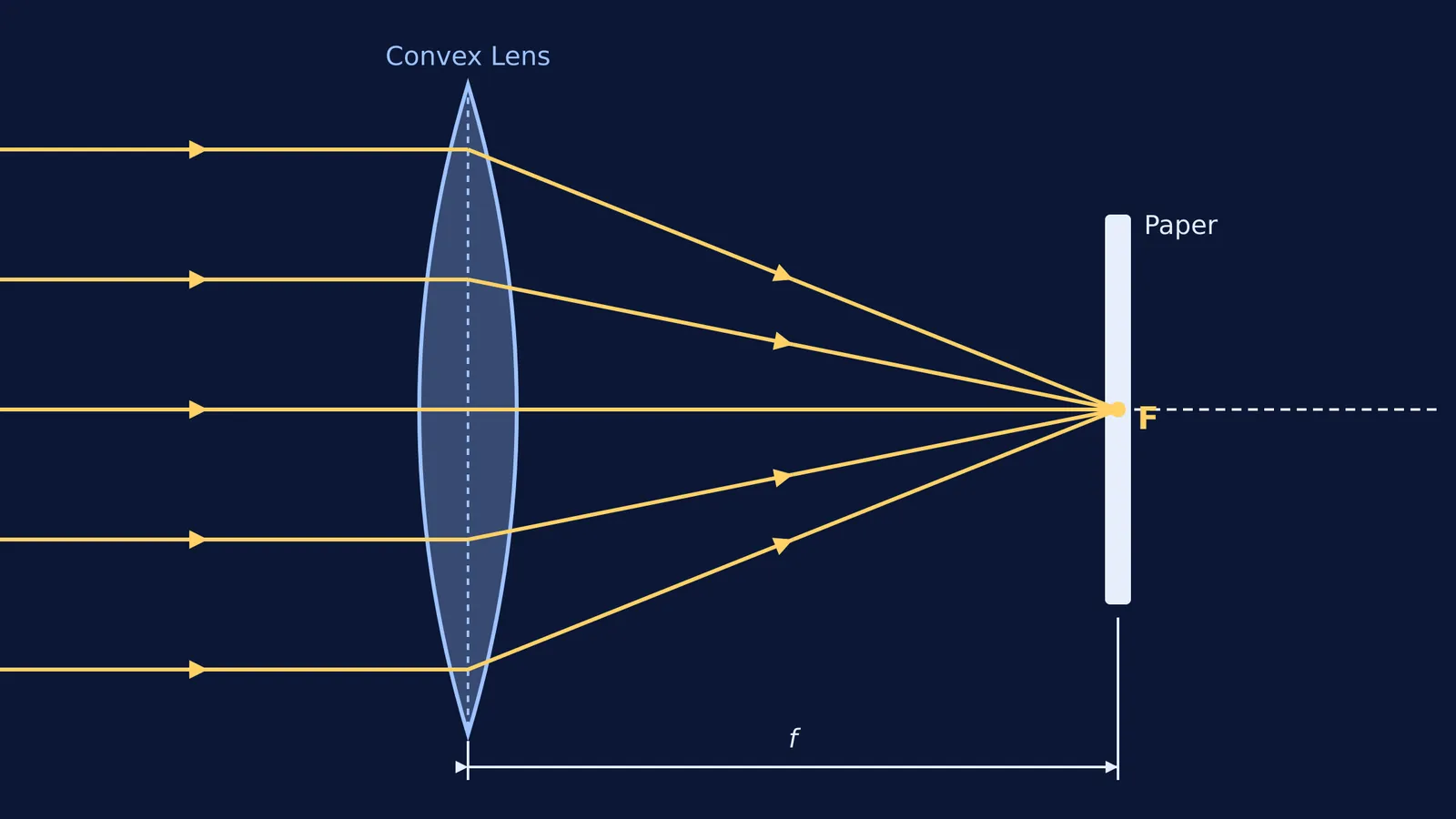
Because the Sun is extremely far away, the light rays arriving at your magnifying glass are practically parallel.
A standard magnifying glass is a convex lens, which means it is thicker in the middle and thinner at the edges. When light passes from the air into the denser glass, it slows down and bends—a process known as refraction. Because of the curved shape of the lens, rays hitting the edges are bent more than those near the centre.
This geometry forces all the incoming parallel rays to converge at a single point on the other side, known as the principal focus. Just as we see in concave mirror images for all six object positions, Class 10, parallel rays from an object at infinity will converge at the focus to form a real, inverted image.
How hot does the focal point get?
The Sun delivers an enormous amount of energy, and the solar constant is approximately 1.361 kilowatts per square metre. Normally, this energy warms the ground evenly, which is why paper left out in the sun does not spontaneously combust.
However, a convex lens collects all the light energy falling across its entire surface area and squeezes it into a tiny spot. This bright spot is actually a tiny projection of the Sun itself. The Sun's angular diameter as seen from Earth is about 32 arcminutes, or roughly half a degree. Because of this, the exact width of the bright dot depends on the focal length of the lens.
By compressing the captured solar power into a tiny area, the lens vastly increases the intensity of the light—and the invisible infrared radiation that carries heat. This concentrated radiation transfers heat to the paper far faster than the paper can cool down.
What is the ignition temperature of paper?
For paper to catch fire without a direct flame or a spark, it must reach its autoignition temperature. The autoignition temperature of paper is 218–246 °C.
Once the focused sunlight raises the temperature of the illuminated spot above this threshold, the chemical bonds in the cellulose begin to break down rapidly. The heated paper reacts with oxygen in the surrounding air, creating smoke and eventually a flame.
How to find the focal length with this method?
You can safely use this principle to find the rough focal length of any converging lens. Do this over pavement or dirt, never indoors or near dry grass.
Take the lens and a piece of dark paper outside on a bright, sunny day.
Hold the lens between the Sun and the paper, keeping the glass perpendicular to the rays.
Slowly move the lens closer to or further from the paper.
Watch the bright circle of light; when it shrinks to its smallest, sharpest point, the paper is exactly at the principal focus.
Ask a friend to measure the distance from the middle of the lens to the paper.
If you are learning ray optics, keeping track of image positions can be tricky. To see how image distances behave when the object is closer than infinity, explore why a lens's object and real image are at least 4f apart. If you want to understand how a prism splits light instead of focusing it, read about the dispersion of white light by a glass prism, explained for Class 10.
If you have gaps in your understanding of ray optics, the Fermi Concept Library has a lesson for every concept in physics. To see it in action, the Fermi Simulation Lab provides interactive simulations for ideas that are easier to see than to read, letting you trace parallel rays to see exactly how the focal point changes with the lens's curvature.


