

On this page
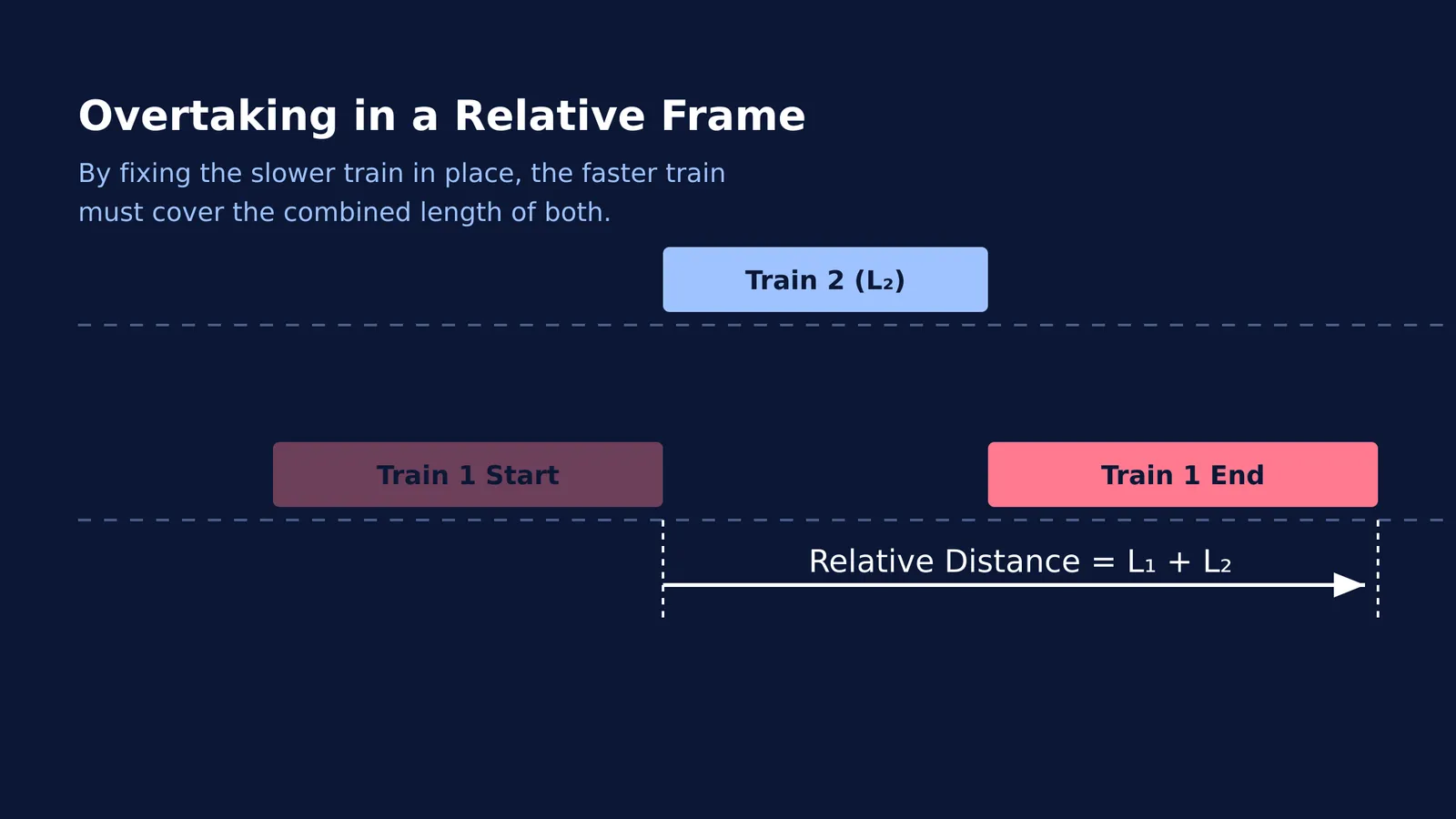
When a fast train passes a slower one on a parallel track, calculating the exact moment it clears the slower train can feel like tracking too many moving pieces at once. Both trains are advancing down the track, eating up distance every second. However, the time it takes depends on a single unifying concept: relative velocity. By shifting your perspective to the slower train, you can freeze it in place and watch the faster train cover the combined length of both.
Here is how the physics works, how to set up the formula, and how to test your understanding.
What is the time for one train to overtake another simulation?
To calculate the time t for one train to completely overtake another, divide the total distance by their relative speed. If the faster train (length L₁, speed v₁) overtakes a slower train (length L₂, speed v₂) moving in the exact same direction, the standard formula is t = (L₁ + L₂) / (v₁ − v₂).
Why add the lengths? In a simulation, overtaking is not instantaneous. It officially begins the moment the nose of the faster train catches up to the tail of the slower train, and ends when its tail clears the slower one's nose. In the frame of reference of the slower train, the faster train must travel exactly its own length plus the slower train's length to complete the pass.
For instance, dividing the combined lengths of both trains by their relative speed gives the exact overtaking time in seconds.
How do you solve the NCERT train overtaking problem?
Standard physics problems often introduce acceleration to test kinematics beyond a steady speed. A classic problem found in NCERT Class 11 Physics involves two trains A and B of length 400 m each. They move on parallel tracks with a uniform speed of 72 km/h (20 m/s) in the same direction, with train A ahead of B.
The driver of B decides to overtake A and accelerates by 1 m/s². The problem states that after 50 seconds, the guard of B just brushes past the driver of A, and asks for the original distance between them.
Because their initial speeds match at 20 m/s, their initial relative velocity is zero. The relative acceleration is simply 1 m/s² (since train A is not accelerating). Using the kinematic equation for relative displacement, s_rel = u_rel t + ½ a_rel t², the relative distance covered over those 50 seconds is ½ × 1 × (50)² = 1250 m. Therefore, the original distance between the two trains was 1250 m.
If you want to see exactly how these positions change second by second, you can set the lengths, speeds, and acceleration rates in the Fermi Simulation Lab. Interactive simulations for the ideas that are easier to see than to read help visualise what the math is doing.
How to handle crossing trains in opposite directions?
When setting up your calculation, the most common trap is forgetting to change the sign for trains moving in opposite directions. The core logic of relative motion remains the same, but the way the gap closes changes.
Same direction (overtaking): Subtract the speeds (v₁ − v₂). The gap between the trains closes slowly.
Opposite direction (crossing): Add the speeds (v₁ + v₂). The gap closes quickly, because both trains are actively reducing the distance between them.
Once you establish the correct relative speed, the required distance is always L₁ + L₂. This relative motion test applies to other moving bodies. For example, if you are predicting Will two projectiles collide midair?, you shift into the frame of one projectile to see if the other is headed straight for its exact coordinates.
What is a step-by-step checklist for exam problems?
If you are solving a high-stakes exam question, follow these steps to guarantee the right answer:
Draw the reference frame. Decide which train will be 'stationary'. Calculate all velocities and accelerations relative to that specific train.
Standardise your units. A speed in km/h mixed with a length in meters will ruin a calculation. Convert everything to SI units immediately.
Identify the reference points. Are you measuring from the driver to the driver, or from the nose to the tail? If a problem asks when a driver passes a guard, you only use one train's length.
Account for changing speeds. If a train is braking, its acceleration is negative relative to its velocity. If the braking is non-linear, you may need to learn Acceleration given as a function of v or x: how to integrate it to find the correct time.
Mastering this perspective shift makes complex kinematics problems straightforward. By freezing one object, you turn moving targets into simple calculations.


