

On this page
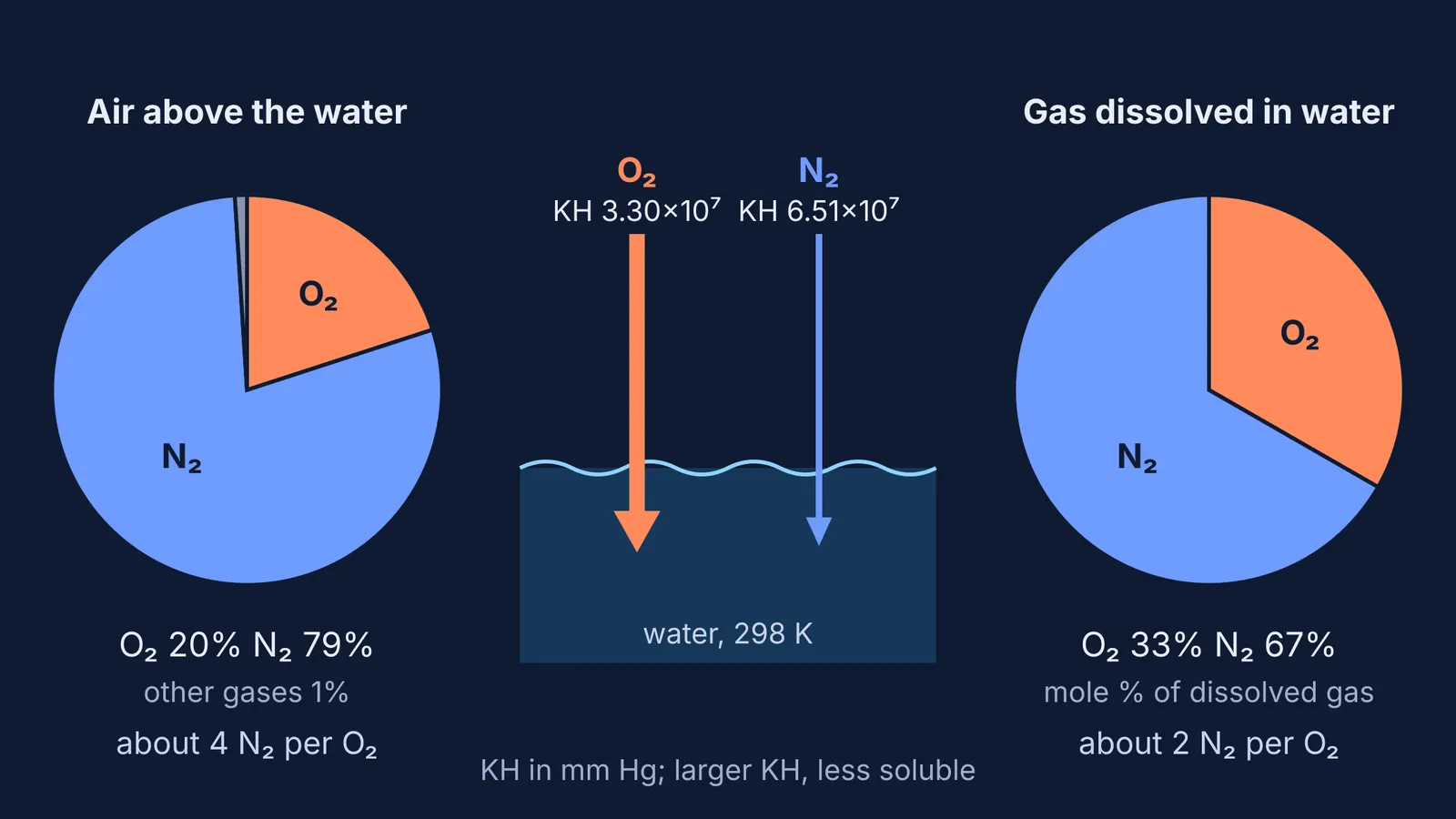
Air is mostly nitrogen. About four molecules in five are N₂ and only one in five is O₂. You might expect dissolved air to have the same mix. It does not. The gas in the water holds about one O₂ for every two N₂, so it is roughly a third oxygen. An NCERT Solutions exercise lets you prove this with Henry's law, and it tests whether you know which way the Henry's law constant runs.
What does Henry's law say about a mixture of gases?
Henry's law in the form NCERT uses is p = KH·x. Here p is the partial pressure of one gas above the liquid, x is that gas's mole fraction in the solution, and KH is the Henry's law constant for that gas in that solvent at that temperature.
For a mixture such as air, each gas obeys the law on its own. Oxygen dissolves according to its own partial pressure and KH, and so does nitrogen. So the recipe is:
Find each gas's partial pressure from Dalton's law: p = (fraction in the gas) × (total pressure).
Divide by that gas's KH to get its mole fraction in the water.
Compare the mole fractions.
If you need a refresher on the basic law and single-gas problems, start with Henry's law and the solubility of gases, with worked problems.
Why does a smaller KH mean a more soluble gas?
Rearrange the law: x = p/KH. At the same partial pressure, a gas with a smaller KH ends up with a larger mole fraction in the water. So in this form of the law, smaller KH means more soluble.
NCERT gives, for water at 298 K:
KH(O₂) = 3.30 × 10⁷ mm Hg
KH(N₂) = 6.51 × 10⁷ mm Hg
N₂'s constant is almost exactly twice O₂'s (6.51/3.30 = 1.97), so at equal partial pressures O₂ is about twice as soluble. That tilts the dissolved gas towards oxygen.
Worked example: what is the composition of air dissolved in water at 10 atm?
This is the NCERT exercise. Air is taken as 20% O₂ and 79% N₂ by volume. Water is in equilibrium with air at a total pressure of 10 atm and 298 K. Find the mole fractions of O₂ and N₂ in the water.
Step 1: total pressure in mm Hg. The constants are in mm Hg, so convert first. 10 atm × 760 mm Hg atm⁻¹ = 7600 mm Hg.
Step 2: partial pressures. For a gas mixture, volume fraction equals mole fraction, so:
p(O₂) = 0.20 × 7600 = 1520 mm Hg
p(N₂) = 0.79 × 7600 = 6004 mm Hg
Step 3: mole fractions in water.
x(O₂) = 1520 / (3.30 × 10⁷) = 4.61 × 10⁻⁵
x(N₂) = 6004 / (6.51 × 10⁷) = 9.22 × 10⁻⁵
Step 4: compare the two. In the air, the ratio N₂ : O₂ is 79/20, about 4 : 1. In the water, the ratio is 9.22 × 10⁻⁵ / 4.61 × 10⁻⁵ = 2.0, so 2 : 1.
Step 5: composition of the dissolved gas. Of all the dissolved O₂ and N₂ together:
O₂: 4.61 / (4.61 + 9.22) = 0.333, about 33%
N₂: 9.22 / (4.61 + 9.22) = 0.667, about 67%
So air that is 20% oxygen becomes dissolved gas that is about 33% oxygen.
Notice that the 10 atm cancels out of step 5. Both partial pressures scale with it, so the 33% figure holds at 1 atm too.
What does the 33% figure actually mean?
The 33% is the mole fraction of O₂ among the dissolved gas molecules. It is not the mole fraction of O₂ in the solution. In the solution, water is by far the main component: x(O₂) is only 4.61 × 10⁻⁵ even at 10 atm.
Also note what the problem leaves out. Real dry air is about 78% N₂, 21% O₂ and about 1% argon, plus some CO₂. NCERT's 20 : 79 split rounds the numbers and ignores argon and water vapour. With 21% O₂ and 78% N₂ the dissolved gas comes out at about 35% O₂ instead of 33%.
And all these numbers are for 298 K only. KH rises with temperature for both gases, so both become less soluble in warm water. That temperature story, with measured values, is in why warm water holds less oxygen, and what it means for fish.
Does the answer match real dissolved oxygen in water?
You can check NCERT's constant against measured data. Take water at 25 °C under air at 1 atm.
p(O₂) = 0.20 × 760 = 152 mm Hg.
x(O₂) = 152 / (3.30 × 10⁷) = 4.61 × 10⁻⁶.
One kilogram of water is 1000/18.02 = 55.5 mol. Since x is tiny, moles of O₂ ≈ x × 55.5 = 2.56 × 10⁻⁴ mol per kg.
Mass: 2.56 × 10⁻⁴ × 32.0 g mol⁻¹ = 8.2 × 10⁻³ g, which is 8.2 mg per kg, or about 8.2 mg L⁻¹.
The USGS DOTABLES saturation table gives about 8.3 mg L⁻¹ at 25 °C and sea-level pressure. If you use 20.95% O₂ and subtract the water vapour pressure at 25 °C (about 24 mm Hg) from the 760, the Henry's law estimate becomes 8.3 mg L⁻¹ as well. The textbook constant holds up.
The same calculation for nitrogen gives about 14 mg L⁻¹, more than the oxygen but far less than the air's 4 : 1 ratio would suggest.
Why does this matter for fish and for divers?
Fish take oxygen from the gas dissolved in water, not from air. Because O₂ is the more soluble of the two main gases, the dissolved gas they draw on is enriched in oxygen compared with air. Even so, the absolute amount is small: about 8 mg L⁻¹ at 25 °C, against roughly 270 mg of O₂ in a litre of air at the same temperature.
For divers, the concern runs the other way. Nitrogen is less soluble, but there is so much more of it that it builds up in body fluids under pressure. That is the subject of why divers get the bends: Henry's law at 30 metres.
If you want to try more mixed-gas Henry's law questions, the Fermi Problem Library has a step-by-step solver that explains the reasoning at each stage.
What slips cost marks on this problem?
Using the total pressure (7600 mm Hg) for each gas instead of its partial pressure.
Leaving pressure in atm while KH is in mm Hg.
Reading KH backwards and concluding that N₂, with the larger constant, is more soluble.
Calling 33% the oxygen content of the solution rather than of the dissolved gas.
Quick checklist
Each gas in a mixture obeys p = KH·x separately, with its own partial pressure.
In this form, smaller KH means more soluble. KH(N₂) is about twice KH(O₂) at 298 K.
At 10 atm: x(O₂) = 4.61 × 10⁻⁵, x(N₂) = 9.22 × 10⁻⁵.
Air has about 4 N₂ per O₂; the dissolved gas has about 2.
Dissolved gas is about 33% O₂, against about 20% in air, at any total pressure.
Check: at 1 atm and 25 °C the estimate is about 8.2 mg L⁻¹ of O₂, close to the measured 8.3 mg L⁻¹.


