

On this page
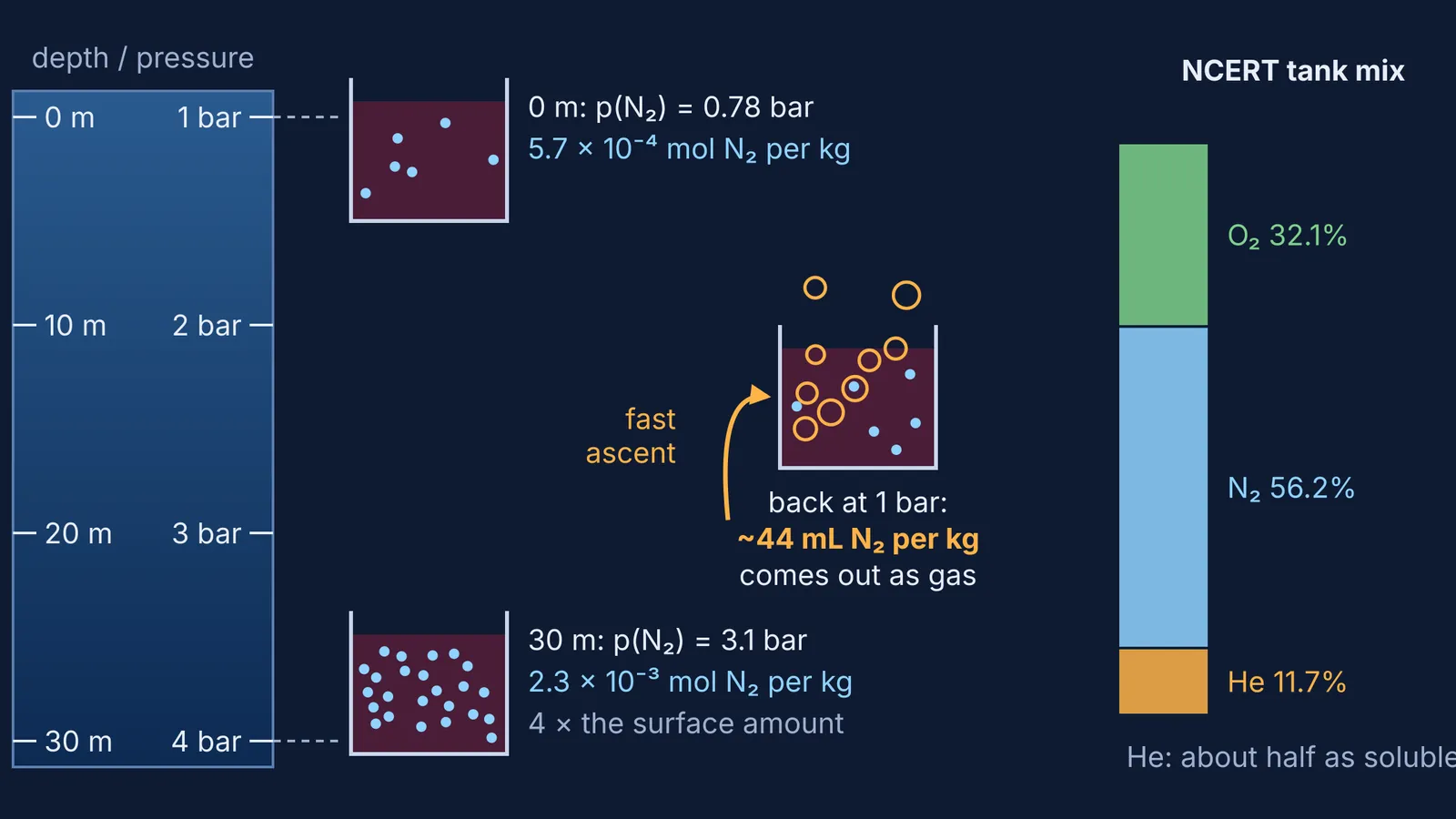
A scuba diver at 30 metres breathes air at about four times the pressure it has at the surface. Henry's law says the amount of a gas that dissolves in a liquid is proportional to that gas's partial pressure above it, so the diver's blood takes up about four times as much nitrogen. If the diver then rises too quickly, the pressure falls and the extra nitrogen comes out of solution as bubbles. That is the bends. NCERT lists it as an application of Henry's law, and it makes a clean numerical.
What does Henry's law say about gas dissolving in blood?
In the mole-fraction form used by NCERT:
p = KH × x
Here p is the partial pressure of the gas above the liquid, x is the mole fraction of that gas in the solution, and KH is the Henry's law constant. A larger KH means a less soluble gas, because a higher pressure is needed to get the same mole fraction into solution. NCERT tabulates KH for N₂ in water as 76.48 kbar and for He as 144.97 kbar, both at 293 K.
The pressure that matters is the partial pressure of N₂, not the total pressure. Air is about 78% N₂, so at the surface p(N₂) is about 0.78 bar. For the full set of unit traps (kbar vs bar, mole fraction vs molality), see Henry's law and the solubility of gases, with worked problems.
How does pressure change with depth underwater?
Water pressure adds ρgh to the atmospheric pressure. Seawater has a density of about 1025 kg m⁻³, so:
every 10 m adds 1025 × 9.81 × 10 ≈ 1.0 × 10⁵ Pa, which is about 1.0 bar
at 30 m the extra pressure is about 3.0 bar
the total pressure at 30 m is about 1.0 + 3.0 = 4.0 bar
A diver's regulator delivers air at the pressure of the surrounding water, so the air in the lungs at 30 m is at about 4.0 bar, and p(N₂) in it is about 0.78 × 4.0 ≈ 3.1 bar. Blood passing through the lungs comes towards equilibrium with that gas.
How much extra nitrogen dissolves at 30 metres?
Treat blood as water and use NCERT's KH value. Take 1 kg of water, which is 1000/18.0 = 55.5 mol. The solution is so dilute that moles of N₂ ≈ x × 55.5.
At the surface. x(N₂) = 0.78 / 76 480 = 1.0 × 10⁻⁵. Moles of N₂ = 1.0 × 10⁻⁵ × 55.5 = 5.7 × 10⁻⁴ mol per kg.
At 30 m. p(N₂) = 0.78 × 4.0 = 3.12 bar. x(N₂) = 3.12 / 76 480 = 4.1 × 10⁻⁵. Moles of N₂ = 4.1 × 10⁻⁵ × 55.5 = 2.3 × 10⁻³ mol per kg.
Ratio. 2.3 × 10⁻³ / 5.7 × 10⁻⁴ = 4.0. Four times the partial pressure, four times the dissolved gas.
Excess on returning to the surface. 2.26 × 10⁻³ − 0.57 × 10⁻³ = 1.7 × 10⁻³ mol of N₂ per kg must leave the solution.
Volume of that gas. At body temperature (310 K) and 1 bar, V = nRT/p = 1.7 × 10⁻³ × 0.0831 × 310 / 1.0 = 0.044 L, about 44 mL per kg of water.
If that gas leaves slowly, it is carried back to the lungs dissolved and breathed out. If the pressure drops fast, the liquid becomes supersaturated and the gas forms bubbles where it is, as a soda bottle fizzes when opened. The soda case, with CO₂, is worked in why fizzy drinks go flat.
Why does surfacing too fast cause the bends?
The cause is chemical: a gas that dissolved under high pressure comes out of solution when the pressure falls. Bubbles that form in the blood and tissues can block small vessels and press on nerves, which causes pain, especially in the joints. The everyday name is the bends; the medical term is decompression sickness.
The chemistry also shows why the rate of ascent matters more than the depth alone. Dissolved gas needs time to diffuse back to the lungs. A slow ascent keeps the dissolved amount close to equilibrium at each depth, so the solution never becomes strongly supersaturated. Divers are trained to follow decompression procedures for this reason. Anything medical belongs with dive professionals and doctors, not with a chemistry calculation.
Why do scuba tanks contain helium?
NCERT says that to avoid the bends, and the toxic effects of high nitrogen concentrations in the blood, scuba tanks are filled with air diluted with helium: 11.7% He, 56.2% N₂ and 32.1% O₂. The reason it gives is solubility. Helium's KH (144.97 kbar) is about 1.9 times nitrogen's, so at the same partial pressure helium is only about half as soluble. Saying helium is used "because it is inert" misses the point: nitrogen is also unreactive in the body. What matters here is how much dissolves.
Redo the 30 m example with this mix, still at 4.0 bar total:
p(N₂) = 0.562 × 4.0 = 2.25 bar, so dissolved N₂ = (2.25 / 76 480) × 55.5 = 1.6 × 10⁻³ mol per kg.
p(He) = 0.117 × 4.0 = 0.47 bar, so dissolved He = (0.47 / 144 970) × 55.5 = 1.8 × 10⁻⁴ mol per kg.
Total dissolved inert gas = 1.8 × 10⁻³ mol per kg, against 2.3 × 10⁻³ mol per kg with plain air.
Excess to release at the surface (surface air gives 5.7 × 10⁻⁴ mol N₂ and almost no He) = 1.24 × 10⁻³ mol per kg, which is about 32 mL at 310 K and 1 bar, against 44 mL with air.
So the same dive with the NCERT mix loads about a quarter less gas that has to come back out. If you want to practise more Henry's law conversions like these, the Fermi Problem Library has a step-by-step solver that explains the reasoning at each stage.
How accurate are these numbers?
Treat them as estimates of the size of the effect, not values for a human body.
NCERT's KH values are for pure water at 293 K. Blood is at about 310 K, and gases are less soluble in warm water, so KH is larger there.
Blood is not pure water. Fats, for example, dissolve more nitrogen than water does.
The body is not one beaker. Different tissues take up and release gas at different rates, which is why real dive planning is more complicated than this model.
High altitude is the opposite case: lower pressure, so less oxygen dissolves, which NCERT links to anoxia. That side is covered in how soldiers survive Siachen's thin air.
Quick checklist
Henry's law: p = KH × x, with p the partial pressure of that one gas.
Seawater adds about 1 bar per 10 m, so 30 m means about 4 bar total.
Dissolved N₂ scales with p(N₂): four times the pressure, four times the nitrogen.
At 30 m, about 1.7 × 10⁻³ mol of extra N₂ per kg of water, about 44 mL of gas at 310 K.
Fast pressure drop gives supersaturation and bubbles: the bends.
NCERT's helium mix works because He is about half as soluble as N₂ (higher KH).
The numbers use water at 293 K, so call them estimates.


