On this page
The Siachen Glacier is a 76-km river of ice where, according to a 2016 Tribune report, 879 Indian Army personnel had died since 1984, most of them from avalanches, landslides and other hostile weather rather than combat. The same report describes an Army camp at 19,600 ft (about 6,000 m). Here is the science of surviving up there, with numbers you can check.
What happens to oxygen at 5,400 m?
We use 5,400 m as an example height on the glacier. Dry air is 20.946% oxygen, according to NOAA's table of atmospheric gases. What matters to your lungs is oxygen's partial pressure: its share of the total air pressure. New to Dalton's law? Try our worked Dalton's law numerical.
To get the total pressure, we used a model atmosphere from physiologist John West, published in the Journal of Applied Physiology in 1996: Pb (in mmHg) = exp(6.63268 − 0.1112h − 0.00149h²), with h in kilometres. West reports predictions within 1% at many high-altitude sites.
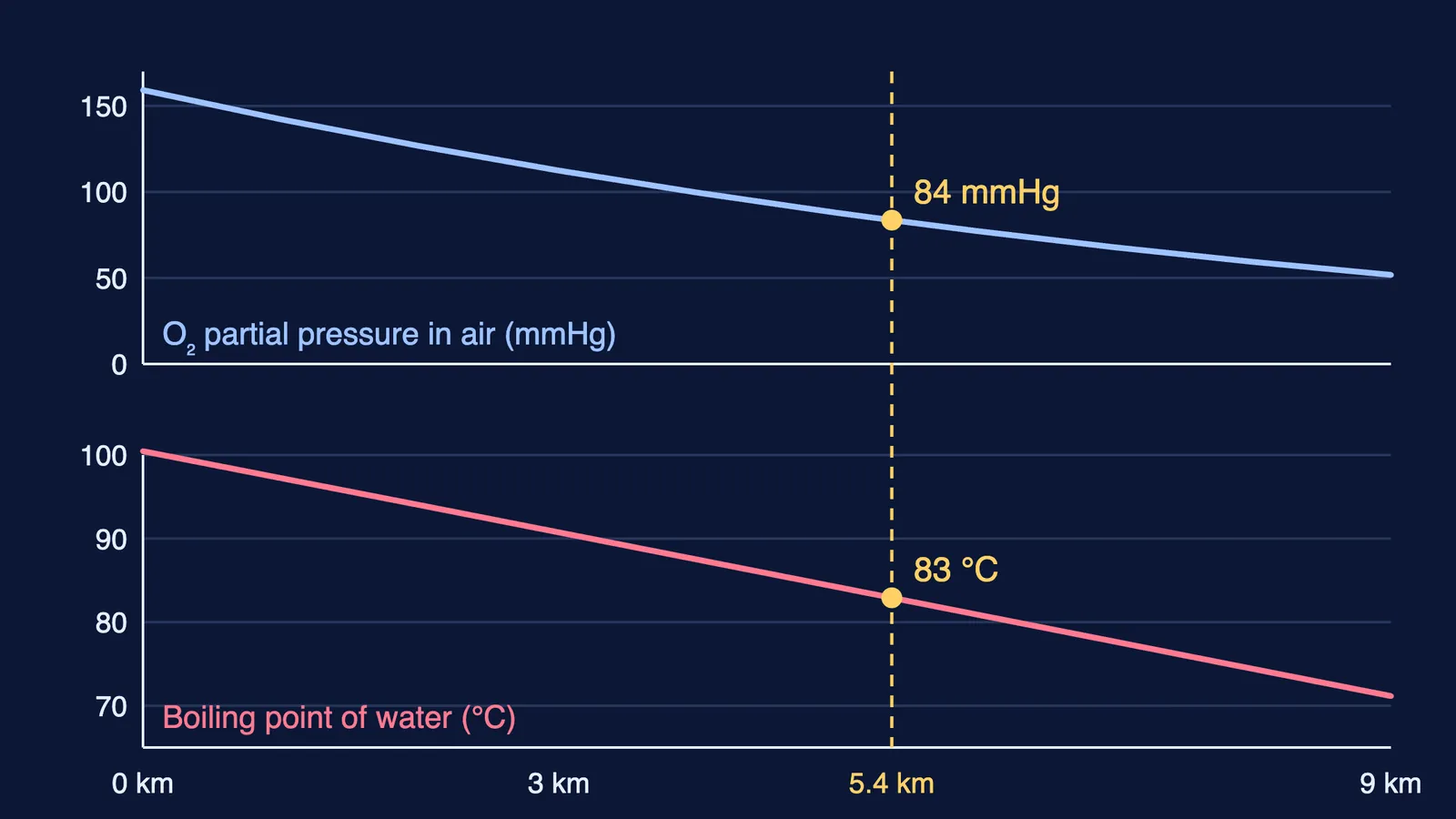
Sea level: Pb = exp(6.63268) ≈ 760 mmHg, so oxygen's partial pressure = 0.20946 × 760 ≈ 159 mmHg.
At 5,400 m: Pb = exp(5.98875) ≈ 399 mmHg, so oxygen's partial pressure ≈ 0.20946 × 399 ≈ 84 mmHg.
Inside your airways, water vapour at 37 °C takes about 47 mmHg (we computed this from the NIST Antoine constants for water). So the oxygen reaching your lungs is 0.20946 × (399 − 47) ≈ 74 mmHg, against about 149 mmHg at sea level: roughly half.
How does the body acclimatise to high altitude?
The CDC Yellow Book says the body can adjust to moderate hypoxia up to about 5,200 m, but needs time. In the first 3 to 5 days, breathing increases steadily and oxygenation improves. Blood plasma volume falls over the first few days, which raises haemoglobin concentration; making extra red cells plays no part in this early phase.
The Indian Army builds that time in. A field trial by Sikri and colleagues in the Medical Journal Armed Forces India notes that the Army divides high altitude into three stages: 9,000 to 12,000 ft (about 2,700 to 3,700 m), 12,000 to 15,000 ft, and above 15,000 ft (about 4,600 m). On the road the study followed, lowland soldiers took 11 days to reach a post at 3,500 m, including 6 days of acclimatisation at 9,404 ft. Even so, 19.14% of responders reported mild acute mountain sickness at a 15,280 ft transit camp.
Acclimatisation is no guarantee. A 2012 study of soldiers on Siachen calls high-altitude pulmonary oedema, fluid in the lungs, the most common challenging emergency on the glacier, and found it above 5,500 m even in fully acclimatised soldiers. For the history, read how Paul Bert found the cause of altitude sickness.
Why is frostbite such a danger at Siachen?
Frostbite is tissue freezing caused by heat loss large enough to form ice crystals in the skin or deeper tissue, according to a 2021 scoping review by Regli and colleagues. Cold first narrows the blood vessels in the skin. The skin then cycles between narrowing and widening every five to ten minutes, the "hunting reaction". Once the skin freezes, ice crystals form between the cells, drying the cells out and shifting salts and pH.
The review lists dehydration, high altitude and hypoxia as added risk factors, and says severity depends on temperature, wind chill and time exposed. Siachen stacks all of them. Your body's other cold defence, shivering, is explained in why we shiver.
Why does water boil below 85 °C at Siachen?
Water boils when its vapour pressure equals the pressure of the air above it. Using NIST's Antoine equation for water, log10(P in bar) = 4.6543 − 1435.264 / (T − 64.848), we set P to 399 mmHg (0.532 bar) and solved for T: about 356 K, or 83 °C, from the NIST WebBook constants. So rice and dal cook more slowly up there. A pressure cooker helps by raising the pressure, and so the boiling point.
If you learn better by seeing, the Fermi Simulation Lab has interactive simulations for ideas that are easier to see than to read.
How can you work this out for any altitude?
Try it for a hill station at 2,000 m, using West's equation and the Antoine equation above, then check against our answers.
Pressure: exp(6.63268 − 0.2224 − 0.00596) ≈ 604 mmHg.
Oxygen's partial pressure: 0.20946 × 604 ≈ 127 mmHg.
Boiling point: 604 mmHg is 0.806 bar; solving the Antoine equation gives about 94 °C.
The CDC Yellow Book sets out ascent rules for travellers, including an extra night for every 1,000 m of sleeping altitude gained.
Planning a trek to Ladakh? Talk to a doctor first. If a step in the numericals trips you up, the Fermi Problem Library has worked problems with a step-by-step solver that explains the reasoning rather than printing an answer.