

On this page
You step out on a December morning and your jaw starts chattering. You did not decide to shiver. Your brain did, because it defends your core temperature.
What controls body temperature?
Your body works like a room with a thermostat. A review in the *Annals of Internal Medicine* calls the preoptic area of the anterior hypothalamus "the thermoregulatory center of the brain" and describes a "set-point" for normal body temperature (Bernheim, Block and Atkins, 1979). Think of the brain comparing the temperature it senses with that target value, the set point.
Normal body temperature is around 37°C (NHS).
A review of the brain circuits behind this names the body's main tools: narrowing the blood vessels in the skin to limit heat loss, and shivering and brown fat to make heat (Morrison and Nakamura, Annual Review of Physiology, 2019). When the temperature drifts down, the brain switches these on until it moves back. That is negative feedback, and holding the inside of the body steady this way is called homeostasis. Read how Walter Cannon coined the word homeostasis.
If homeostasis feels like a list of words rather than one idea, the Fermi Concept Library gives every biology concept its own lesson and its place in the map.
Why do we shiver when cold?
Shivering is your skeletal muscles contracting rapidly and without your control. The shaking moves nothing useful outside your body, so almost all the chemical energy the muscles burn ends up as heat inside you.
A 2017 review by Haman and Blondin describes shivering skeletal muscle as the most important source of heat in adults exposed to cold (Temperature, 2017).
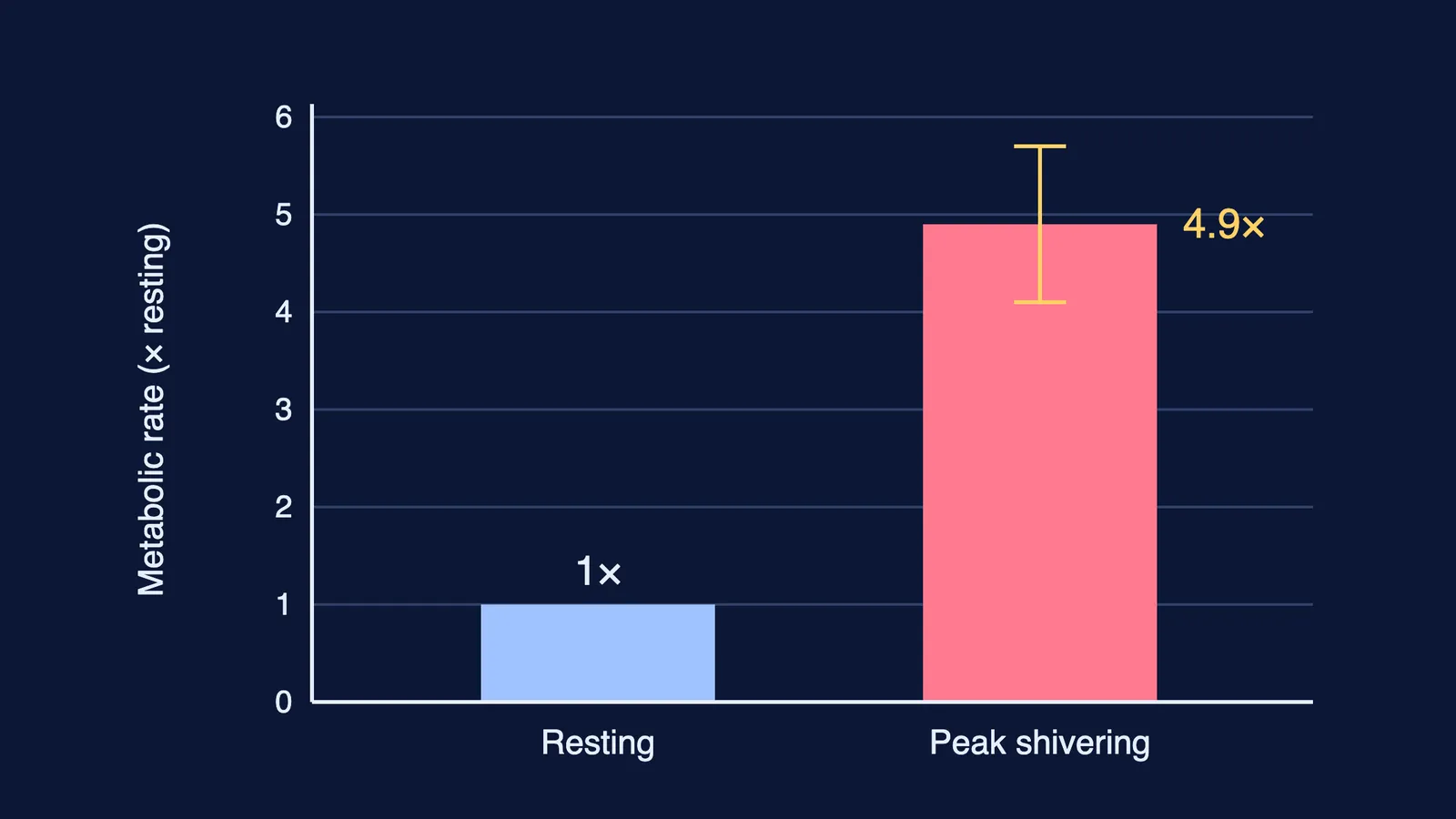
In a study of 15 volunteers, peak shivering raised oxygen use to 4.9 times resting metabolism (Eyolfson et al., European Journal of Applied Physiology, 2001). The volunteers were first immersed in 8°C water, then the water was warmed slowly to 20°C, when their core temperature was already low, to push shivering to its peak.
Fever works through the same thermostat. The 1979 review explains that a fever-inducing hormone released during infection raises the set point, and the body then makes heat by shivering and cuts heat loss by narrowing skin blood vessels to produce the fever (Bernheim et al., 1979). We explain more in why your body gets a fever during an infection.
Worked example: how much oxygen does a hard shiver use?
At peak shivering, Eyolfson's volunteers used 22.1 ml of oxygen per kilogram of body mass per minute, which was 4.9 times their resting rate (Eyolfson et al., 2001). Scale that to a 60 kg student, assuming the same rate per kilogram:
Peak shivering: 22.1 × 60 = 1,326 ml, about 1.3 litres of oxygen per minute.
Resting: 22.1 ÷ 4.9 = about 4.5 ml per kg per minute, so 4.5 × 60 = about 0.27 litres per minute.
Difference: about 1.05 extra litres of oxygen every minute, used to burn fuel for heat.
Why do lips turn blue in the cold?
Shivering makes heat. The second response saves it. In the cold, blood vessels in the skin narrow, so less warm blood reaches the surface and less heat escapes (Morrison and Nakamura, 2019). You can see the cost on your face.
Cyanosis is a bluish colour of the skin or mucous membranes that appears when deoxygenated haemoglobin reaches 5.0 g/dL or more (Pahal and Goyal, StatPearls). It is easiest to see where blood vessels lie close to the surface under thin skin: lips, nose, earlobes and the tips of fingers and toes. When less blood flows through cold skin, each bit of blood stays longer and gives up more of its oxygen, so the colour can shift from red towards blue. The same source says this peripheral kind of cyanosis, in the hands, fingers and toes and sometimes around the mouth, is rarely a life-threatening emergency.
Wet skin makes you colder still, as our post on why you feel cold after a bath explains.
When is shivering a warning sign?
The NHS defines hypothermia as a dangerous drop in body temperature below 35°C and calls it a medical emergency (NHS). Its list of symptoms includes:
shivering
pale, cold and dry skin, with skin and lips that may turn blue or grey
slurred speech
slow breathing
tiredness or confusion
How do you explain thermoregulation in an exam answer?
Use a four-step loop:
Sense: skin and core temperature fall.
Compare: the preoptic area of the hypothalamus finds the temperature below the set point.
Respond: skin blood vessels narrow to save heat. Muscles shiver and brown fat burns fuel to make heat.
Check: as the temperature returns to the set point, the responses switch off. That is negative feedback.
To talk the loop through, Fermi's AI tutor works out what you already know, builds a plan for the session and checks your understanding as it goes.


