On this page
A question gives you grams of two gases in a closed vessel and asks for each gas's pressure. Many students stall because grams are not pressure. The bridge is the mole: once you count molecules in moles, Dalton's law does the rest in two lines. Below is one numerical worked from start to finish, plus the checks that catch the usual slips.
What does Dalton's law of partial pressure say?
Dalton's law states that the total pressure of a mixture of ideal gases equals the sum of the partial pressures of the component gases (OpenStax Chemistry 2e, section 9.4/09%3A_Gases/9.04%3A_Stoichiometry_of_Gaseous_Substances_Mixtures_and_Reactions)).
The partial pressure of a gas is the pressure it exerts in the mixture, and it equals the gas's mole fraction times the total pressure: p(A) = x(A) × P(total), where x(A) = n(A) / n(total) (OpenStax Chemistry 2e/09%3A_Gases/9.04%3A_Stoichiometry_of_Gaseous_Substances_Mixtures_and_Reactions)).
Why mole fraction and not mass fraction? For an ideal gas, pressure depends on how many molecules hit the walls, not on what they are. A mole of nitrogen and a mole of oxygen push equally hard at the same volume and temperature. Mass only enters when you convert it to moles.
How do you find partial pressures from the masses of N2 and O2?
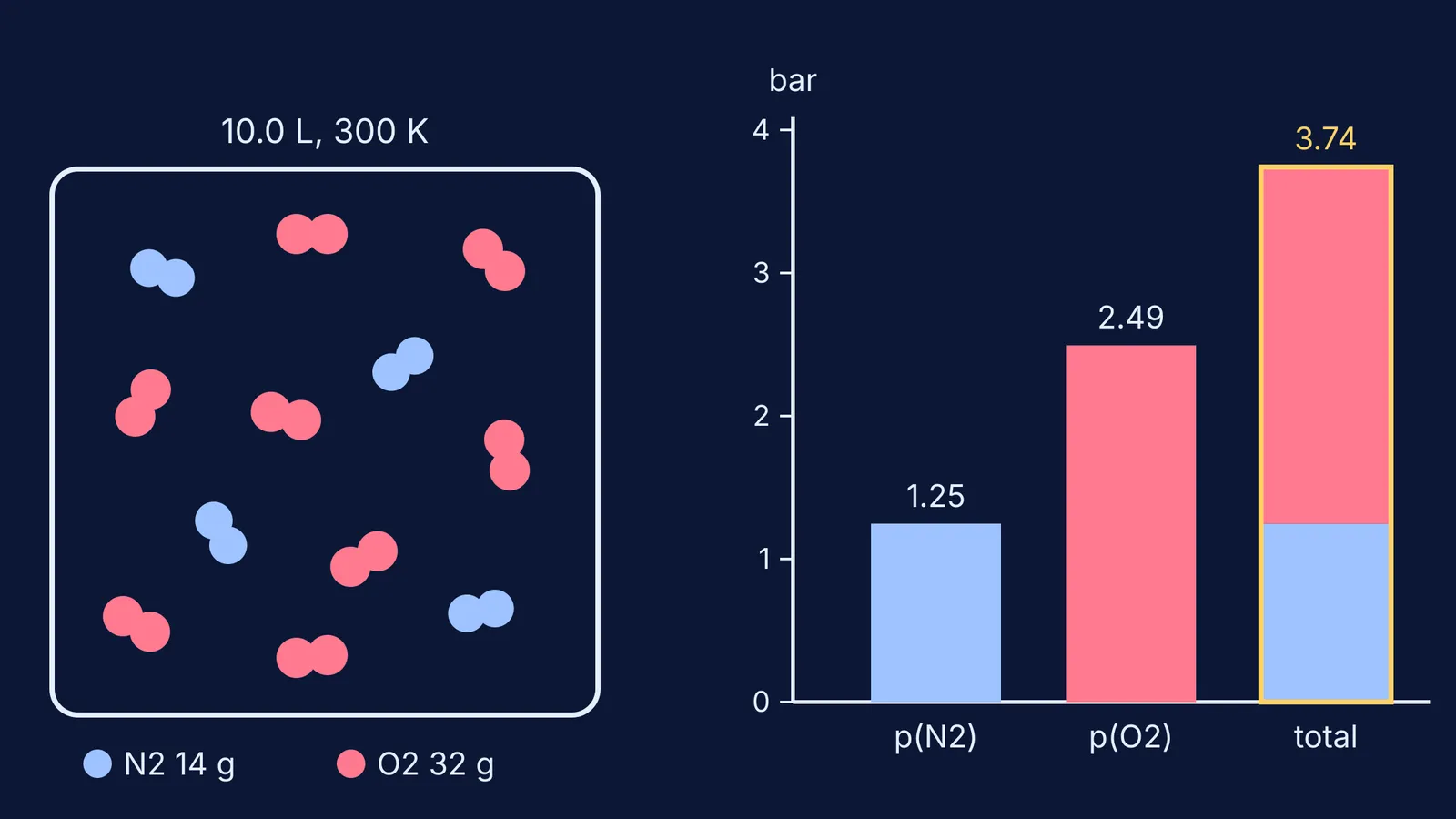
Question: A 10.0 L vessel at 300 K holds 14 g of N2 and 32 g of O2. Find the partial pressure of each gas and the total pressure.
The abridged standard atomic weights are 14.007 for nitrogen and 15.999 for oxygen (CIAAW abridged atomic weights), so N2 is 28.0 g/mol and O2 is 32.0 g/mol to three figures. The molar gas constant is 8.314 J/(mol K) (NIST CODATA). Since 1 bar = 100,000 Pa and 1 L = 0.001 m³, that is 0.08314 L bar/(mol K).
Moles of N2 = 14 / 28 = 0.50 mol. Moles of O2 = 32 / 32 = 1.00 mol.
Total moles = 1.50 mol, so x(N2) = 0.50 / 1.50 = 1/3 and x(O2) = 2/3.
Total pressure = nRT / V = 1.50 × 0.08314 × 300 / 10.0 = 3.74 bar.
p(N2) = 1/3 × 3.74 = 1.25 bar, and p(O2) = 2/3 × 3.74 = 2.49 bar.
Check: 1.25 + 2.49 = 3.74 bar. You can also find p(N2) directly as 0.50 × 0.08314 × 300 / 10.0 = 1.25 bar, as if the nitrogen were alone in the vessel.
That last check is Dalton's idea in one line: each gas fills the whole vessel and ignores the other.
Does the heavier gas always have the higher partial pressure?
No, and this is where the question setter likes to test you. Suppose the vessel held 16 g of each gas instead. Nitrogen gives 16 / 28 = 0.571 mol, oxygen gives 16 / 32 = 0.500 mol, so x(N2) = 0.571 / 1.071 = 0.533. Equal masses, but nitrogen now has the larger share of the pressure, because its lighter molecules mean more of them per gram.
What mistakes cost marks in partial pressure numericals?
Using 14 g/mol for N2. Nitrogen gas is diatomic; using the atomic mass doubles its moles.
Taking mass fractions as mole fractions. 14 g out of 46 g is not 1/3.
Leaving temperature in Celsius. Add 273 (273.15 if the data is precise) before using PV = nRT.
Mixing units. Use 8.314 with pascals and cubic metres, or 0.08314 with bar and litres. Putting litres into the 8.314 version leaves the pressure too small by the litre-to-cubic-metre factor.
Forgetting to add the partial pressures back up as a final check.
How can you check your answer against real air?
Dry air is 78.08% N2 and 20.95% O2 by volume, and Earth's surface pressure is about 1014 millibars (NASA Earth fact sheet). For ideal gases, volume fraction equals mole fraction, so the partial pressure of oxygen in dry air at the surface is about 0.2095 × 1014 = 212 millibars. If your method gives that, it works on a mixture close to the one you are breathing right now.
To see why the bars in a mixture stack up this way, try our walk-through of Dalton's law of partial pressures as a simulation you can check. If mole fraction itself still feels slippery, converting mole fraction to molality and molarity, step by step drills the same counting. And for the story behind the law, read about the 1801 discovery behind Dalton's law.
When you get a mixture problem wrong and cannot see which step slipped, the Fermi Problem Library has worked problems with a step-by-step solver that explains the reasoning rather than printing an answer. If the gap is in the idea, not the arithmetic, the Fermi Concept Library gives each chemistry concept its own lesson.
Next step: change the masses in the worked example to 28 g of N2 and 16 g of O2, and predict which gas wins before you calculate.