On this page
Until the 1870s, scientists argued about why climbers and balloonists suffered from mountain sickness. Was it the mechanical effect of low barometric pressure on the body, or was it a chemical change in the blood? French physiologist Paul Bert resolved the debate using the decompression chamber. His findings laid the groundwork for modern aerospace and diving medicine.
What causes altitude sickness?
In 1878, Paul Bert published *La Pression barométrique*, which proved that altitude sickness is caused by a low partial pressure of oxygen rather than a drop in total air pressure (Source).
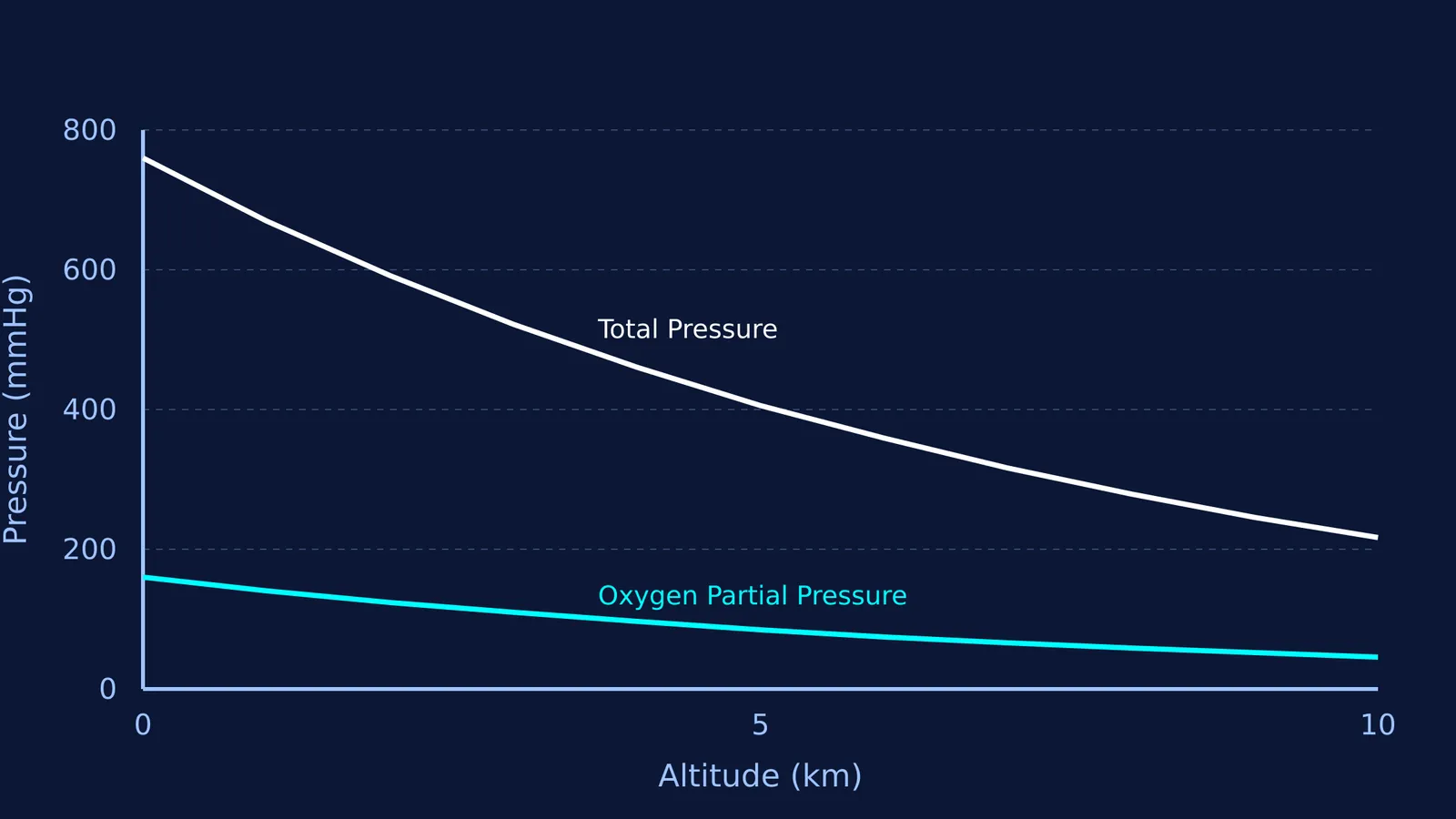
To understand his discovery, we have to look at how gases behave. At sea level, standard air pressure is 760 millimetres of mercury (mmHg) (Source). Oxygen makes up roughly 21% of the atmosphere (Source). According to Dalton's law, this gives oxygen a partial pressure of about 160 mmHg.
If you climb a mountain where the total atmospheric pressure drops to half of its sea-level value, oxygen still makes up 21% of the air. However, its partial pressure drops to 80 mmHg. Bert realised that the human body relies on this partial pressure, or "tension," to drive oxygen across the lung tissues and into the blood. When the partial pressure is too low, the lungs cannot extract enough oxygen, leading to hypoxia.
If you are trying to picture how gas molecules spread out and exert pressure in different environments, Fermi's Simulation Lab provides interactive simulations for the ideas that are easier to see than to read. You can also explore the biological side of this process in our guide on the mechanism of inspiration and expiration.
How did Paul Bert use pressure chambers?
To test his theories safely, Bert built steel hypobaric chambers. By placing subjects in these pneumatic cabinets and pumping the air out, he could simulate the atmospheric conditions of high altitudes without ever leaving his laboratory.
During self-experimentation, he recorded his own symptoms of dizziness, nausea and mental fatigue as the pressure fell. He then demonstrated that inhaling pure oxygen from a rubber bag instantly reversed these symptoms. The total pressure in the chamber was still dangerously low, but the supplemental oxygen raised the partial pressure of oxygen in his lungs back to normal levels.
His findings had immediate applications for early aviation. During the flight of the *Zénith* balloon in 1875, Bert provided the three aeronauts with bags of supplemental oxygen. Unfortunately, the oxygen supply was too small, and the crew waited too long to use it. Two of the three aeronauts died from hypoxia at extreme altitude, highlighting the necessity of his research (Source). For a look at how different planetary bodies fail to hold onto their gases at all, you can read our explanation of why the Moon has no atmosphere.
What is the Paul Bert effect?
While investigating low-pressure environments, Bert also researched the opposite extreme: high-pressure environments like those experienced by deep-sea divers. He discovered that oxygen, the very gas that sustains human life, becomes a rapid and fatal poison at high partial pressures.
The Paul Bert effect is the phenomenon where breathing oxygen at high partial pressures becomes toxic to the central nervous system (Source).
He found that hyperoxia could cause violent convulsions and was lethal to a surprisingly wide range of life forms. His experiments showed oxygen toxicity in insects, arachnids, myriapods, birds, earthworms, fungi and even germinating seeds. This discovery proved that too much oxygen is just as dangerous as too little, a principle that remains central to modern scuba diving safety.
How do you calculate partial pressures for exams?
Understanding partial pressures is a staple of gas law problems in chemistry and physics. Bert's discoveries rely on Dalton's law of partial pressures, which states that the total pressure of a mixture of gases is the sum of the partial pressures of its individual components.
Here is a simple framework for solving these numericals in your exams:
Identify the total atmospheric pressure of the environment.
Find the mole fraction or volume percentage of the specific gas.
Multiply the total pressure by the fractional percentage to find the partial pressure.
For example, if an exam question states that the total atmospheric pressure at a certain high altitude is 400 mmHg, you know that oxygen remains at roughly 21% of the mixture (Source). The partial pressure of oxygen is 21% of 400, which is 84 mmHg.
If you get stuck on similar physics or chemistry numericals during your revision, the Fermi Problem Library provides worked problems with a step-by-step solver that explains the reasoning rather than printing an answer. This helps you understand the concepts deeply.