

On this page
In 1767, Joseph Priestley, an English chemist and theologian, made a discovery that changed what the world drinks. While living next to a brewery in Leeds, he noticed a gas drifting off the fermenting beer vats. By suspending a bowl of water above the vats, he found that the gas dissolved into the water, giving it a sharp, refreshing taste Wikipedia.
Priestley had invented carbonated water, known today as soda water. He published his method in a 1772 pamphlet titled *Directions for Impregnating Water with Fixed Air*. For this discovery, the Royal Society awarded him the Copley Medal in 1773.
Who invented soda water?
Joseph Priestley is credited with inventing artificial soda water in 1767, though he did not commercialise it Wikipedia. At the time, naturally carbonated mineral springs were popular for their supposed health benefits, but their waters had to be bottled and transported. Priestley's method allowed anyone to make fizzy water anywhere.
He called the gas "fixed air", which we now know as carbon dioxide. Later, he improved his process by dripping sulfuric acid onto chalk to produce the gas directly, rather than relying on a brewery. It was a Swiss watchmaker named Johann Jacob Schweppe who simplified Priestley's method in the 1780s and founded a company to mass-produce the drink.
How did Joseph Priestley invent soda water?
Priestley's initial method was wonderfully simple. He took advantage of the natural fermentation happening in the brewery next door, which released large amounts of carbon dioxide. By placing a bowl of water above the vats and agitating it, he increased the surface area of the water exposed to the gas.
This experimental rigour places Priestley among other pioneering physical chemists, much like Jean Perrin and the proof that atoms exist or Dulong and Petit weighing atoms with heat. Priestley believed his fizzy water might help prevent scurvy on long sea voyages, a theory that proved incorrect but spurred widespread interest in his invention. If you are ever confused by the physical chemistry behind dissolving gases, the Fermi Concept Library holds every concept in physics, chemistry, biology, mathematics and computing, each with its own lesson and its place in the map.
What is Henry's Law of gas solubility?
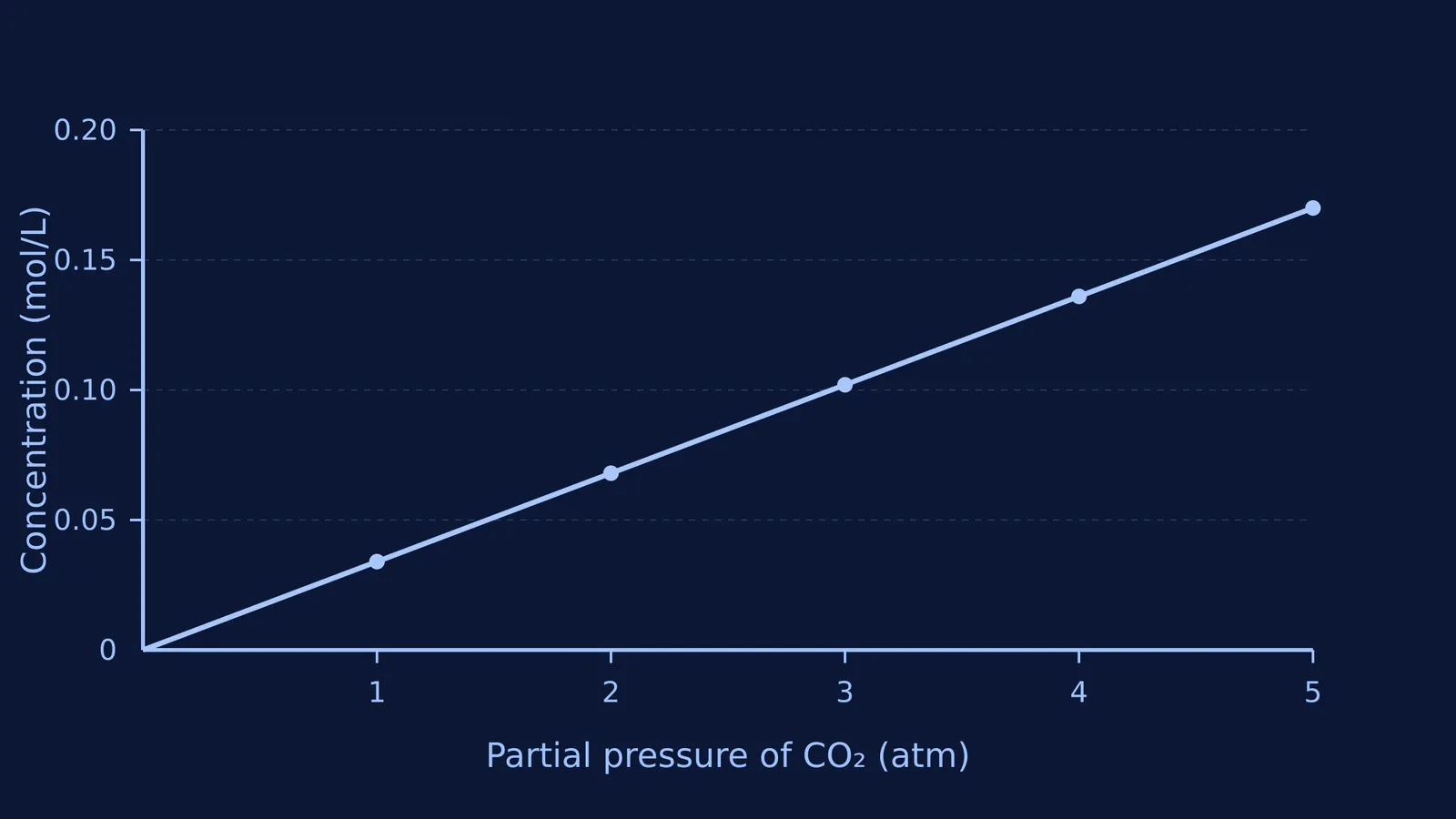
The fizz in Priestley's soda water is governed by a rule discovered in 1803. The English chemist William Henry published a paper establishing what is now known as Henry's Law. It states that at a constant temperature, the amount of a given gas that dissolves in a liquid is directly proportional to the partial pressure of that gas above the liquid Wikipedia.
Mathematically, this is written as C = kH × P, where C is the concentration of the dissolved gas and P is its partial pressure. When a modern soda bottle is sealed at a factory, high-pressure carbon dioxide is forced into the space above the liquid. The high pressure forces the gas into solution. When you open the bottle, the pressure drops, the solubility decreases, and the gas rushes out as bubbles.
Understanding how pressure controls solubility is crucial not just for drinks, but for environmental science and diving medicine. You can explore problems involving gas laws, partial pressures, and heterogeneous equilibria using the Fermi Problem Library, a step-by-step solver that explains the reasoning rather than printing an answer.


