

On this page
In the boron family chapter, diborane, B₂H₆, is where a lot of students get stuck. It has six hydrogens, two borons and not enough electrons to give every bond its pair. Before anyone could argue about that, someone had to make the stuff and keep it alive. That person was the German chemist Alfred Stock (1876–1946), and his main tool was a set of sealed glass tubes.
Why did boron hydrides need a glass vacuum line?
The lighter boron hydrides are gases or volatile liquids, and they react with air and water. Diborane is a toxic, pyrophoric gas that reacts violently with water to give hydrogen and boric acid, according to the Wikipedia summary of its chemistry. Ordinary open glassware with greased taps was not good enough for them.
Stock "devised a high-vacuum apparatus that permitted the quantitative manipulation and fractionation of small amounts of gaseous and volatile materials in the absence of air and lubricating greases", in the words of the Dictionary of Scientific Biography entry on Stock. In plain terms, he could move, separate and measure tiny amounts of reactive gas inside closed glass, with no air getting in and no grease touching the sample.
Stock and Carl Massenez reported their first results in 1912 in a paper simply titled *Borwasserstoffe*, "boron hydrides" in the *Berichte der deutschen chemischen Gesellschaft*. William Lipscomb's 1976 Nobel lecture credits Stock with the techniques for preparing B₂H₆, B₄H₁₀, B₅H₉, B₅H₁₁ and B₆H₁₀, and the crystalline B₁₀H₁₄. The same lecture quotes the chemist Sidgwick: "All statements about the hydrides of boron earlier than 1912, when Stock began to work on them, are untrue."
The Dictionary of Scientific Biography describes that poisoning, and Stock published a warning in 1926, *Die Gefährlichkeit des Quecksilberdampfes* ("The danger of mercury vapour"), in *Angewandte Chemie*.
Why is the bonding in diborane so strange?
Stock could make the boranes, but he could not explain them. He drew diborane like ethane, H₃B–BH₃, as the diborane article notes. Lipscomb's lecture describes what came next: Pauling wrote about resonating one-electron bonds, and in 1940–41 Stitt found infrared and thermodynamic evidence for a bridged structure.
The answer came in 1943, when H. C. Longuet-Higgins and R. P. Bell published *The structure of the boron hydrides* in the *Journal of the Chemical Society*. Lipscomb's lecture credits Longuet-Higgins with clearly formulating the three-centre B–H–B bond.
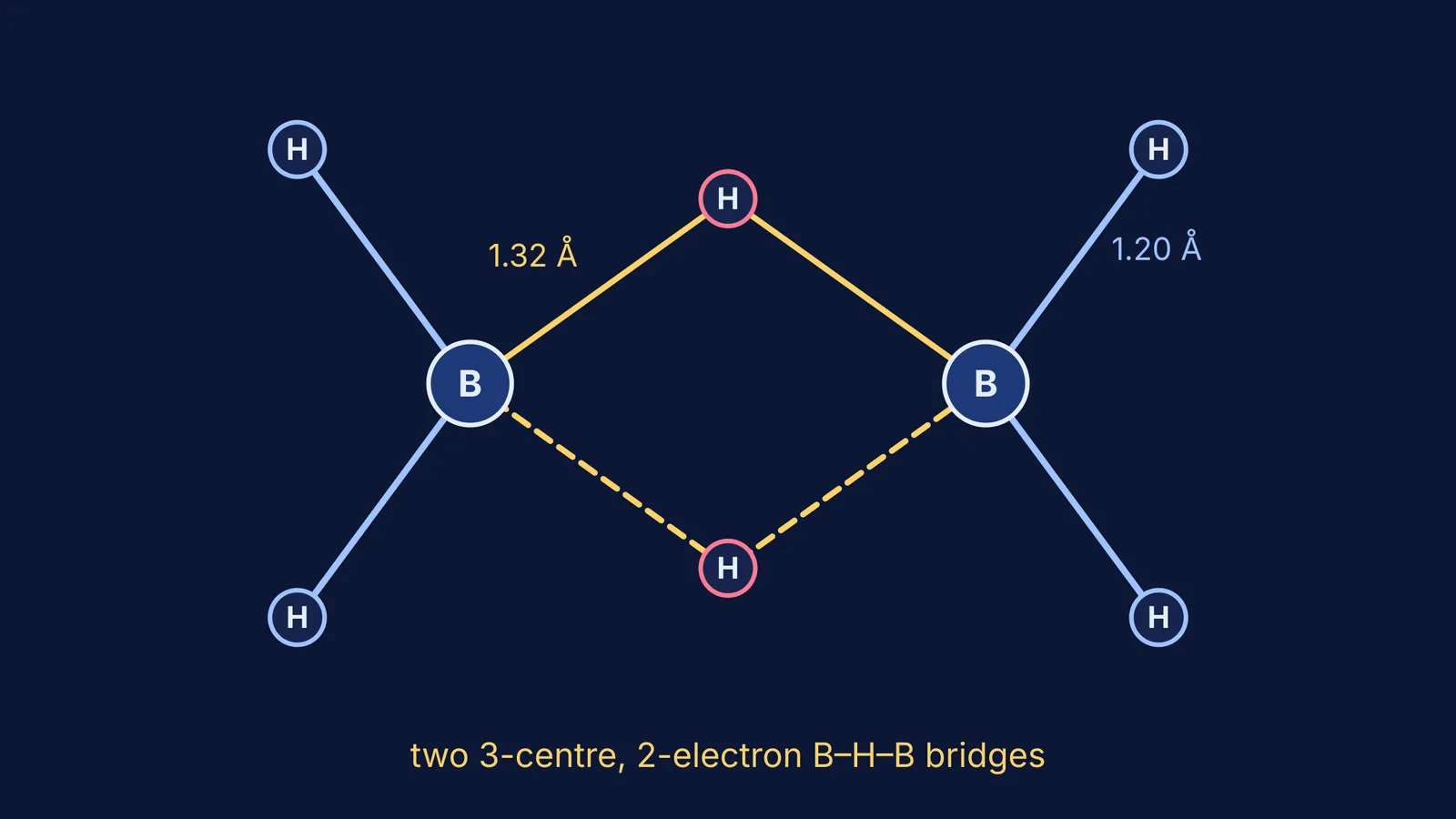
A three-centre, two-electron bond is one pair of electrons holding three atoms together: here, two borons and the hydrogen between them. Diborane has two of them, one above and one below the line joining the borons. Lipscomb won the 1976 Nobel Prize in Chemistry "for his studies on the structure of boranes illuminating problems of chemical bonding".
The measured shape shows the difference. In NIST's experimental geometry for B₂H₆, a terminal B–H bond is 1.200 Å long and a bridging B–H bond is 1.320 Å. The bridge bonds are longer because one pair of electrons is shared across three atoms.
How do you count the electrons in diborane?
This four-step count shows why the ethane-like drawing fails, and it ends at the two B–H–B bridges described in the three-centre two-electron bond article. Try it on paper before you read the answers.
Count valence electrons. Each boron brings 3 and each hydrogen 1: 2 × 3 + 6 × 1 = 12.
Count what a classical drawing needs. H₃B–BH₃ has seven two-electron bonds, so it needs 14 electrons. You have 12, so you are two short.
Spend electrons on the bonds you know are normal. The four terminal B–H bonds take 4 × 2 = 8, which leaves 4.
Share out the rest. Four electrons make two pairs, and each pair holds one B–H–B bridge. That gives two three-centre, two-electron bonds and no direct B–B bond pair.
To check your answer, add up 8 + 2 + 2 = 12. If your total is 14, you have drawn ethane again.
That last link is worth following. Our explainer on Lewis acidity of the boron trihalides and back bonding uses the same idea that boron is short of electrons. For the orbital side, our guide to sp, sp² and sp³ hybridisation covers the orbital language textbooks use when they describe boron.
How can you make the bridge bond stick?
Draw it, then explain it out loud in one sentence: "One electron pair, three atoms." If a step still feels shaky, the Fermi Concept Library gives every chemistry concept its own lesson and shows where it sits on the map. Then try a few problems in the Fermi Problem Library, whose step-by-step solver explains the reasoning instead of just printing an answer.
If you enjoy chemists who found something by measuring carefully, read about Clemens Winkler and the discovery of germanium next.


