

On this page
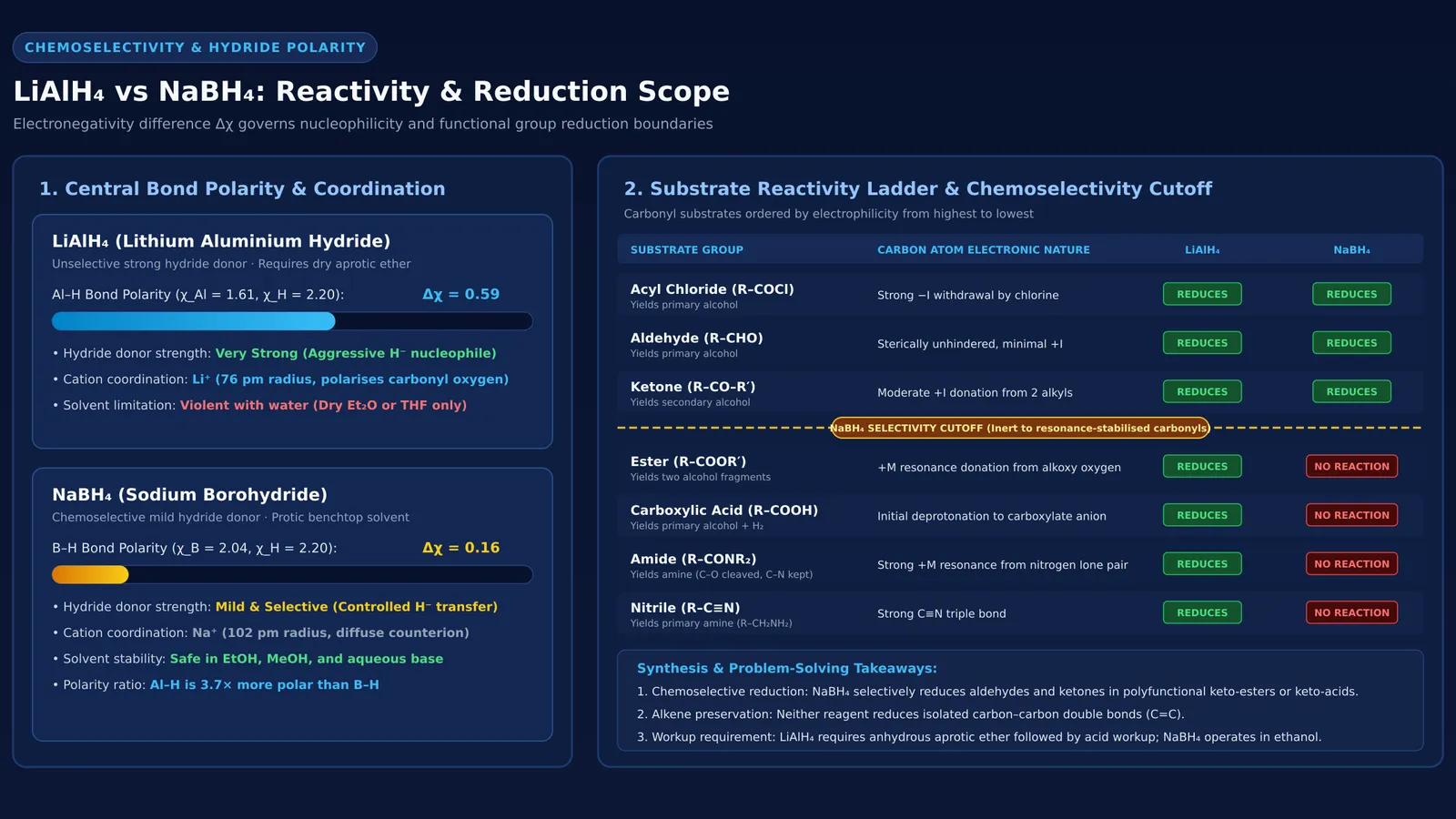
Both lithium aluminium hydride (LiAlH4) and sodium borohydride (NaBH4) deliver nucleophilic hydride ions, but their reducing strengths differ markedly. This reactivity gap originates in the electronegativity of the central atom and the resulting bond polarity. According to thermochemical revisions of the Pauling scale (Journal of Inorganic and Nuclear Chemistry80142-5)), hydrogen has an electronegativity of 2.20. In LiAlH4, aluminium has an electronegativity of 1.61, creating an electronegativity difference of 0.59 that heavily polarises the Al–H bond toward hydrogen. In NaBH4, boron has an electronegativity of 2.04, leaving an electronegativity difference of only 0.16. Because of this greater polarity, the hydride in [AlH4]⁻ carries substantially higher electron density, making it a stronger nucleophile than [BH4]⁻.
A. E. Finholt, A. C. Bond Jr., and H. I. Schlesinger reported the synthesis and potent reducing action of LiAlH4 in 1947 (Journal of the American Chemical Society). In 1953, Schlesinger and Herbert C. Brown introduced sodium borohydride as a milder, selective alternative (Journal of the American Chemical Society). Brown later received the 1979 Nobel Prize in Chemistry for developing organoborane and boron-hydride chemistry (Nobel Prize in Chemistry 1979). Cation coordination also plays a role: lithium has an effective ionic radius of 76 pm compared to 102 pm for sodium (Acta Crystallographica Section A). In aprotic solvents, the compact Li⁺ cation coordinates tightly to carbonyl oxygen, polarising the C=O bond and activating carbon toward hydride addition.
Which functional groups do LiAlH4 and NaBH4 reduce?
In organic synthesis and exam problems, choosing between these reagents determines chemoselectivity:
Aldehydes and ketones: Both reagents reduce aldehydes to primary alcohols and ketones to secondary alcohols.
Acyl chlorides: Both reduce acid chlorides smoothly to primary alcohols.
Esters: LiAlH4 reduces esters to two alcohol fragments. Esters do not react with NaBH4 under standard conditions.
Carboxylic acids: LiAlH4 reduces acids to primary alcohols (after releasing H2 in an initial acid–base step). Acids resist NaBH4.
Amides: LiAlH4 reduces amides to amines, completely removing carbonyl oxygen while preserving the carbon–nitrogen bond. Amides resist NaBH4.
Nitriles: LiAlH4 reduces nitriles to primary amines; NaBH4 does not react.
As detailed in the NCERT Class 12 Chemistry curriculum, LiAlH4 reduces carboxylic acids in excellent yields, but its high cost makes converting acids into esters before reduction standard practice in industry. When complete deoxygenation to a methylene unit (–CH2–) is needed rather than an alcohol, students choose Clemmensen and Wolff-Kishner reductions. Recognizing these boundaries is foundational for broader organic oxidation and reduction strategies.
Why do solvent choices differ between LiAlH4 and NaBH4?
LiAlH4 reacts violently with protic solvents to produce metal hydroxides and flammable hydrogen gas: LiAlH4 + 4 H2O → LiOH + Al(OH)3 + 4 H2. The released heat can ignite the hydrogen. Therefore, LiAlH4 must be handled in strictly dry aprotic solvents such as diethyl ether or tetrahydrofuran (THF), followed by cautious aqueous acidic workup.
In contrast, NaBH4 features a less polarised, more covalent B–H bond that hydrolyses slowly in neutral or basic water. It dissolves safely in protic solvents like ethanol and methanol, where solvent hydrogen bonding activates the carbonyl oxygen toward reduction. In their 40-year review of hydride reductions (Tetrahedron87003-9)), Herbert C. Brown and S. Krishnamurthy noted that this solvent stability makes NaBH4 the practical choice for routine benchtop reductions. Protecting or modifying carbonyls via Fischer esterification often relies on this stability.
How do you solve multi-functional reduction problems in exams?
Exam questions in JEE Main, JEE Advanced, and NEET-UG frequently feature molecules containing multiple carbonyl groups. A clear three-step strategy prevents mistakes:
Identify every functional group: Note aldehydes, ketones, esters, acids, and amides.
Select by selectivity: Use NaBH4 in ethanol to reduce an aldehyde or ketone while leaving esters and acids untouched. Choose LiAlH4 in dry ether when you need to reduce esters, acids, or amides. Neither reagent reduces isolated alkene double bonds (C=C).
Count products and fragments: Reducing an ester with LiAlH4 cleaves the acyl–alkoxy bond, yielding two alcohols. Reducing an amide retains the carbon–nitrogen bond, producing an amine.
For example, consider ethyl 4-oxopentanoate (CH3–CO–CH2–CH2–COOCH2CH3). With NaBH4 in ethanol, only the ketone is reduced, yielding ethyl 4-hydroxypentanoate with the ester intact. With LiAlH4 in dry ether followed by hydronium workup, both groups are reduced, producing pentane-1,4-diol and ethanol.
When students find reaction selectivity or mechanisms confusing, the Fermi Concept Library organizes every concept in physics, chemistry, biology, mathematics and computing, each with its own lesson and its place in the map. For mastering exam-style conversions, the Fermi Problem Library provides worked problems with a step-by-step solver that explains the reasoning rather than printing an answer.


