On this page
When two wires touch in a short circuit, the current in a house cable can jump from about 10 A to a thousand amperes or more. The copper does not melt at once, but its PVC insulation is in trouble within a fraction of a second. How long a cable can survive is a neat Class 12 current electricity problem: Joule heating, I²R, with one twist that makes the maths very clean. The answer also explains why the breaker, not the cable, has to win the race.
Safety first. This post is about physics, not about wiring. Do not open a distribution board, change a breaker or try to create a short circuit to test anything. Electrical work in a home is a job for a licensed electrician.
What happens to a cable in a short circuit?
Why the current becomes so large, and how a fuse responds, is covered in what happens in a short circuit. This post picks up after that: the current is already huge, and we ask how hot the copper gets and how fast.
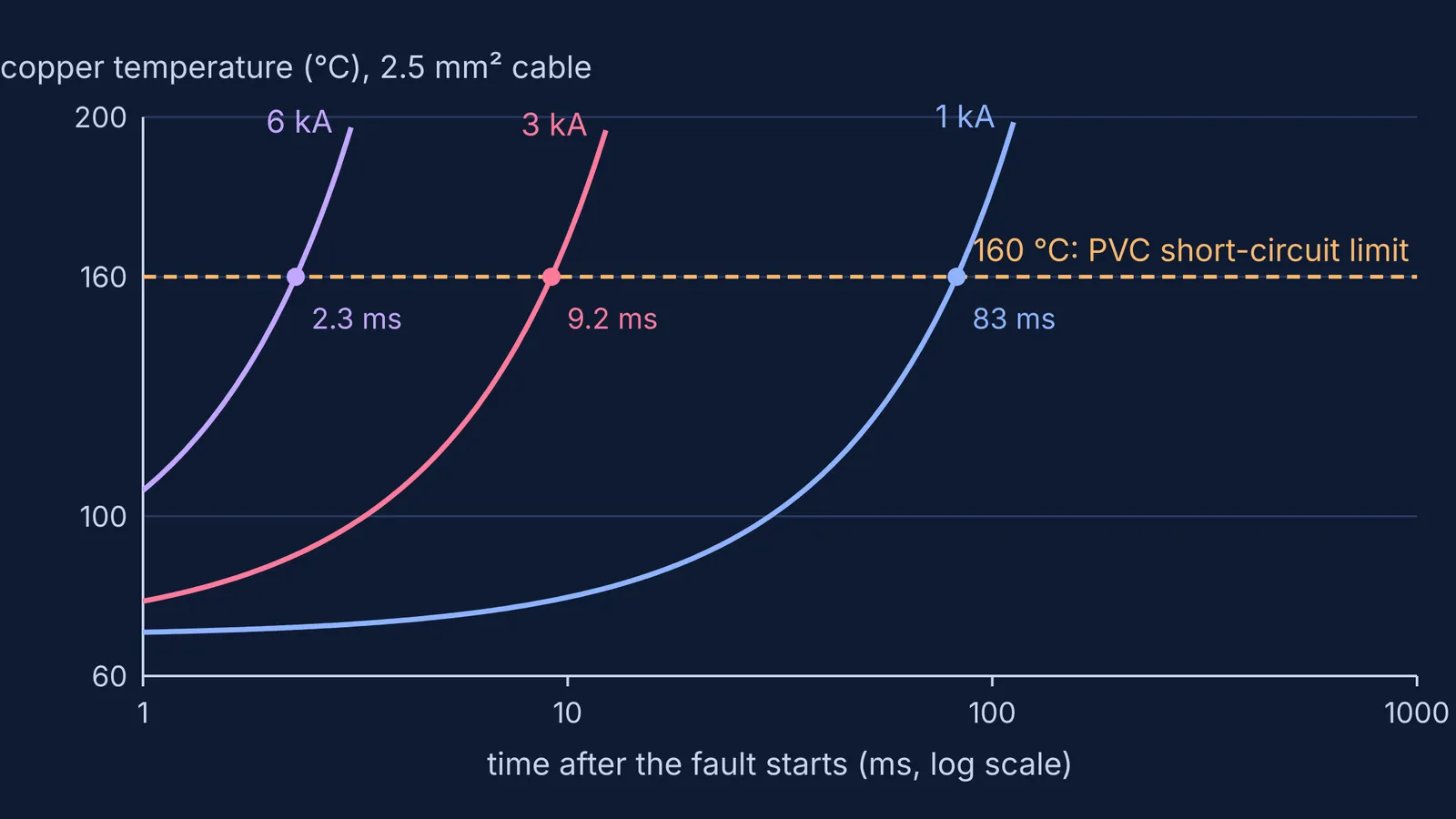
The heat produced per second in the copper is I²R. With R = ρL/A, a current that is 100 times larger makes 10,000 times more heat. For a while, the cable can carry it, because the copper has heat capacity. But PVC insulation is only rated for a short excursion: the usual limit is a conductor temperature of 160 °C during a short circuit, starting from 70 °C, its normal maximum working temperature (values listed in this cable engineering table, which attributes them to IEC 60364-5-54 and BS 7671; check the standard itself for design work). Above that, PVC softens and can be permanently damaged.
Why can we ignore heat loss during a short circuit?
In normal use, a wire reaches a steady temperature when heat made inside equals heat lost through the surface. That balance is what sets the rating of a fuse wire, as worked in why a fuse wire's rating depends on radius.
A short circuit is the opposite limit. Everything is over in milliseconds, far too fast for heat to get through the insulation. So we assume all the I²R energy stays in the copper. Engineers call this adiabatic heating, borrowing the word from thermodynamics, and treat the result as valid for faults lasting up to about 5 seconds (same source). For longer faults the cable loses some heat, so the adiabatic answer is on the safe side.
How do you derive the cable formula I²t = k²A²?
Take a length L of copper with cross-section A, density d, specific heat c and resistivity ρ.
Heat produced in time t: I²Rt = I²(ρL/A)t.
Heat needed to warm it by ΔT: mass × c × ΔT = (dAL)cΔT.
Set them equal. The length L cancels, which is why the answer does not depend on how long the cable is:
I²(ρ/A)t = dAcΔT, so I²t = (dcΔT/ρ) × A².
Call dcΔT/ρ = k². Then I²t = k²A², or t = k²A²/I². The constant k depends only on the conductor and on the starting and final temperatures that the insulation allows.
Check the units: d × c × ΔT has units (kg/m³)(J/kg K)(K) = J/m³. Dividing by ρ in Ω m gives J/(Ω m⁴). Since a joule is A² Ω s, that is A² s/m⁴, the same as I²t/A².
Worked example: how long does a 2.5 mm² cable last?
Use copper with d = 8,960 kg/m³ and c = 385 J/kg K, so dc = 3.45 × 10⁶ J/m³ K. Resistivity at 20 °C is 1.72 × 10⁻⁸ Ω m and the temperature coefficient is 0.00393 per °C (standard textbook values).
Temperature rise. From 70 °C to 160 °C, ΔT = 90 K.
Resistivity. Resistivity rises as the copper warms. Take it at the mean temperature, 115 °C: ρ = 1.72 × 10⁻⁸ × (1 + 0.00393 × 95) ≈ 2.37 × 10⁻⁸ Ω m.
Find k. k² = 3.45 × 10⁶ × 90 / 2.37 × 10⁻⁸ ≈ 1.31 × 10¹⁶ A² s/m⁴, so k ≈ 1.145 × 10⁸ A √s per m². In the units engineers use, divide by 10⁶ for mm²: k ≈ 115 A √s per mm². Treating the change in resistivity exactly, with a logarithm, gives 114.8. Both round to the tabulated 115.
Cable limit. For A = 2.5 mm², k²A² = 115² × 2.5² ≈ 82,700 A² s.
Time at 1,000 A. t = 82,700 / 1,000² ≈ 0.083 s, or 83 ms.
At 3,000 A. t = 82,700 / 9 × 10⁶ ≈ 9.2 ms.
At 6,000 A. t ≈ 2.3 ms.
How fast is that? At 3,000 A the copper rises 90 K in 9.2 ms, an average of about 9,800 K per second.
A thinner 1.5 mm² cable, a size often used for lighting circuits, has k²A² = 115² × 1.5² ≈ 29,800 A² s. It reaches the limit in about 30 ms at 1,000 A and 3.3 ms at 3,000 A. Because t ∝ A², halving the area cuts the time to a quarter.
The temperature does not rise in a straight line. Since resistivity grows with temperature, the copper heats faster as it gets hotter. Solving the heating equation with ρ ∝ (234.5 + θ) gives an exponential climb, which is what the hero graph shows.
Why must the breaker open before the cable overheats?
The cable cannot cool itself in time, so something else has to stop the current. A miniature circuit breaker does this with its magnetic trip, which acts on large currents without waiting for anything to warm up; how that works is explained in why a miniature circuit breaker trips.
What matters is not only how fast the breaker opens but how much I²t gets through while it opens, called its let-through energy. Breaker makers publish let-through curves for this. The design rule is simple to state: the breaker's let-through I²t at the highest possible fault current must be less than the cable's k²A². For the 2.5 mm² cable above, that budget is about 82,700 A² s. Choosing breakers and cable sizes to meet this is part of an electrician's or designer's job, using the standards and the makers' data.
If you want to revise Joule heating, resistivity and temperature coefficients together, the Concept Library has explanations for each idea in current electricity.
Quick checklist
In a short circuit, heating is so fast that heat loss can be ignored: all I²R energy stays in the copper.
Equating I²(ρL/A)t to dALcΔT gives I²t = k²A²; the length cancels.
k² = dcΔT/ρ; for copper with PVC from 70 °C to 160 °C, k ≈ 115 A √s per mm².
A 2.5 mm² copper cable reaches 160 °C in about 83 ms at 1,000 A and 9 ms at 3,000 A.
Survival time scales as A²/I².
The breaker's let-through I²t must stay below the cable's k²A².
Never test any of this at home; electrical work is for a licensed electrician.