On this page
On a flat road, the fastest you can take a bend depends only on the grip of your tyres and the radius of the bend. Mass cancels out, so a heavy truck and a light hatchback face the same limit. A racing car breaks that rule. Its wings push it into the road harder as it goes faster, so its grip grows with speed. That one change turns the familiar v = √(μgr) into a new formula.
Why does a racing car's wing push down instead of up?
An aircraft wing is shaped and tilted so that air moving over it leaves lower pressure on top and higher pressure underneath. The net force is upward: lift. Why that pressure difference appears is covered in how Bernoulli's principle explains lift on a wing, so it is not repeated here.
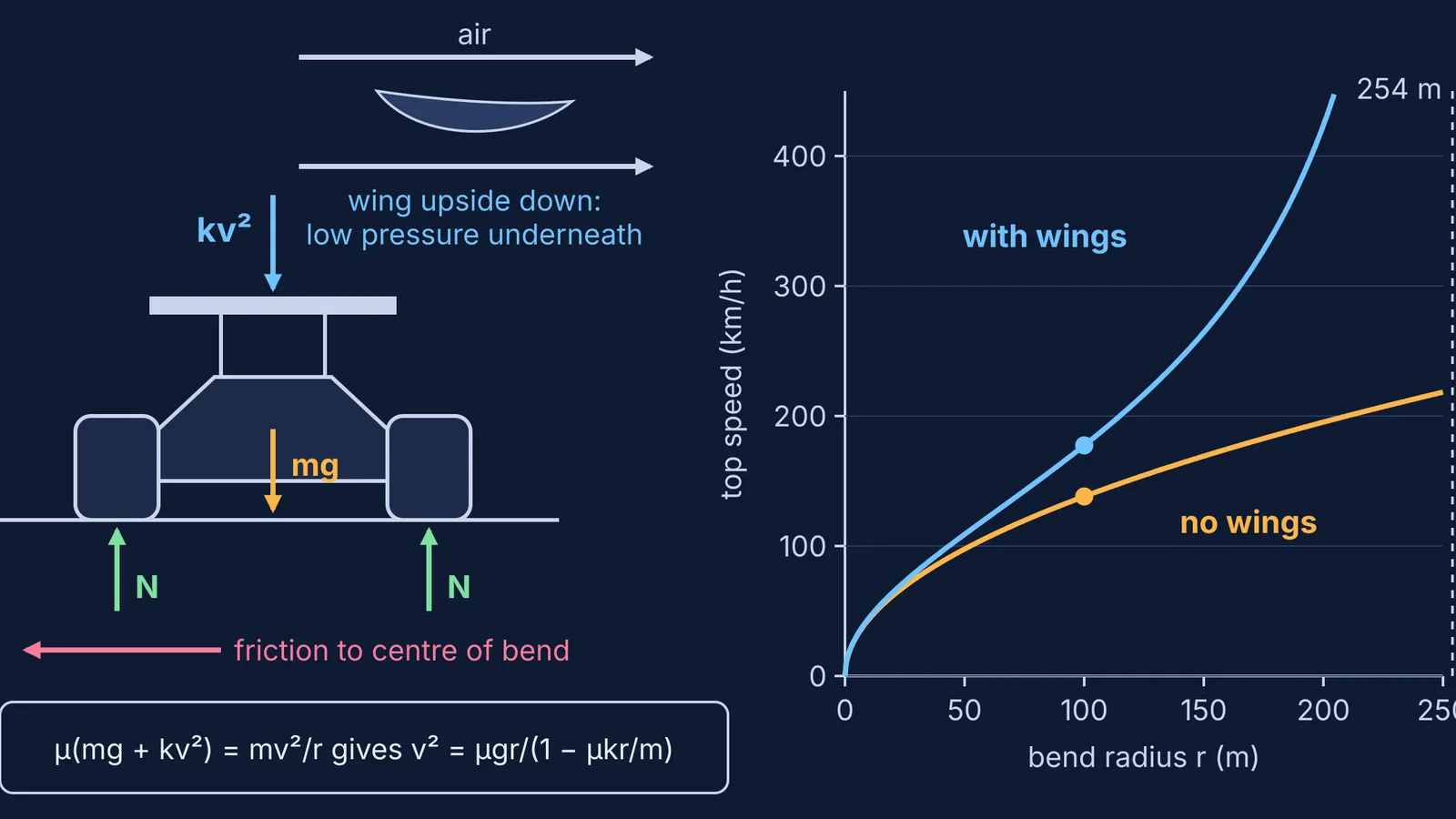
A racing car's wings are the same kind of aerofoil mounted upside down. The low-pressure side faces the road, so the net force points down. Engineers call it negative lift or downforce. The floor of a modern car does the same job: air speeds up through the narrow gap between the floor and the track, its pressure drops, and the car is sucked down. In his review of race car aerodynamics in the Annual Review of Fluid Mechanics, Joseph Katz describes inverted wings, diffusers and vortex generators as the main ways to make downforce.
Like lift, downforce grows with the square of speed:
F_down = ½ρv²C_L·A = kv²
Here ρ is the density of air, C_L·A is the wing's lift coefficient times its reference area, and k = ½ρC_L·A collects the constants. Double the speed and the downforce goes up four times.
How does downforce change the maximum speed on a curve?
On a flat bend, friction alone supplies the centripetal force. Without wings the normal force is just mg, so μmg = mv²/r and v = √(μgr). The friction limit on a constant normal force is worked out in maximum safe speed on a banked road with friction.
With wings, the road has to push up on the tyres with N = mg + kv². The largest friction is μN, so at the limit:
μ(mg + kv²) = mv²/r
Collect the v² terms: v²(m/r − μk) = μmg. Divide by m/r:
v² = μgr / (1 − μkr/m)
Check the limits. If k = 0, you get back v² = μgr. If k > 0, the denominator is less than 1, so the speed is always higher. And mass no longer cancels: a lighter car gains more from the same wings, which is one reason racing series set a minimum mass. The FIA set it at 800 kg for Formula 1 in 2025, car plus driver, without fuel.
Worked example: how much faster round a 100 m bend?
The numbers below are a round illustrative model, not data for any real car: m = 800 kg, C_L·A = 3.5 m², ρ = 1.2 kg/m³ and μ = 1.5 for warm racing tyres.
Find k. k = ½ × 1.2 × 3.5 = 2.1 N s²/m².
Downforce at a few speeds. At 100 km/h (27.8 m/s): 2.1 × 27.8² ≈ 1.62 kN. At 200 km/h: 6.48 kN. At 250 km/h: 10.1 kN, which is 1.29 times the car's weight of 800 × 9.81 = 7.85 kN.
No wings, r = 100 m. v = √(1.5 × 9.81 × 100) = 38.4 m/s = 138 km/h.
With wings. μkr/m = 1.5 × 2.1 × 100 / 800 = 0.394. So v² = 1,471.5 / 0.606 = 2,428 m²/s² and v = 49.3 m/s = 177 km/h.
Check the forces. At 49.3 m/s the downforce is 5.10 kN, so N = 7.85 + 5.10 = 12.9 kN, 1.65 times the weight. Friction can be 1.5 × 12.9 = 19.4 kN, and mv²/r = 800 × 2,428 / 100 = 19.4 kN. They match.
Sideways acceleration. v²/r = 24.3 m/s², about 2.5g. Without wings it is μg, 1.5g.
On a 50 m bend the gain is smaller: 98 km/h without wings and 109 km/h with them, because the car is slower and the downforce is small.
Why does the formula blow up at large radius?
The denominator 1 − μkr/m reaches zero at r = m/μk. In the model that is 800 / (1.5 × 2.1) ≈ 254 m. On a 200 m bend the formula already gives 424 km/h, which needs about 7g of sideways acceleration.
This does not mean the car can take any bend above 254 m at any speed. It means friction is no longer what limits it. On a wide enough bend, every extra bit of speed adds more downforce, and so more grip, than the turn needs. The limit then comes from engine power and drag, the same things that set top speed on a straight.
Real cars make more downforce than this deliberately modest model. Willem Toet, a former head of aerodynamics at the Sauber Formula 1 team, writes in Paddock Magazine that a Formula 1 car makes about its own weight in downforce at around the European motorway speed limit, and about four times that at double the speed. That is the v² law at work.
Could a racing car really drive upside down?
In the model, downforce equals weight when kv² = mg, so v = √(mg/k) = √(7,848 / 2.1) = 61.1 m/s, or 220 km/h. On Toet's figures it happens far lower. Above that speed, the wings could in principle hold the car against the roof of a tunnel.
Treat that as a statement about forces only, a thought experiment. Real cars are not built for it: fuel, oil and the driver would all hang the wrong way, and the car would have to reach that speed before it got onto the roof.
What does downforce cost?
Drag. A wing that pushes down also pushes back. Zhang, Toet and Zerihan, in their review of ground effect aerodynamics of race cars, note that teams accept this because downforce does more for lap time than low drag does. A car set up with big wings for corners is slower on long straights.
Grip per newton falls. Tyres lose a little of their friction coefficient as the load rises, so treating μ as fixed overstates the gain. The real speed is lower than the formula gives.
None of this applies to road cars. At city speeds the forces are tiny, and add-on spoilers that are badly made or fitted can make a car less safe, not more.
If you want to try more curve problems with an extra force added, the Fermi Problem Library has a step-by-step solver that explains the reasoning at each stage.
Quick checklist
Downforce = ½ρv²C_L·A = kv², growing with the square of speed.
Flat curve with wings: μ(mg + kv²) = mv²/r, so v² = μgr/(1 − μkr/m).
Set k = 0 to check you get back v = √(μgr).
Mass no longer cancels once wings are added.
Friction stops being the limit at r = m/μk; then power and drag take over.
The upside-down claim is about forces, not a real stunt.
Downforce costs drag, and real tyres lose some grip per newton at high load.