On this page
Bennu is a dark, rubble-pile asteroid about 490 m across, the one NASA's OSIRIS-REx spacecraft visited and took a sample from. Its orbit is shrinking. Every year its average distance from the Sun falls by about 285 m, and no planet or collision is doing it. The asteroid is pushing itself, using nothing but the heat it radiates. The push is tiny, roughly the weight of a few grams, but it never stops, and over a century it moves Bennu by thousands of kilometres along its orbit. This is the Yarkovsky effect, and you can estimate its size with Class 11 and 12 physics.
What is the Yarkovsky effect?
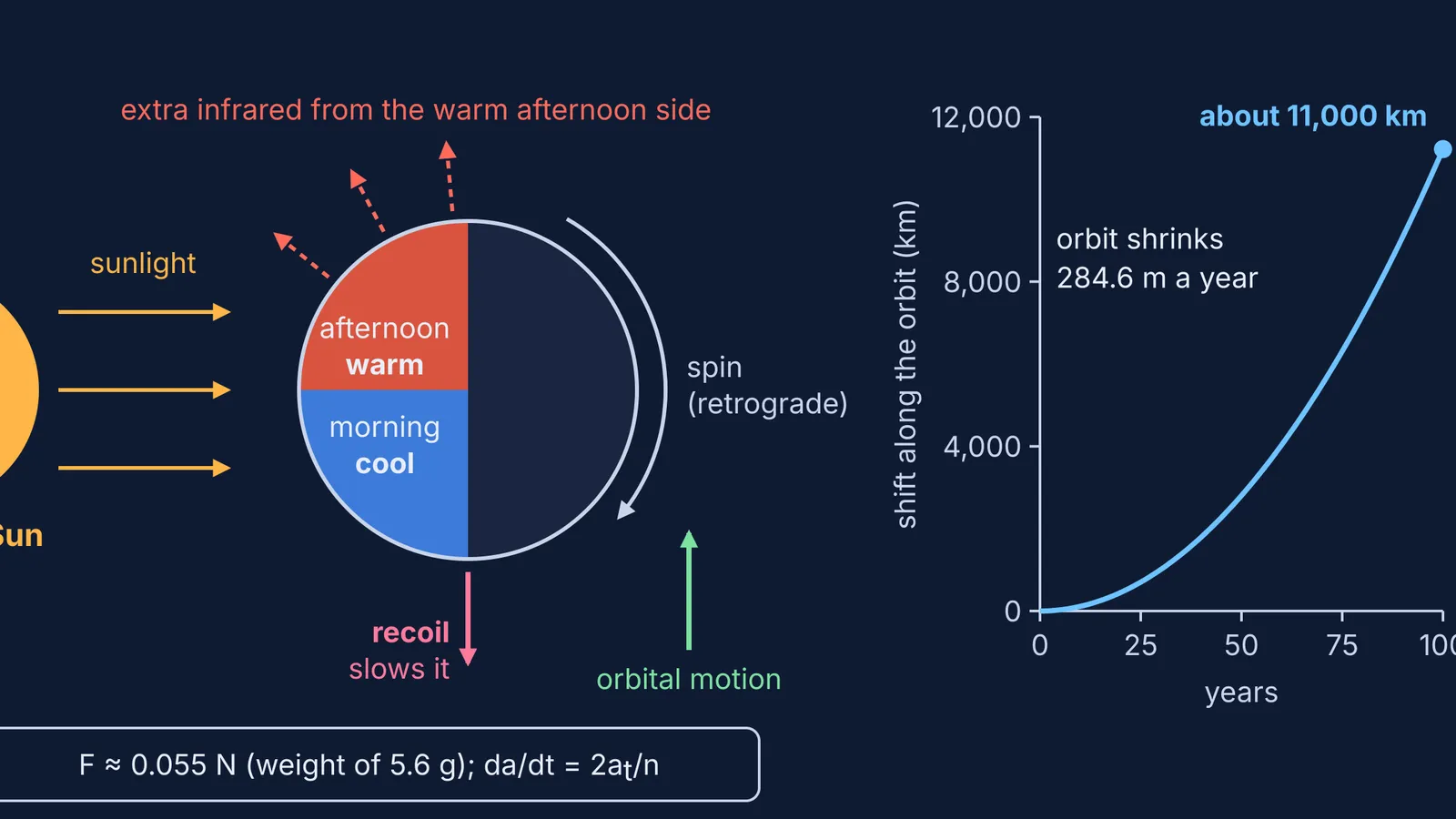
Sunlight warms an asteroid's day side. The warm surface then gives the energy back as infrared radiation, and each infrared photon carries momentum p = E/c away. If the asteroid radiated equally in every direction, the recoils would cancel. They do not, because the hottest part of a spinning body is not the part facing the Sun.
Think of a summer day. The ground is hottest in the afternoon, not at noon, because it takes time to warm up and then holds the heat. An asteroid is the same. The surface that has spent longest in sunlight, the afternoon side, is the warmest, so it radiates a little more than the morning side. More photons leave in one direction, and the asteroid recoils the other way.
Farnocchia and colleagues at NASA's Jet Propulsion Laboratory describe it as a recoil acceleration due to thermal radiation emitted unevenly, which causes a drift in the semimajor axis. Note what is doing the pushing: the asteroid's own heat, not sunlight striking it. Sunlight pressure, worked in photon momentum and radiation pressure, pushes straight away from the Sun and hardly changes the orbit's size. A solar sail uses reflected sunlight; the Yarkovsky push comes from re-radiated heat.
Why does Bennu's orbit shrink instead of grow?
It depends on which way the asteroid spins.
Prograde spin (same sense as the orbit): the warm afternoon side faces backward along the orbit. It radiates backward, so the recoil pushes forward. The asteroid gains energy and spirals outward.
Retrograde spin (opposite sense): the afternoon side faces forward. It radiates forward, the recoil acts like a brake, and the orbit shrinks.
Bennu spins backwards. OSIRIS-REx measured its spin axis tilted 177.6° to its orbit, with a rotation period of 4.30 hours, reported by Lauretta and colleagues in Nature. So it drifts inward, as expected. Using spacecraft tracking data, Farnocchia and colleagues measured the drift of Bennu's semimajor axis as −284.6 ± 0.2 m per year.
Worked example: how big is the push on Bennu?
Data, with sources:
Mass: GM = 4.890 m³/s² (Farnocchia et al., 2021), so M = 4.890 / 6.674 × 10⁻¹¹ = 7.33 × 10¹⁰ kg.
Radius: 246 m, the equivalent radius used in the same paper.
Albedo 0.044 and semimajor axis 1.126 AU, from NASA JPL's Small-Body Database entry for Bennu.
da/dt = −284.6 m per year.
Orbital period from Kepler's third law. T = 2π√(a³/GM☉). With a = 1.126 × 1.496 × 10¹¹ m and GM☉ = 1.327 × 10²⁰ m³/s², T = 436.6 days. The mean motion is n = 2π/T = 1.67 × 10⁻⁷ rad/s.
Convert the drift. da/dt = 284.6 m / 3.156 × 10⁷ s = 9.02 × 10⁻⁶ m/s.
Along-track acceleration. For a nearly circular orbit, a steady push along the direction of motion gives da/dt = 2aₜ/n. So aₜ = (da/dt)(n/2) = 9.02 × 10⁻⁶ × 1.67 × 10⁻⁷ / 2 = 7.5 × 10⁻¹³ m/s².
Force. F = Maₜ = 7.33 × 10¹⁰ × 7.5 × 10⁻¹³ = 0.055 N. That equals the weight of 0.055/9.81 kg = 5.6 g.
Compare with the Sun's pull. At 1.126 AU the Sun's gravity is GM☉/r² = 4.7 × 10⁻³ m/s². The Yarkovsky acceleration is 1.6 × 10⁻¹⁰ of that.
The orbit changes in size by 284.6 × 100 = 28.5 km in a century.
How much of the absorbed sunlight does the push use?
Sunlight absorbed. Solar intensity at Earth's distance is about 1,361 W/m². At 1.126 AU it is 1,361 / 1.126² = 1,073 W/m². Bennu's cross-section is π × 246² = 1.90 × 10⁵ m². With an albedo of 0.044, roughly 96% is absorbed: P ≈ 195 MW.
Largest possible recoil. If all of that energy left as radiation in one direction, F = P/c = 1.95 × 10⁸ / 3.00 × 10⁸ = 0.65 N.
Fraction. 0.055 / 0.65 = 0.085. Only about 8.5% of the maximum shows up as a push along the orbit.
The rest cancels, because most of the heat leaves in all directions and only the small afternoon excess counts. This 8.5% is a result for Bennu; it depends on spin, shape, surface material and tilt, so it is not a constant to learn. (The albedo used here is approximate; the absorbed share is close to 96% either way.)
Why does a 6-gram push matter for impact predictions?
Because a change in orbit size changes the orbital period, and timing errors build up. A smaller orbit means a slightly faster asteroid, so Bennu gets ahead of where it would otherwise be. The shift along the orbit grows with the square of time: Δs ≈ ¾ n (da/dt) t².
Put in the numbers for 100 years (t = 3.16 × 10⁹ s): Δs ≈ 0.75 × 1.67 × 10⁻⁷ × 9.02 × 10⁻⁶ × (3.16 × 10⁹)² ≈ 1.1 × 10⁷ m, or about 11,000 km. That is close to the diameter of Earth. This simple estimate ignores close passes by planets, which change the orbit too, but it shows why you cannot predict where Bennu will be a century from now without the Yarkovsky effect.
Farnocchia and colleagues put Bennu's cumulative chance of hitting Earth through the year 2300 at 5.7 × 10⁻⁴, about 1 in 1,750. The effect does not make Bennu more dangerous; it changes when and where a close approach happens, which is a prediction problem. How agencies track such objects and test deliberate pushes is in why scientists track near-Earth asteroids.
If you want to practise orbit problems like steps 1 to 4, the Fermi Problem Library has a step-by-step solver that explains the reasoning at each stage.
Quick checklist
Yarkovsky push: recoil from the asteroid's own infrared emission, strongest from the warm afternoon side.
Prograde spin pushes forward (orbit grows); retrograde spin brakes (orbit shrinks).
Bennu: da/dt = −284.6 m per year, measured with OSIRIS-REx data.
Along-track push on a circular orbit: da/dt = 2aₜ/n.
Bennu's push is about 0.055 N, the weight of 5.6 g, 8.5% of P/c.
Position along the orbit drifts as t², about 11,000 km in a century.