

On this page
When you step out into the noon sun in Delhi or Chennai, you feel warmth on your skin, but you never feel a physical shove. Sunlight seems weightless. Yet in classical electromagnetism and quantum physics, light carries real linear momentum. James Clerk Maxwell demonstrated mathematically in 1873 that electromagnetic waves exert pressure on any surface they strike. Three decades later, physicists Ernest Fox Nichols and Gordon Ferrie Hull published the first precise quantitative measurements in their 1903 paper in the Physical Review, confirming Maxwell's prediction to within experimental limits.
Each photon carries an energy E = hν and a linear momentum given by p = E/c, where c is the speed of light (approximately 3.00 × 10⁸ m/s). When photons strike a surface, they transfer this momentum. By Newton's second law, force is the rate of change of momentum (F = Δp / Δt). Radiation pressure is simply this force distributed across a given area: P = F / A.
At Earth's orbital distance from the Sun (1 astronomical unit, or 1 AU), satellite radiometry documented by Greg Kopp and Judith Lean in Geophysical Research Letters establishes an average total solar irradiance of approximately 1,361 W/m². When this radiant flux strikes a completely absorbing surface, the resulting radiation pressure is P = I / c, which equals roughly 4.54 µN/m² (micronewtons per square metre). That force is imperceptible on a human scale, but in the frictionless vacuum of space, even a tiny continuous force produces steady acceleration.
Why does a reflective sail produce twice as much thrust?
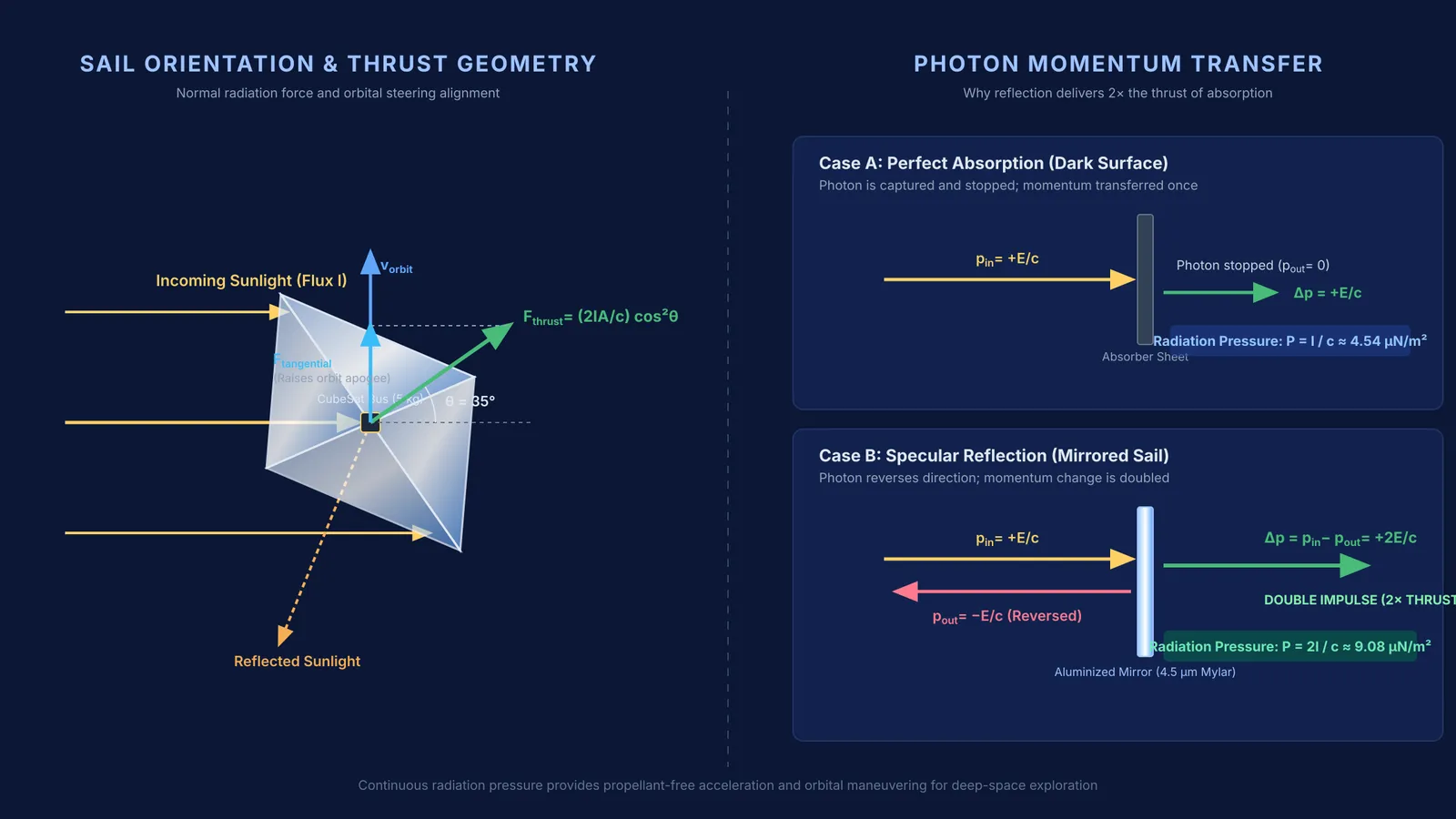
The secret to effective solar sailing lies in reflection rather than absorption. If a dark, non-reflective sheet absorbs a stream of photons, each photon gives up its forward momentum p and comes to rest relative to the sail. The total momentum transferred per photon is Δp = p.
If the sail is coated with a shiny mirror, such as the 4.5-micron aluminized Mylar described by The Planetary Society, incoming photons do not stop. They bounce back in the opposite direction with momentum −p. The change in photon momentum is Δp_photon = (−p) − (+p) = −2p. By conservation of momentum, the sail absorbs an impulse of +2p. Reflection delivers twice the momentum change of absorption, doubling the ideal radiation pressure to P = 2I / c.
This double impulse is the same principle students encounter when deciding whether to use energy or momentum conservation in collision problems. It works much like how Lester Pelton's split-cup water wheel reversed momentum to extract double the impulse from incoming water jets. For a perfectly reflecting solar sail perpendicular to sunlight at 1 AU, doubling the absorbed flux pressure raises the normal radiation pressure to approximately 9.08 µN/m².
How fast does a solar sail accelerate in space?
To see how these tiny pressures translate to real spaceflight, consider the LightSail 2 mission documented by David A. Spencer and colleagues in Advances in Space Research.
Identify the sail area and spacecraft mass:
LightSail 2 deployed a square sail with an area A = 32 m² on a CubeSat with a total mass m = 5.0 kg, as reported in Advances in Space Research.
Calculate the total force:
Assuming near-perfect reflection perpendicular to sunlight (I = 1,361 W/m²), the total thrust is: F = (2 × I × A) / c F = (2 × 1,361 W/m² × 32 m²) / (3.00 × 10⁸ m/s) ≈ 2.90 × 10⁻⁴ N (or 290 µN). This force of roughly 290 µN equals the gravitational force on Earth on a mass of just 30 milligrams.
Calculate the acceleration:
Using Newton's second law, acceleration is calculated from the mission mass and thrust documented in Advances in Space Research: a = F / m = (2.90 × 10⁻⁴ N) / 5.0 kg = 5.8 × 10⁻⁵ m/s² (0.058 mm/s²).
Calculate velocity gain over one month:
While 0.058 mm/s² sounds negligible, continuous thrust accumulates without burning a gram of fuel. Over a month of constant sunlight, The Planetary Society calculates that this steady acceleration increases the spacecraft's speed by 549 km/h (roughly 150 m/s), comparable to the cruising speed of a passenger jetliner.
If you are practicing these radiation pressure derivations for Class 12 boards or JEE Advanced, the Fermi Problem Library offers worked problems with a step-by-step solver that explains the reasoning rather than printing an answer.
How can a spacecraft steer or change orbits using sunlight?
A common misconception is that solar sails can only travel directly away from the Sun. In practice, a solar sail can maneuver throughout the solar system by angling its mirror relative to incoming sunlight, an orbital technique known as tacking.
Because photons bounce specularly off the mirror, the thrust vector always acts perpendicular (normal) to the sail surface. If the sail is tilted at an angle θ to the incoming sunlight, the effective area catching light decreases by cos θ, and the component of momentum transferred along the normal also scales by cos θ. The resulting normal force follows the relationship F = (2IA / c) cos² θ.
By tilting the sail, navigators direct a component of thrust along the spacecraft's orbital velocity vector. This adds kinetic energy to the orbit, raising the spacecraft's altitude, exactly as demonstrated when LightSail 2 raised its orbital apogee by 2 km in 4 days, as documented by The Planetary Society. Angling the sail against the orbital velocity vector does the opposite: it removes orbital energy and drops the spacecraft into a lower orbit closer to the Sun. You can explore how tangential thrust reshapes elliptical trajectories in our guide on planetary orbits with a gravity simulation.
If you want to see how continuous thrust alters orbital eccentricity over time, the Fermi Simulation Lab provides interactive simulations for the ideas that are easier to see than to read.
What is the difference between radiation pressure and solar wind?
Another frequent question is whether solar sails are pushed by the solar wind. They are not. Although both emanate from the Sun, their physical mechanisms and force scales are completely distinct.
Solar radiation pressure comes from electromagnetic waves (photons) traveling at the speed of light.
Solar wind consists of a stream of charged plasma—protons and electrons—ejected from the solar corona at high speeds.
While particles in the solar wind have rest mass, their density in space is diffuse. As noted by The Planetary Society, the mechanical pressure from the solar wind creates a force that is less than 1% as strong as solar radiation pressure. Solar sail missions, including JAXA's pioneering IKAROS demonstrator documented in Acta Astronautica, rely almost entirely on photon momentum.
Understanding radiation pressure transforms light from an intangible wave into a tangible mechanical drive. By trading chemical propellant for continuous photon reflection, solar sails turn sunlight into an inexhaustible engine for interplanetary flight.


