

On this page
You open a physics textbook to the chapter on momentum and see a strange, double-cupped bucket. It is a Pelton wheel. Unlike a standard water wheel that simply gets pushed by a river, the Pelton wheel is a clever piece of engineering designed to extract energy from a high-speed jet of water.
Before 1880, hydroelectric power was often wasteful. When a high-pressure jet of water hit the flat wooden paddle of a traditional "hurdy-gurdy" wheel, the water would splash back in all directions. It collided with the incoming stream and hit the back of the next paddle, creating massive drag. Because of this chaotic splashing, the wheels were highly inefficient and lost most of the water's kinetic energy.
Lester Pelton changed hydroelectric power by asking a simple question: what if we do not just stop the water, but turn it completely around?
How does the Pelton wheel work?
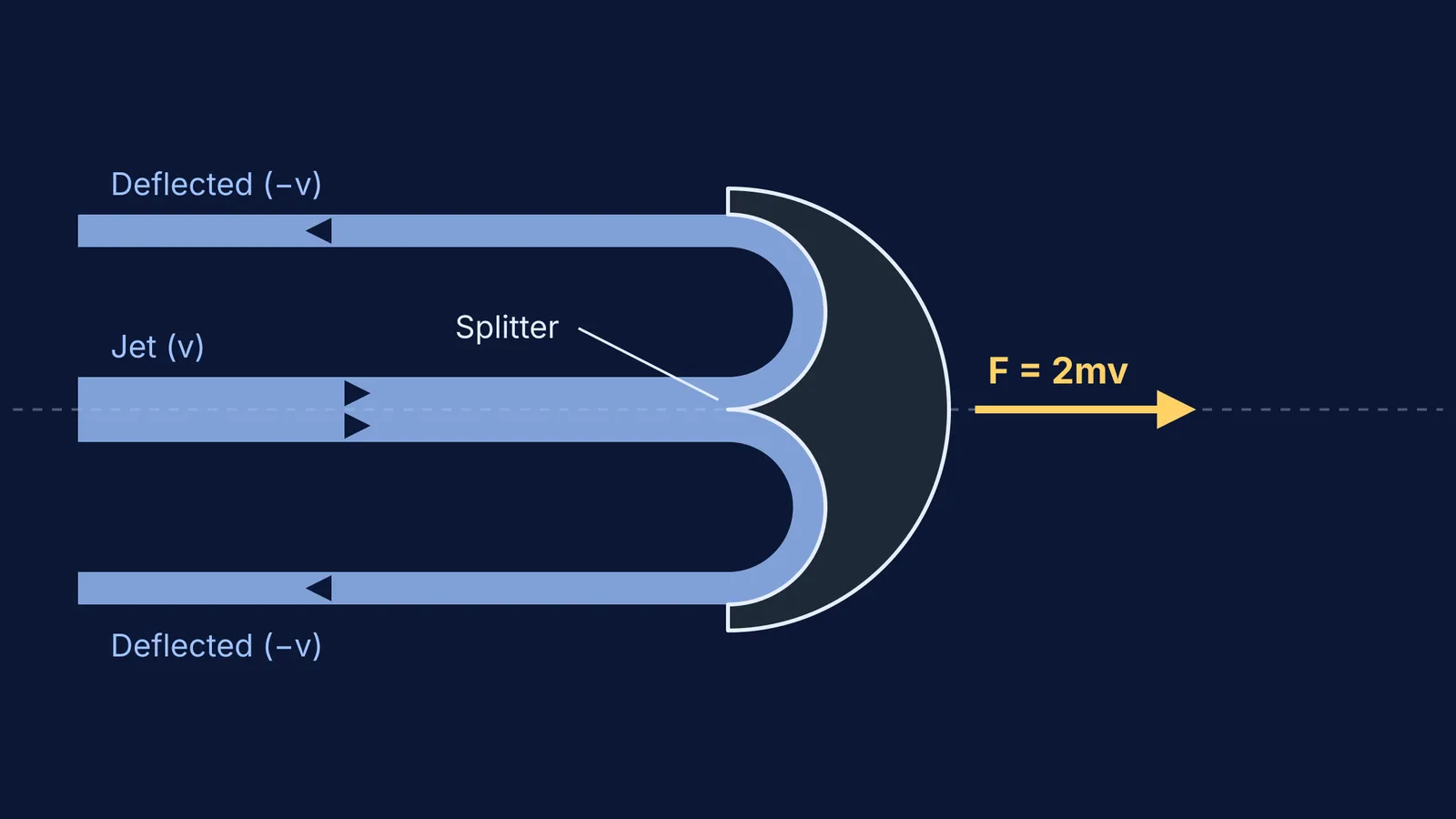
Pelton's genius was the "split cup" design, patented in 1880. Instead of a flat board, he created a bucket with two symmetrical, spoon-shaped halves separated by a sharp central ridge called a splitter.
When the high-speed water jet hits the splitter, it is sliced perfectly into two equal streams. The curved shape of the cups guides these streams along the metal surface, turning them outward and backward until they exit the bucket at an angle of roughly 165° to 170° (almost a full 180° turn) according to Wikipedia. This clears the water out of the way so it does not interfere with the next bucket rotating into place. By smoothly reversing the water's direction, Pelton's split-bucket wheels maximized efficiency, becoming the standard for modern high-head hydroelectric plants.
Why does reversing the water double the force?
To understand why this is so effective, we have to look at the impulse-momentum theorem (FΔt = mΔv). The force exerted on the bucket depends entirely on how much the water's velocity changes.
Imagine a jet of water with mass m flowing every second at a velocity v.
The old way: If the water hits a flat paddle and stops moving forward, the change in velocity is simply v. The force it exerts is mv. This is the standard calculation for the force of a water jet.
The Pelton way: If the water hits a curved cup and is thrown straight back at a velocity of −v, the total change in velocity is v − (−v) = 2v. The force exerted on the bucket is 2mv.
By forcing the water to pull a U-turn, Pelton mathematically doubled the force extracted from the exact same stream. If you are solving kinetic energy and momentum relation problems for your physics exams, this is the ultimate real-world application of p = mv.
How fast should the wheel spin?
If you want to extract all the kinetic energy from the water, you cannot hold the bucket still. The bucket must move. But how fast?
Let's assume the water jet travels at speed v, and the bucket moves away from it at speed u. The water hits the bucket at a relative speed of v − u. Because of the split cup, it rebounds backwards at that same relative speed, v − u.
To find the water's absolute speed relative to the ground after it leaves the bucket, you subtract the rebound speed from the bucket's forward speed: u − (v − u) = 2u − v. This is because the water is travelling backwards relative to the bucket, but the bucket itself is moving forwards relative to the ground. When these two speeds perfectly cancel each other out, the water has no forward or backward motion left.
If we want the water to drop out of the bucket with zero kinetic energy (so all the energy goes into spinning the wheel), its final speed must be zero: 2u − v = 0 u = v/2
The Pelton wheel achieves its maximum theoretical efficiency when the buckets are moving at exactly half the speed of the incoming water jet. Visualising these relative velocity vectors can be tricky. The Fermi Simulation Lab allows you to run this exact scenario, adjusting the bucket speed u to watch how it perfectly zeroes out the water's final velocity.
What does Pelton teach us about studying?
There is a profound lesson in Pelton's design for any student preparing for physics exams.
Reading a textbook or watching a lecture is like a flat water wheel. The information hits you, splashes around, and mostly drains away, leaving you with poor retention. You are only capturing a fraction of the value, and much of your study time is wasted on passive absorption.
Active learning is the split cup. You take the incoming concept and deliberately reverse its direction—by teaching it to a friend, drawing the diagram from memory, or tackling a hard numerical problem immediately. You force your brain to push the information back out.
If you struggle to switch from passive reading to active problem-solving, Fermi's AI tutor is built to help. Instead of just handing you an answer key to read, the Fermi Problem Library guides you step-by-step, asking you questions and checking your reasoning. It acts as the splitter ridge, ensuring you capture every concept from your study sessions.


